• HOME
  • NEWS
  • EXPLORE
    • CAREER
      • Companies
      • Jobs
    • EVENTS
    • iGEM
      • News
      • Team
    • PHOTOS
    • VIDEO
    • WIKI
  • BLOG
  • COMMUNITY
    • FACEBOOK
    • INSTAGRAM
    • TWITTER
Thursday, June 25, 2026
BIOENGINEER.ORG
No Result
View All Result
  • Login
  • HOME
  • NEWS
  • EXPLORE
    • CAREER
      • Companies
      • Jobs
        • Lecturer
        • PhD Studentship
        • Postdoc
        • Research Assistant
    • EVENTS
    • iGEM
      • News
      • Team
    • PHOTOS
    • VIDEO
    • WIKI
  • BLOG
  • COMMUNITY
    • FACEBOOK
    • INSTAGRAM
    • TWITTER
  • HOME
  • NEWS
  • EXPLORE
    • CAREER
      • Companies
      • Jobs
        • Lecturer
        • PhD Studentship
        • Postdoc
        • Research Assistant
    • EVENTS
    • iGEM
      • News
      • Team
    • PHOTOS
    • VIDEO
    • WIKI
  • BLOG
  • COMMUNITY
    • FACEBOOK
    • INSTAGRAM
    • TWITTER
No Result
View All Result
Bioengineer.org
No Result
View All Result
Home NEWS Science News

Scientists created edible food films for food packaging

Bioengineer by Bioengineer
March 23, 2021
in Science News
Reading Time: 3 mins read
0
IMAGE
Share on FacebookShare on TwitterShare on LinkedinShare on RedditShare on Telegram

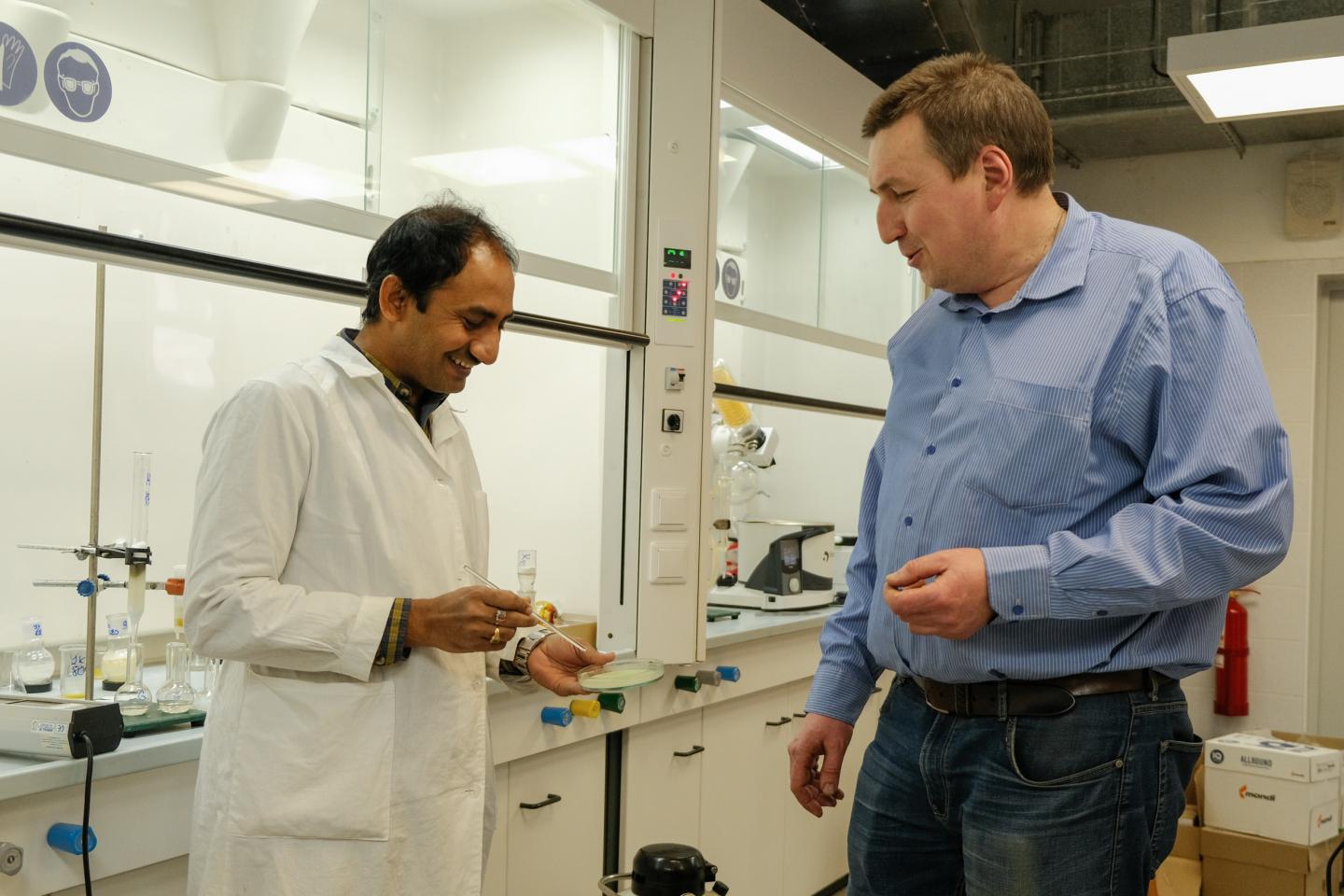
Films consist of natural ingredients, they are healthy-safe and water-solubility
IMAGE

Credit: UrFU / Andrey Fomin.

An international group of scientists from India and Russia has created edible food films for packaging fruits, vegetables, poultry, meat, and seafood. Films consist of natural ingredients, they are safe for health and the environment. In addition, films are water-soluble and dissolve by almost 90% in 24 hours. Description of the research and results of experiments are published in the Journal of Food Engineering.

“We have created three types of food films based on the well-known naturally occurring seaweed biopolymer sodium alginate,” said Rammohan Aluru, senior researcher Organic synthesis laboratory at Ural Federal University and co-author of the paper. “Its molecules have film-forming properties. Sodium alginate is an auspicious carbohydrate macromolecule that has the potential film-forming properties upon hydrolysis and abundantly existed in cell walls as a mixture of various salts. The greatest advantage of sodium alginate is that it performs as liquid-gel in an aqueous medium.”

Alginate molecules were cross-linked with a natural antioxidant ferulic acid. It makes the film not only strong, but also homogeneous, more rigid, and prolongs the life of the products.

“Food stays fresh longer due to the antioxidant components that slow down the oxidation processes,” said Grigory Zyryanov, professor of the Department of Organic and Biomolecular Chemistry at Ural Federal University. “In addition, we can add to the films natural antiviral agents, that will also extend the shelf life of food. Garlic, turmeric, and ginger contain compounds that may prevent the spread of the viruses.”

According to the authors, no special equipment for the production of films is required. On an industrial scale, it can be created by food products and films manufacturers.

“It can also be produced at a polymer production plant. The only condition is that it must meet the standards that apply to food production. And if an inexhaustible source of algae the ocean is nearby it will be quite simple to create such films,” said Grigory Zyryanov.

###

Scientists from the Sri Venkateswara and Sri Padmavati Mahila Viswavidyalayam Universities (Tirupati, India), Ural Federal University and Ural Branch of the RAS (Ekaterinburg, Russia) worked on the creation of the films. The research was supported by the University Grants Commission (New Delhi, India, Rajiv Gandhi National Scholarship F1-17.1 / 2016-17 / RGNF-2015-17-SC -AND-18494 / SAIII) and the Central Institute of Plastics Engineering and Technology (Vijayawada, India).

Reference

Sodium alginate is a well-known edible biopolymer of natural origin used as a thickener and stabilizer (food additive E401), used as a thickener or stabilizer. Ferulic acid (a derivative of cinnamic acid) has a wide range of pharmacological properties, in particular, anti-inflammatory, antitumor, antitoxic, hepato- and cardioprotective, antiviral and antibacterial ones, which is mainly due to the antioxidant properties of this acid.

Media Contact
Anna Marinovich
[email protected]

Original Source

http://doi.org/10.1016/j.jfoodeng.2021.110566

Related Journal Article

http://dx.doi.org/10.1016/j.jfoodeng.2021.110566

Tags: Agricultural Production/EconomicsBiochemistryChemistry/Physics/Materials SciencesEcology/EnvironmentEnvironmental HealthFood/Food ScienceNutrition/NutrientsPollution/Remediation
Share12Tweet8Share2ShareShareShare2

Related Posts

Tracking Lanthanide-Labeled Microplastics in Plants

June 25, 2026

POSTECH Researchers Slash Cost of Reconstituted Cell-Free Systems by 95%

June 25, 2026

AI and Physics Collaborate to Design Advanced Hydrogen Storage Materials

June 25, 2026

Natural Hallucinogens: Evolution’s Ecological Tools, Not Mere Chemical Byproducts

June 25, 2026
Please login to join discussion

POPULAR NEWS

  • Saying Goodbye to PGY-6: Pediatric Fellowship Realities

    103 shares
    Share 41 Tweet 26
  • Multi-Hospital Study Reveals Long Covid Burden Is Twice as High as Current Estimates

    92 shares
    Share 36 Tweet 23
  • Detection of EDCs in Breast Milk and Infant Urine Up to Six Months Highlights Early Exposure Risks

    77 shares
    Share 31 Tweet 19
  • New Drug Candidate Developed at McMaster Shows Potential for Treating Brain Cancer

    58 shares
    Share 23 Tweet 15

About

We bring you the latest biotechnology news from best research centers and universities around the world. Check our website.

Follow us

Recent News

Tracking Lanthanide-Labeled Microplastics in Plants

POSTECH Researchers Slash Cost of Reconstituted Cell-Free Systems by 95%

AI and Physics Collaborate to Design Advanced Hydrogen Storage Materials

Subscribe to Blog via Email

Enter your email address to subscribe to this blog and receive notifications of new posts by email.

Join 82 other subscribers
  • Contact Us

Bioengineer.org © Copyright 2023 All Rights Reserved.

Welcome Back!

Login to your account below

Forgotten Password?

Retrieve your password

Please enter your username or email address to reset your password.

Log In
No Result
View All Result
  • Homepages
    • Home Page 1
    • Home Page 2
  • News
  • National
  • Business
  • Health
  • Lifestyle
  • Science

Bioengineer.org © Copyright 2023 All Rights Reserved.