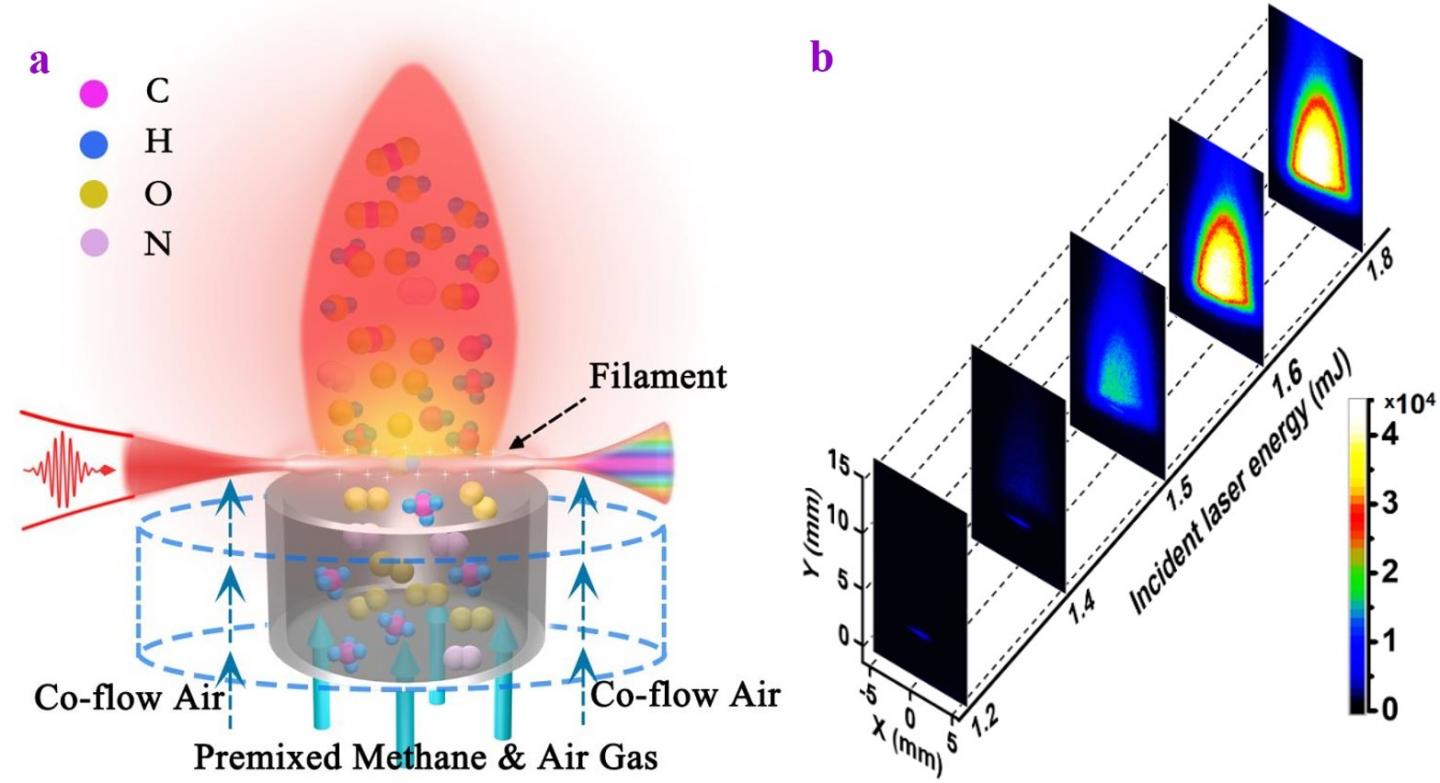
Credit: by Hongwei Zang, Helong Li, Wei Zhang, Yao Fu, Shanming Chen, Huailiang Xu, and Ruxin Li
Laser ignition (LI) is a promising electrode-less alternative to electronic spark ignition of lean fuel/air mixtures, offering high thermal efficiency with low harmful emissions. One of the most widely adopted LI methods is nanosecond laser-induced spark ignition (ns-LISI), in which combustible mixtures undergo multiphoton ionization followed by avalanche breakdown, resulting in high-temperature and high-pressure plasma along with shockwaves. However, inevitable shot-to-shot energy fluctuations resulting from ns light sources lead to the stochastic nature of the breakdown, influencing reaction routes and producing potential misfiring.
Although LI is not a new concept, it is commonly deemed that igniting lean-fuel mixtures by an ultrashort femtosecond (fs) laser is hard to realize since avalanche breakdown cannot occur on the fs timescale, and the fs-laser-induced plasma temperature is 1-2 orders of magnitude smaller than that pumped by ns lasers, both of which decrease the lean-fuel ignitability. Indeed, researchers have failed so far to ignite lean mixtures using intense fs-pulsed lasers.
In a new paper published in Light Science & Application, a team of scientists, led by Professor Huailiang Xu from State Key Laboratory of Integrated Optoelectronics, College of Electronic Science and Engineering, Jilin University, China, and Professor Ruxin Li from State Key Laboratory of High Field Laser Physics, Shanghai Institute of Optics and Fine Mechanics, Chinese Academy of Sciences, have demonstrated the successful realization and robustness of fs-LI by irradiating a lean methane/air mixture with an intense fs laser pulse in the filamentation regime. It is revealed that the pump laser energy for lean combustion can decrease to ?1.5 mJ with an energy deposition of ?25%, implying that it takes only sub-mJ energy to achieve fs-LI. They tested the laser ignition with a 1.8-mJ laser energy more than 1000 times and consequently achieved a 100% rate of success, showing the robustness of this approach for igniting lean mixtures. The present approach has general applicability to the complex combustion conditions in a variety of engines that are not in stoichiometric ratios.
It is shown that the fs-LI scheme has two major advantages compared with the ns-LISI scheme: (i) ultralow ignition energy, which is about one order of the magnitude smaller than that in ns-LISI scheme, and (ii) 100% ignition success rate. The fs-LI mechanism is ascribed to the thermal effect by laser energy deposition in the filament followed by combustion chemical reactions and the robustness to the line ignition effect, which is described in detail as below:
“The dynamic equilibrium between self-focusing and plasma defocusing in the laser filament allows for the generation of several Rayleigh-range or longer plasma channels with the laser intensity clamped at the ?50-100 TW/cm2 level. Fuel molecules can be activated and even fragmented by high-intensity laser filaments, producing many combustion intermediates. In particular, the long filament provides the possibility of “multipoint” ignition along the filament, referred to as “line” ignition, which can help improve the ignition reliability of lean mixtures.”
“In addition, inside the fs laser filament, although the initial temperature of gas molecules determined through various energy deposition pathways, such as multiphoton/tunnel ionization, dissociation, Raman excitation, and collision excitation is only approximately 1400 K, the low-temperature oxidation reaction of methane molecules can still occur, which allows for the initiation of combustible chemical reactions” they added.
“The present approach, in which the ultrashort laser ignition of lean-fuel mixtures works in a relatively low-temperature and centimeter-long plasma filament, not only has general applicability to complex combustion conditions in a variety of engines that are not in stoichiometric ratios, but provides possibilities for investigating ultrafast physical/chemical processes on the fs/ps timescale after the laser-fuel interaction” the Scientists forcast.
###
Media Contact
Huailiang Xu
[email protected]
Related Journal Article
http://dx.