Credit: by Yuquan Zhang, Changjun Min, Xiujie Dou, Xianyou Wang, H. Paul Urbach, Michael Somekh and Xiaocong Yuan
Optical tweezers and associated manipulation tools in the far field have had a major impact on scientific and engineering research by offering precise manipulation of small objects. More recently, the near-field manipulation with surface plasmons has opened opportunities not feasible with conventional far-field optical methods. The use of surface plasmon techniques enables excitation of hotspots much smaller than the free-space wavelength; with this confinement, the plasmonic field facilitates trapping of various nanostructures and materials with higher precision. It has become commonly used in trapping of micro- and nanometre-sized objects in various fields of science.
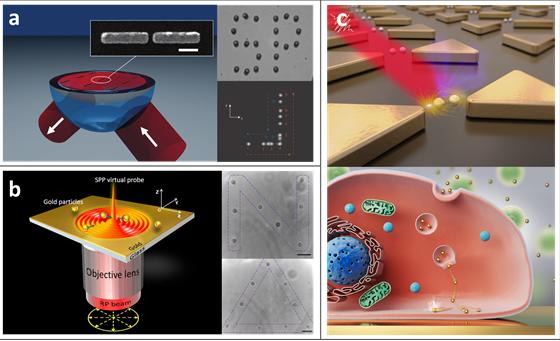
In a new review paper published in Light Science & Application, a team of scientists, led by Professor Xiaocong Yuan from Nanophotonics Research Center, Shenzhen University, China, and co-workers have reviewed the principles, developments, and applications of the plasmonic tweezers techniques, including both nanostructure-assisted platforms and structureless systems.
According to excitation situations, surface plasmon can be divided into two types: localized surface plasmon in bounded geometries such as nanoparticles and all-optical excited structureless surface plasmon polaritons on a smooth dielectric-metal interface. Accordingly, the plasmonic tweezers system can be divided into structural type and all-optical modulated type. The structural platform provides an effective approach to trap micro- and nano-scale objects with the advantages of high precision; while the all-optical modulated type is an effective complement for dynamic manipulation and expand the trapping size range to mesoscopic and Mie range. These two kinds of plasmonic tweezers complement each other and have fostered numerous and expanding applications.
Owing to great strides in fundamental science, plasmonic tweezers have been used to manipulate many kinds of matter with various shapes, properties, and compositions. By feat of this technique, small objects can be manipulated dynamically to be sorted and transported for on-chip lithography and fabrications. In particular, biological particles of all sizes are important targets for trapping, and the plasmonic platforms exactly provide stable noninvasive probes for manipulation and detection of them.
Moreover, plasmonic hotspots can be selectively generated as specific traps through the design of structures or modulation of the polarization and phase distribution of excitation laser beams. Such hotspots have the advantages of strong near-field energy, providing the possibility of enhancing spectroscopic measurement of molecules located in the region through techniques such as SERS, infrared absorption, and fluorescence emission spectroscopy. The nanoscale precision of the method enables manipulation and detection at the molecular level, making plasmonic tweezers an important tool for physics, chemists, and life scientists.
“The mechanism and relevant phenomena in nonlinear light-matter interactions, and the intracellular manipulation and detection applications will be the possible development directions and breaking points of the plasmonic tweezers technique in the future.” the scientists forecast.
“There are still challenges to be overcome in terms of the inherent properties to extend the applicability of the technique. Regardless, we are confident that the uses of plasmonic tweezer techniques will continue to grow in the near future, and many new applications in this area will be developed. ” they added.
###
Media Contact
Xiaocong Yuan
[email protected]
Related Journal Article
http://dx.