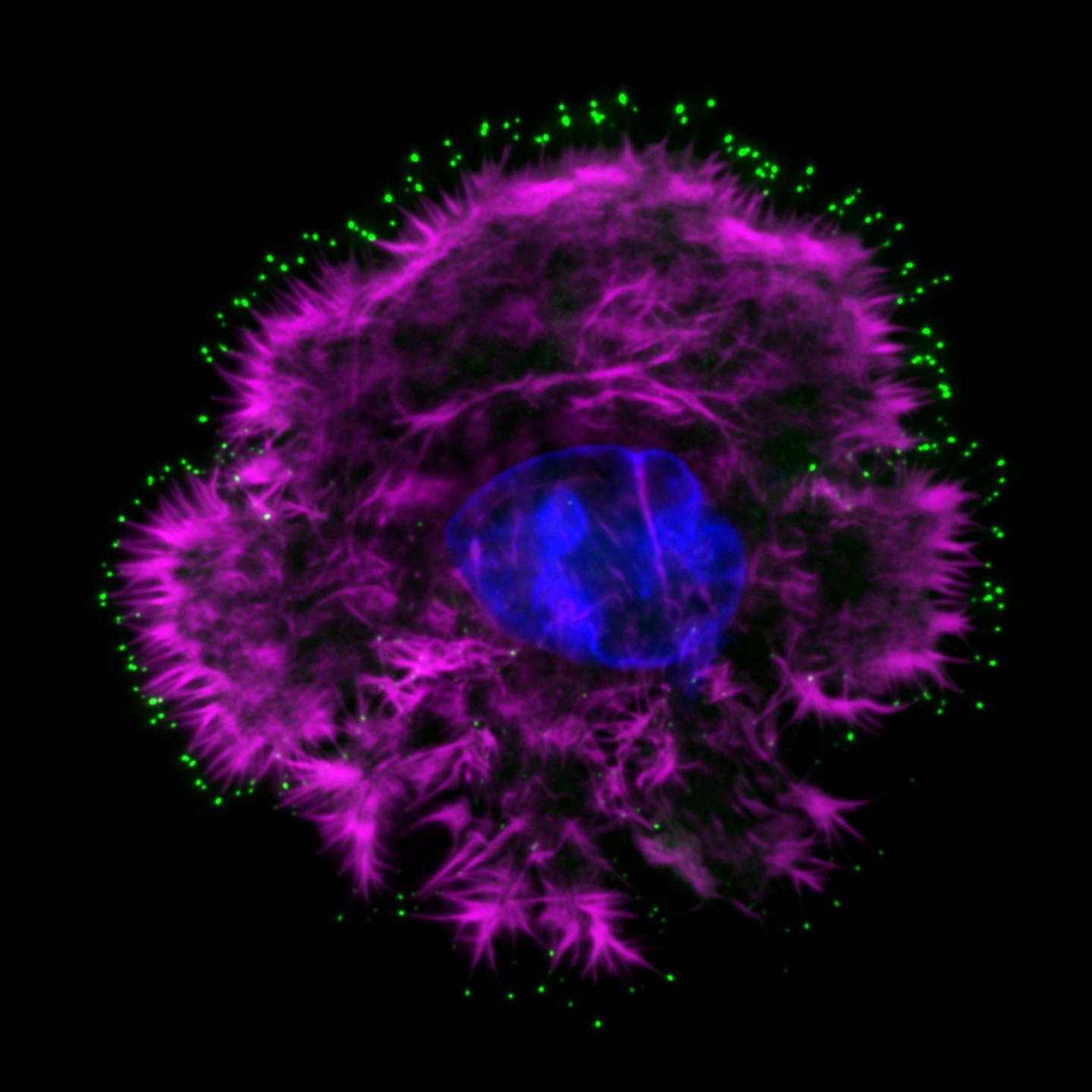
Credit: Dr Guillaume Jacquemet, University of Turku
By screening already approved drugs, the team led by Postdoctoral Researcher Guillaume Jacquemet and Academy Professor Johanna Ivaska has discovered that calcium channel blockers can efficiently stop cancer cell invasion in vitro. Calcium channel blockers are currently used to treat hypertension, also known as high blood pressure, but their potential use in blocking cancer cell metastases has not been previously reported.
Cancer kills because of its ability to spread throughout the body and form metastases. Therefore, developing drugs that block the ability of cancer cells to disseminate is a major anti-cancer therapeutic avenue. Developing new drugs, however, is a very lengthy and expensive process and many promising drugs fail clinical trials because of unanticipated toxicity and side effects. Thus, finding new targets for drugs already in use to treat other diseases, in other words drug repurposing, is an emerging area in developing anti-cancer therapies.
– Identification of anti-hypertension drugs as potential therapeutics against breast and pancreatic cancer metastasis was a big surprise. The targets of these drugs were not know to be present in cancer cells and therefore no one had considered the possibility that these drugs might be effective against aggressive cancer types, says Professor Ivaska.
Sticky finger-like structures in cancer cell enable its movement
For several years, the research team from the Turku Centre for Biotechnology lead by Professor Johanna Ivaska has focused their efforts on understanding how cancer cells move and invade surrounding tissue. The team has identified that aggressively spreading cancer cells express a protein called Myosin-10 which drives cancer cell motility.
– Myosin-10 expressing cancers have a large number of structures called filopodia. They are sticky finger-like structures the cancer cells extend to sense their environment and to navigate – imagine a walking blind spider, explains Dr Jacquemet.
The team found that calcium channel blockers target specifically these sticky fingers rendering them inactive, thus efficiently blocking cancer cell movement. This suggest that they might be effective drugs against cancer metastasis. However, at this stage much more work is required to assess if these drugs would be efficient against cancer progression.
The team and their collaborators are currently assessing the efficiency of calcium channel blockers to stop the spreading of breast and pancreatic cancer using pre-clinical models and analysing patient data.
The findings were published in Nature Communications journal on 2 December 2016.
###
Original publication: L-type calcium channels regulate filopodia stability and cancer cell invasion downstream of integrin signalling. Jacquemet G, Baghirov H, Georgiadou M, Sihto H, Peuhu E, Cettour-Janet P, He T, Perälä M, Kronqvist P, Joensuu H, Ivaska J. Nat Commun. 2016 Dec 2;7:13297. doi: 10.1038/ncomms13297.
Link to publication: http://www.nature.com/articles/ncomms13297
Download a high resolution microscope image: https://apps.utu.fi/media/tiedotteet/syopasolu-tahmeat-sormet.png
Image: Dr Guillaume Jacquemet, University of Turku
Caption: High-resolution microscope image of an invasive breast cancer cell (magenta) expressing Myosin-10 induced "sticky-fingers" (green).
Media Contact
Professor Johanna Ivaska, University of Turku, Finland
[email protected]
358-405-020-812
http://www.utu.fi/en/
############
Story Source: Materials provided by Scienmag