Credit: by Jinchao Tong, Fei Suo, Tianning Zhang, Zhiming Huang, Junhao Chu and Dao Hua Zhang
Millimetre and terahertz wave detectors have a wide range of applications in areas such as communications, security, biological diagnosis, spectroscopy, and remote sensing. They are the components that can transform light information loaded by long-wavelength millimetre and terahertz waves into electrical signals. High-performance room-temperature detectors with high sensitivity, fast response, broad spectral bandwidth, and possibility to be extended to large format arrays are always pursued. They are the building blocks for a wide range of millimetre and terahertz wave related systems, including communication network, deep space exploration equipment, security screening system, spectroscopy system, and material composition inspection. However, conventional efficient photoexcitation in optoelectronic semiconductors seems not applicable due to small quantum energy of millimetre and terahertz waves and strong background thermal disturbances. Although Golay cells, pyroelectrics, bolometers, and Schottky barrier diodes (SBDs) are in widespread use, they suffer from poor noise equivalent power (NEP) (only 10-9-10-10 W Hz-1/2 level for Golay cells and pyroelectrics), slow response (ms level for Golay cells, pyroelectrics), or narrow spectral bandwidth (multiple modules for SBDs to achieve broad spectral bandwidth).
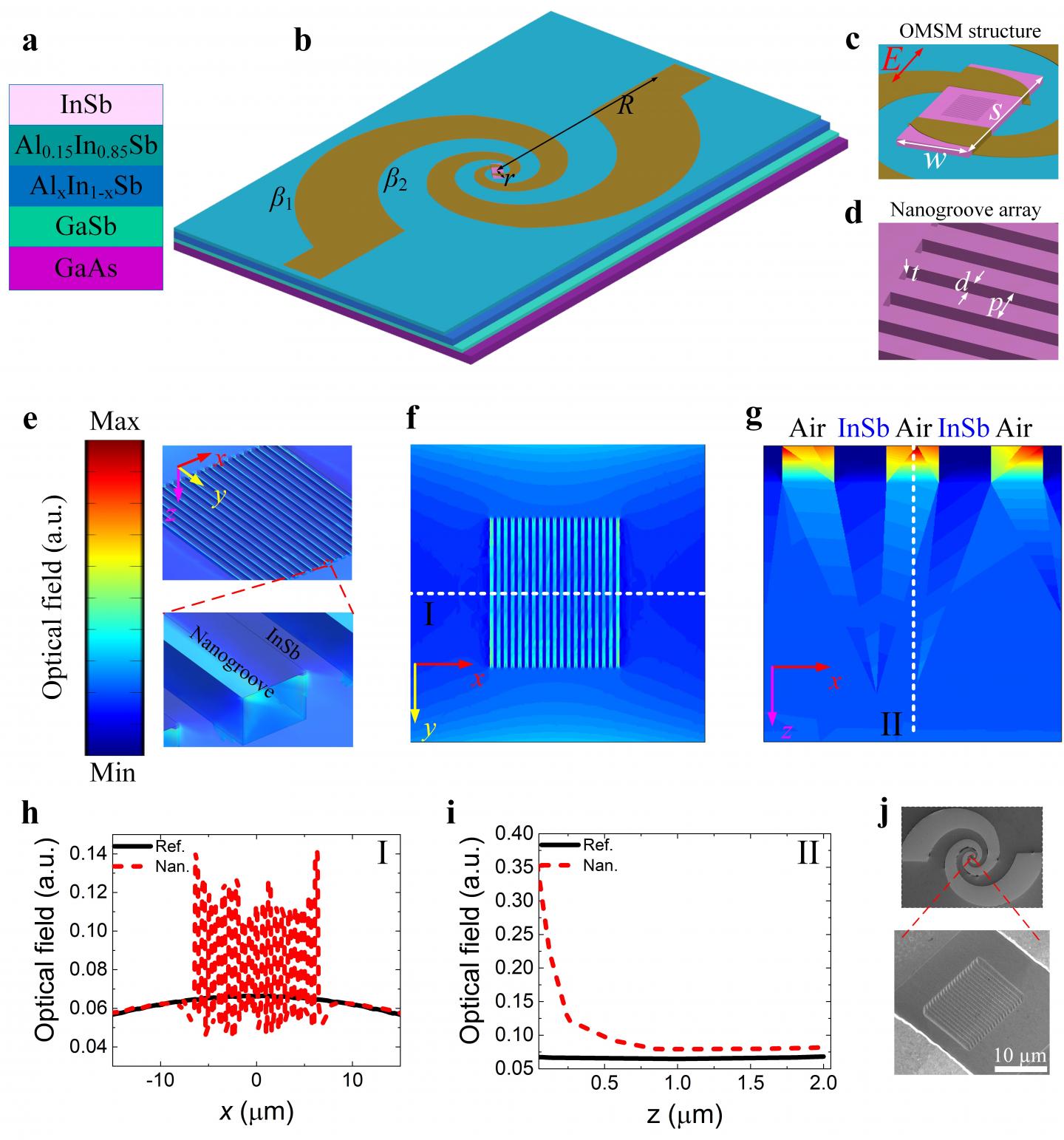
In a new paper published in Light Science & Application, Professor Dao Hua Zhang and Presidential Postdoctoral Fellow Jinchao Tong from the School of Electrical and Electronic Engineering, Nanyang Technological University, Singapore and co-workers reported millimetre and terahertz wave detectors based on epitaxially grown InSb/AlInSb/GaSb/GaAs by molecular-beam epitaxy (MBE) with nanogroove array for enhancement. The InSb films in such a novel structure possess high electron mobility and negative permittivity in a broad millimetre and terahertz wave band, and further, it is suitable for fabrication of large format arrays. A broad spectral bandwidth planar equiangular spiral antenna is designed to efficiently couple millimetre and terahertz waves. A nanogroove array is fabricated in the InSb layer, which can arouse strong excitation of millimetre and terahertz wave surface plasmon polaritons (SPPs), especially at the InSb-air interfaces, leading to a general improvement of 50-100% for detection performance. A NEP of 2.2×10⁻¹⁴ W Hz-1/2 or a detectivity (D*) of 2.7×1012 cm Hz1/2 W-1 is achieved at 1.75 mm (0.171 THz) at room temperature. The device also shows a broad spectral band detection from 0.9 mm (0.330 THz) to 9.4 mm (0.032 THz) and a fast response speed of 3.5 μs. By moderately decreasing the temperature to the thermoelectric cooling of 200 K, the corresponding NEP, D* and response speed can be further improved to 3.8×10⁻¹⁵ W Hz-1/2, 1.6×1013 cm Hz1/2 W-1 and 780 ns, respectively.
The detection of the detector is based millimetre and terahertz wave SPPs induced nonequilibrium electrons. Under external bias, unidirectional drift of these carriers will form photocurrent. The newly developed detector has a few advantages compared to current technologies. High sensitivity: the achieved NEP is 2-3 order superior to state-of-the-art. Uncooled operation: no cooling technology is required for its normal operation. Broad spectral band detection: A single detector can performance detection in 0.9-9.4 mm. Easy to be extended: this detector is based on wafer-scale InSb. Fast response speed: the detector has a response speed of μs level at room temperature. Simple configuration: the detector is based on very simple two-terminal structure.
###
Media Contact
Dao Hua Zhang
[email protected]
Related Journal Article
http://dx.