• HOME
  • NEWS
  • EXPLORE
    • CAREER
      • Companies
      • Jobs
    • EVENTS
    • iGEM
      • News
      • Team
    • PHOTOS
    • VIDEO
    • WIKI
  • BLOG
  • COMMUNITY
    • FACEBOOK
    • INSTAGRAM
    • TWITTER
Saturday, February 7, 2026
BIOENGINEER.ORG
No Result
View All Result
  • Login
  • HOME
  • NEWS
  • EXPLORE
    • CAREER
      • Companies
      • Jobs
        • Lecturer
        • PhD Studentship
        • Postdoc
        • Research Assistant
    • EVENTS
    • iGEM
      • News
      • Team
    • PHOTOS
    • VIDEO
    • WIKI
  • BLOG
  • COMMUNITY
    • FACEBOOK
    • INSTAGRAM
    • TWITTER
  • HOME
  • NEWS
  • EXPLORE
    • CAREER
      • Companies
      • Jobs
        • Lecturer
        • PhD Studentship
        • Postdoc
        • Research Assistant
    • EVENTS
    • iGEM
      • News
      • Team
    • PHOTOS
    • VIDEO
    • WIKI
  • BLOG
  • COMMUNITY
    • FACEBOOK
    • INSTAGRAM
    • TWITTER
No Result
View All Result
Bioengineer.org
No Result
View All Result
Home NEWS Science News

University of Minnesota scientists discover attacking fungi that show promise against emerald ash borer

Bioengineer by Bioengineer
March 10, 2021
in Science News
Reading Time: 2 mins read
0
IMAGE
Share on FacebookShare on TwitterShare on LinkedinShare on RedditShare on Telegram

IMAGE

Credit: N/A

Since its introduction, the emerald ash borer (EAB) has become the most devastating invasive forest insect in the United States, killing hundreds of millions of ash trees at a cost of hundreds of millions of dollars.

Now, new research from the University of Minnesota’s Minnesota Invasive Terrestrial Plants and Pests Center (MITPPC) shows a possible path forward in controlling the invasive pest that threatens Minnesota’s nearly one billion ash trees.

In a recent study published in Fungal Biology, MITPPC researchers identified various fungi living in EAB-infested trees — a critical first step in finding fungi that may be harnessed to control the spread of EAB, and ultimately, prevent ash tree death.

“We discovered that several different species of fungi attack EAB and other insects, and they can now be further tested for their potential for biocontrol,” said Robert Blanchette, the study’s project leader and professor in the College of Food, Agricultural and Natural Resource Sciences. “This is a very important first step in the search for a biocontrol for emerald ash borer.”

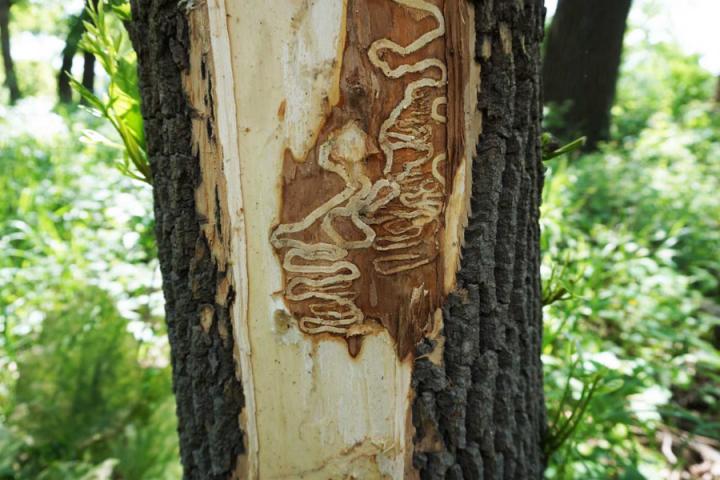
Larval EAB feed just beneath the bark, leaving behind tunnel galleries that can stretch up to 20 inches long. Beneath the surface, fungi — some of which may be capable of parasitizing the EAB — may be carried by the larvae as they develop, or may enter the tree through the tunnel galleries. Some of these fungi also seriously affect urban trees, causing rapid wood decay which result in hazardous tree situations.

From Rochester to Duluth, researchers gathered samples where ash is affected by EAB. Through DNA sequencing, scientists identified fungal isolates and revealed a diverse assemblage of fungi. This included entomopathogenic fungi that attack insects, as well as other fungi that cause cankers — which help EAB kill trees — and some that cause wood decay.

“Before now, we simply haven’t been sure what fungi are associated with EAB infestations in Minnesota. This project identified those species and, in doing so, opened up new possibilities for managing one of our state’s most devastating tree pests,” said Ben Held, the study’s lead author and researcher in the College of Food, Agricultural and Natural Resource Sciences.

As research continues, the scientists will build on the work from this study to determine if any of the fungi can be used to kill the emerald ash borer. Results will also be of value in helping control the insect in other parts of North America where EAB is found.

“Ash trees are vitally important to Minnesota,” said Rob Venette, MITPPC director. “They reduce air pollution, storm water runoff, and cooling costs, all while increasing property values in local communities. It’s critical we work to protect them from this invasive pest.”

###

The research was funded through the Minnesota Environment and Natural Resources Trust Fund.

Media Contact
Christine Lee
[email protected]

Related Journal Article

http://dx.doi.org/10.1016/j.funbio.2021.02.004

Tags: BiologyEcology/EnvironmentEntomologyForestryPlant Sciences
Share12Tweet8Share2ShareShareShare2

Related Posts

Succinate Receptor 1 Limits Blood Cell Formation, Leukemia

February 7, 2026

Palmitoylation of Tfr1 Drives Platelet Ferroptosis and Exacerbates Liver Damage in Heat Stroke

February 7, 2026

Oxygen-Enhanced Dual-Section Microneedle Patch Improves Drug Delivery and Boosts Photodynamic and Anti-Inflammatory Treatment for Psoriasis

February 7, 2026

Scientists Identify SARS-CoV-2 PLpro and RIPK1 Inhibitors Showing Potent Synergistic Antiviral Effects in Mouse COVID-19 Model

February 7, 2026
Please login to join discussion

POPULAR NEWS

  • Robotic Ureteral Reconstruction: A Novel Approach

    Robotic Ureteral Reconstruction: A Novel Approach

    82 shares
    Share 33 Tweet 21
  • Digital Privacy: Health Data Control in Incarceration

    63 shares
    Share 25 Tweet 16
  • Study Reveals Lipid Accumulation in ME/CFS Cells

    57 shares
    Share 23 Tweet 14
  • Breakthrough in RNA Research Accelerates Medical Innovations Timeline

    53 shares
    Share 21 Tweet 13

About

We bring you the latest biotechnology news from best research centers and universities around the world. Check our website.

Follow us

Recent News

Succinate Receptor 1 Limits Blood Cell Formation, Leukemia

Palmitoylation of Tfr1 Drives Platelet Ferroptosis and Exacerbates Liver Damage in Heat Stroke

Oxygen-Enhanced Dual-Section Microneedle Patch Improves Drug Delivery and Boosts Photodynamic and Anti-Inflammatory Treatment for Psoriasis

Subscribe to Blog via Email

Enter your email address to subscribe to this blog and receive notifications of new posts by email.

Join 73 other subscribers
  • Contact Us

Bioengineer.org © Copyright 2023 All Rights Reserved.

Welcome Back!

Login to your account below

Forgotten Password?

Retrieve your password

Please enter your username or email address to reset your password.

Log In
No Result
View All Result
  • Homepages
    • Home Page 1
    • Home Page 2
  • News
  • National
  • Business
  • Health
  • Lifestyle
  • Science

Bioengineer.org © Copyright 2023 All Rights Reserved.