• HOME
  • NEWS
  • EXPLORE
    • CAREER
      • Companies
      • Jobs
    • EVENTS
    • iGEM
      • News
      • Team
    • PHOTOS
    • VIDEO
    • WIKI
  • BLOG
  • COMMUNITY
    • FACEBOOK
    • INSTAGRAM
    • TWITTER
Monday, January 12, 2026
BIOENGINEER.ORG
No Result
View All Result
  • Login
  • HOME
  • NEWS
  • EXPLORE
    • CAREER
      • Companies
      • Jobs
        • Lecturer
        • PhD Studentship
        • Postdoc
        • Research Assistant
    • EVENTS
    • iGEM
      • News
      • Team
    • PHOTOS
    • VIDEO
    • WIKI
  • BLOG
  • COMMUNITY
    • FACEBOOK
    • INSTAGRAM
    • TWITTER
  • HOME
  • NEWS
  • EXPLORE
    • CAREER
      • Companies
      • Jobs
        • Lecturer
        • PhD Studentship
        • Postdoc
        • Research Assistant
    • EVENTS
    • iGEM
      • News
      • Team
    • PHOTOS
    • VIDEO
    • WIKI
  • BLOG
  • COMMUNITY
    • FACEBOOK
    • INSTAGRAM
    • TWITTER
No Result
View All Result
Bioengineer.org
No Result
View All Result
Home NEWS Science News Chemistry

Instrument at BESSY II shows how light activates MoS2 layers to become catalysts

Bioengineer by Bioengineer
March 5, 2021
in Chemistry
Reading Time: 2 mins read
0
IMAGE
Share on FacebookShare on TwitterShare on LinkedinShare on RedditShare on Telegram

IMAGE

Credit: Martin Künsting /HZB

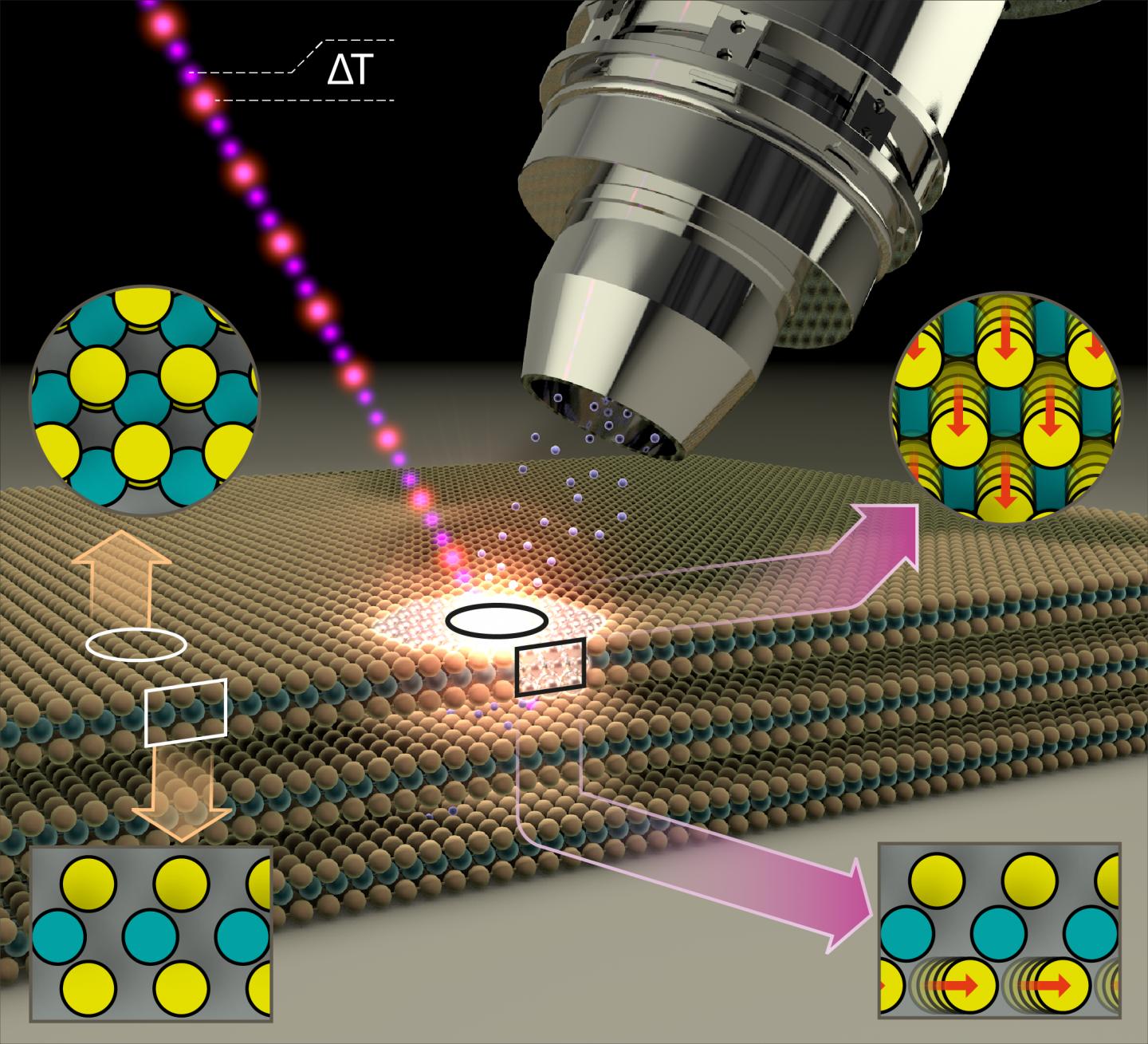
MoS2 thin films of superposed alternating layers of molybdenum and sulfur atoms form a two-dimensional semiconducting surface. However, even a surprisingly low-intensity blue light pulse is enough to alter the properties of the surface and make it metallic. This has now been demonstrated by a team at BESSY II.

The exciting thing is that the MoS2 layers in this metallic phase are also particularly active catalytically. They can then be employed, for example, as catalysts for splitting of water into hydrogen and oxygen. As inexpensive catalysts, they could facilitate the production of hydrogen – an energy carrier whose combustion produces no CO2, only water.

Physicist Dr. Nomi Sorgenfrei and her team have constructed a new instrument at BESSY II to precisely measure the changes in samples using temporally-resolved electron spectroscopy for chemical analysis (trESCA) when irradiating the samples with low-intensity, ultra-short light pulses. These light pulses are generated at BESSY II using femtosecond time-slicing (femtoslicing) and are therefore both low intensity and extremely short duration. The new instrument, named SurfaceDynamics@FemtoSpeX, can also rapidly obtain meaningful measurements of electron energies, surface chemistry, and transient alterations using these low-intensity light pulses.

Analysis of the empirical data showed that the light pulse leads to a transient accumulation of charge at the surface of the sample, triggering the phase transition at the surface from a semiconducting to a metallic state.

“This phenomenon should also occur in other representatives of this class of materials, the p-doped semiconducting dichalcogenides, so it opens up possibilities of influencing functionality and catalytic activity in a deliberate way”, Sorgenfrei explains.

###

Media Contact
Antonia Roetger
[email protected]

Original Source

https://www.helmholtz-berlin.de/bin/news_seite?nid=22585;sprache=en;intern=0

Related Journal Article

http://dx.doi.org/10.1002/adma.202006957

Tags: Chemistry/Physics/Materials Sciences
Share12Tweet8Share2ShareShareShare2

Related Posts

blank

Advancing Alkene Chemistry: Homologative Difunctionalization Breakthrough

January 8, 2026
Biocompatible Ligand Enables Safe In-Cell Protein Arylation

Biocompatible Ligand Enables Safe In-Cell Protein Arylation

January 8, 2026

Monovalent Pseudo-Natural Products Boost IDO1 Degradation

January 7, 2026

Catalytic Enantioselective [1,2]-Wittig Rearrangement Breakthrough

January 7, 2026
Please login to join discussion

POPULAR NEWS

  • Enhancing Spiritual Care Education in Nursing Programs

    154 shares
    Share 62 Tweet 39
  • PTSD, Depression, Anxiety in Childhood Cancer Survivors, Parents

    146 shares
    Share 58 Tweet 37
  • Robotic Ureteral Reconstruction: A Novel Approach

    69 shares
    Share 28 Tweet 17
  • Study Reveals Lipid Accumulation in ME/CFS Cells

    49 shares
    Share 20 Tweet 12

About

We bring you the latest biotechnology news from best research centers and universities around the world. Check our website.

Follow us

Recent News

Deep Learning Boosts Weed and Rice Detection from UAVs

Mapping Europe’s Rooftop Solar Potential Building-Level

Urban Social Capital: Bogotá’s Cable Car Impact

Subscribe to Blog via Email

Enter your email address to subscribe to this blog and receive notifications of new posts by email.

Join 71 other subscribers
  • Contact Us

Bioengineer.org © Copyright 2023 All Rights Reserved.

Welcome Back!

Login to your account below

Forgotten Password?

Retrieve your password

Please enter your username or email address to reset your password.

Log In
No Result
View All Result
  • Homepages
    • Home Page 1
    • Home Page 2
  • News
  • National
  • Business
  • Health
  • Lifestyle
  • Science

Bioengineer.org © Copyright 2023 All Rights Reserved.