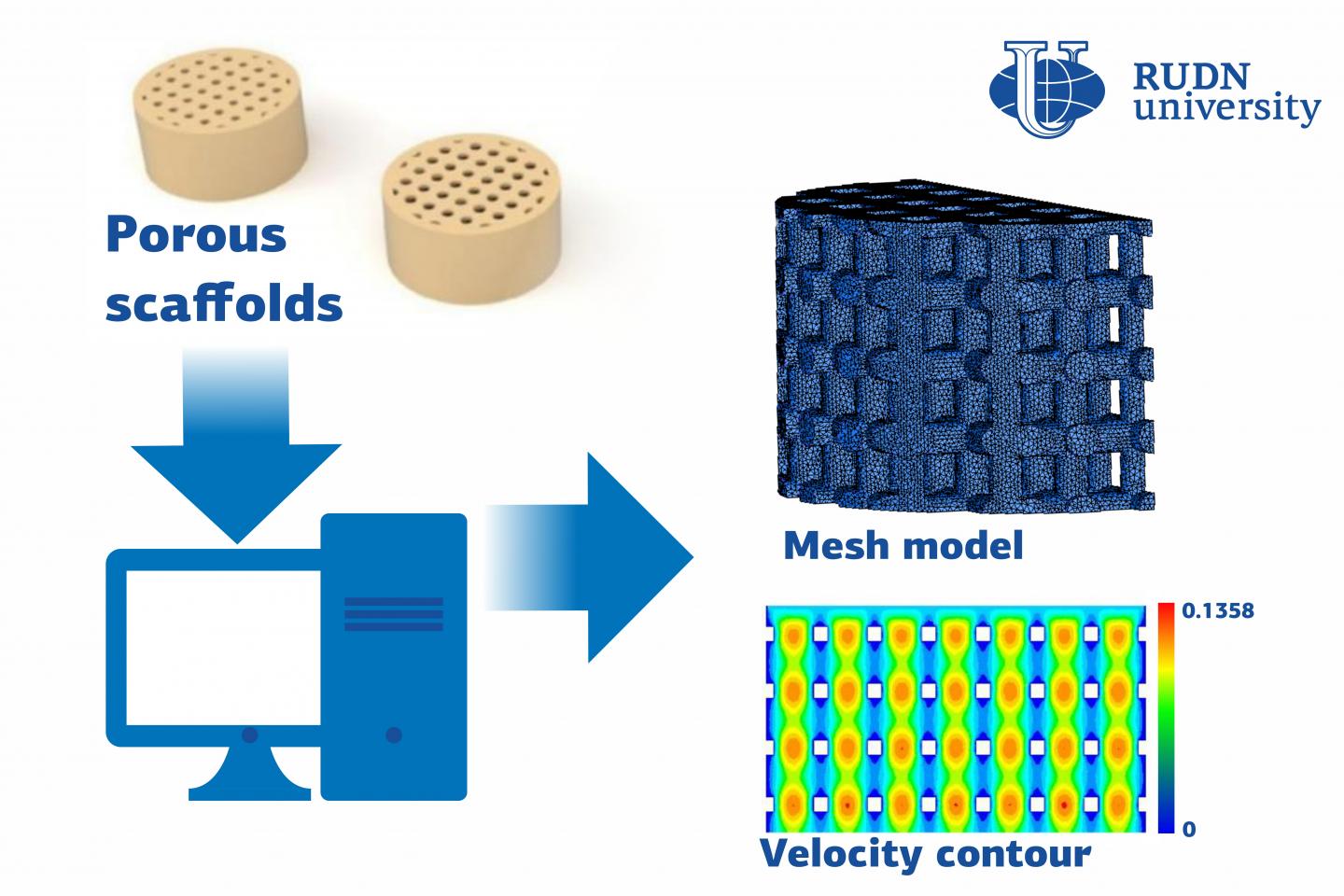
Credit: RUDN University
An associate professor from RUDN University found out the effect of the number and size of pores on the permeability of bone implants by biological fluids. The results of the study could help choose the optimal physical parameters of implants. The results of the study were published in the International Journal of Engineering.
For an implant to survive in the body and to take the place of bone tissue, it should be made of a non-toxic, biologically inert, and wearproof material. However, at the same time, it should be light, porous, and permeable by biological liquids. If an implant does not interfere with the transfer of oxygen, minerals, and nutrients, new bone tissue and blood vessels start to grow around it, and a patient’s regeneration is more successful. However, it is still unclear what level of porosity secures the best permeability and bone restoration. An engineer from RUDN University was the first to carry out a numerical simulation of these characteristics and to provide a quantitative evaluation of the correlation between porosity and permeability.
“The internal structure of implant material is as important for bone reconstruction as its biocompatibility. It is still unknown whether the process of bone tissue regeneration depends on implant porosity and whether it affects permeability. The results of experimental studies of this issue are unclear. A model of the material structure allows us to simulate the processes that an implant undergoes in a body and to evaluate the importance of its parameters in quantitative terms,” said Kazem Reza Kasyzadeh, an associate professor at the Department of Mechanical and Instrumental Engineering of the Engineering Academy, RUDN University.
The team used a 3D printer to create two groups of structures made of identical cubic cells with a plane length of 1.8 mm in the first group and 2 mm in the second one. Then, three cylinder-shaped objects (8 mm high and 14 mm in diameter) were added to each group. The levels of porosity in them varied from 34% to 72%, and the pores were 0.8 to 1.3 mm in diameter in the first group and 0.9 to 1.5 mm in the second one. To test their permeability, the engineers used three water and glycerin mixtures with different density and viscosity levels. Then, the team modeled the flow of liquids and their pressure on the porous structures of the implants at different rates. After that, the scientists calculated the permeability coefficient of each structure based on the models. Although the calculations failed to match the experimental data, they followed the same trend: the higher the porosity, the more permeable are the materials. Permeability also correlated with the size of the pores: a 20% diameter reduction led to a 76% decrease of permeability.
“Potentially, our results could help reduce the number of experimental tests of new bone implant structures. We managed to confirm that both the number of pores in a structure and their size affect material permeability. Therefore, if the mechanical properties of a material permit it, its permeability could be increased by means of changing the pore size while keeping its porosity on the same level,” added Kazem Reza Kashyzadeh from RUDN University.
###
Media Contact
Valeriya Antonova
[email protected]
Related Journal Article
http://dx.