Start of KIsSME collaboration project — algorithms capable of learning efficiently capture scenarios when testing highly automated vehicles
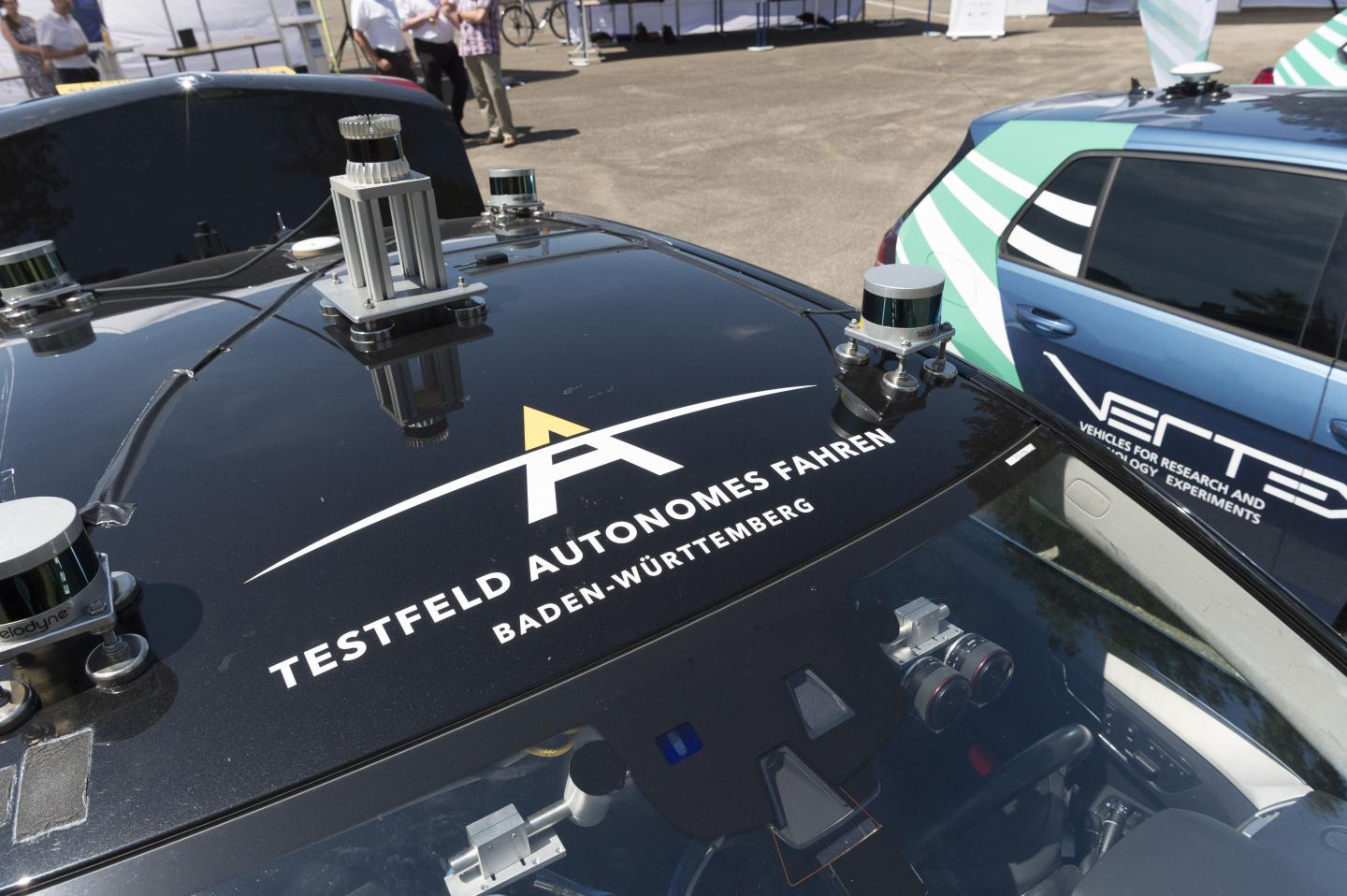
Credit: (Photo: Markus Breig, KIT)
Large data volumes arise when testing highly automated vehicles. The new KIsSME project is aimed at reducing these data volumes to save storage capacity, power, and evaluation expenditure and, at the same time, at compressing data to enhance vehicle safety. Algorithms based on artificial intelligence (AI) select the data in the driving mode and sort them into scenario catalogs. Within the collaboration project funded by the Federal Ministry for Economic Affairs, Karlsruhe Institute of Technology (KIT) supplies data from test drives and simulations.
Highly automated driving promises to have a number of advantages, such as more comfort for the drivers, less accidents, smoother traffic flow and, hence, environmentally friendlier road traffic. Future vehicles will be equipped with numerous sensors measuring data on their own status and in their environment. Based on this information, they have to make reliable driving decisions within shortest periods of time. During tests, any vehicle model has to cover millions of kilometers and to master various scenarios combining the infrastructure with weather, other traffic participants, and their behaviors. “These tests produce gigantic data volumes, 4 to 8 terabytes per vehicle and day,” says Dr. Michael Frey, Deputy Head of KIT’s Institute of Vehicle System Technology (FAST), Division of Vehicle Technology. “These data volumes can hardly be handled anymore.”
Algorithms for Intelligent Data Selection
Setting up catalogs of driving scenarios and sorting new test drive scenarios into these catalogs means recording only those data during the drive mode, which will have an added value. This is the approach of the KIsSME collaboration project, KIsSME being the German acronym of artificial intelligence for selective near-real-time recording of scenario and maneuver data during tests of highly automated vehicles. Scientists will develop algorithms based on AI, which will select the data arising during the driving mode already. “KIsSME is aimed at extending the catalog of scenarios and reducing data volumes,” Frey says, who heads the “Automation” group of FAST. “This saves storage capacity and power and reduces the evaluation and data protection expenditure.”
Experiments on the Baden-Württemberg Test Area for Autonomous Driving (TAF BW)
For KIsSME, KIT researchers will make available data from real test drives and simulations. Measurements are made in public urban traffic as well as on the Baden-Württemberg Test Area for Autonomous Driving (TAF BW) in Karlsruhe. Addition data are obtained from closed vehicle-in-the-loop simulations at a vehicle test bed of KIT. The AI models and AI selectors developed in the project will be checked by FAST researchers applying the algorithms to experiment and simulation data. KIsSME concerns automated driving of levels 4 to 5 (fully automated to autonomous).
The KIsSME collaboration project is coordinated by AVL Deutschland GmbH. The partners are KIT, Fraunhofer Institute for High-Speed Dynamics, Ernst-Mach Institute, FZI Research Center for Information Technology, LiangDao GmbH, Mindmotiv GmbH, RA Consulting GmbH, and Robert Bosch GmbH. Associated partners are ASAM e.V., Association for Standardization of Automation and Measuring Systems, and the Electric Mobility South-West Cluster coordinated by e-mobil BW GmbH, the Baden-Württemberg State Agency for New Mobility Solutions and the Automotive Sector. The project is funded by the Federal Ministry for Economic Affairs and Energy (BMWi) with EUR 6.5 million. Of these, about € 330,000 go to KIT. KIsSME started in early 2021 and is scheduled for a duration of three years. (or)
###
More about the KIT Mobility Systems Center: https:/
Contact for This Press Release: Johannes Wagner, phone: +49 721 608-41175, email: [email protected]
Being “The Research University in the Helmholtz-Association,” KIT creates and imparts knowledge for the society and the environment. It is the objective to make significant contributions to the global challenges in the fields of energy, mobility and information. For this, about 9,300 employees cooperate in a broad range of disciplines in natural sciences, engineering sciences, economics, and the humanities and social sciences. KIT prepares its 24,400 students for responsible tasks in society, industry, and science by offering research-based study programs. Innovation efforts at KIT build a bridge between important scientific findings and their application for the benefit of society, economic prosperity, and the preservation of our natural basis of life. KIT is one of the German universities of excellence.
This press release is available on the internet at http://www.
Media Contact
Monika Landgraf
[email protected]
Original Source
http://www.