• HOME
  • NEWS
  • EXPLORE
    • CAREER
      • Companies
      • Jobs
    • EVENTS
    • iGEM
      • News
      • Team
    • PHOTOS
    • VIDEO
    • WIKI
  • BLOG
  • COMMUNITY
    • FACEBOOK
    • INSTAGRAM
    • TWITTER
Sunday, March 29, 2026
BIOENGINEER.ORG
No Result
View All Result
  • Login
  • HOME
  • NEWS
  • EXPLORE
    • CAREER
      • Companies
      • Jobs
        • Lecturer
        • PhD Studentship
        • Postdoc
        • Research Assistant
    • EVENTS
    • iGEM
      • News
      • Team
    • PHOTOS
    • VIDEO
    • WIKI
  • BLOG
  • COMMUNITY
    • FACEBOOK
    • INSTAGRAM
    • TWITTER
  • HOME
  • NEWS
  • EXPLORE
    • CAREER
      • Companies
      • Jobs
        • Lecturer
        • PhD Studentship
        • Postdoc
        • Research Assistant
    • EVENTS
    • iGEM
      • News
      • Team
    • PHOTOS
    • VIDEO
    • WIKI
  • BLOG
  • COMMUNITY
    • FACEBOOK
    • INSTAGRAM
    • TWITTER
No Result
View All Result
Bioengineer.org
No Result
View All Result
Home NEWS Science News

Ultra-high-resolution X-ray imaging of 3D objects

Bioengineer by Bioengineer
February 25, 2021
in Science News
Reading Time: 3 mins read
0
IMAGE
Share on FacebookShare on TwitterShare on LinkedinShare on RedditShare on Telegram

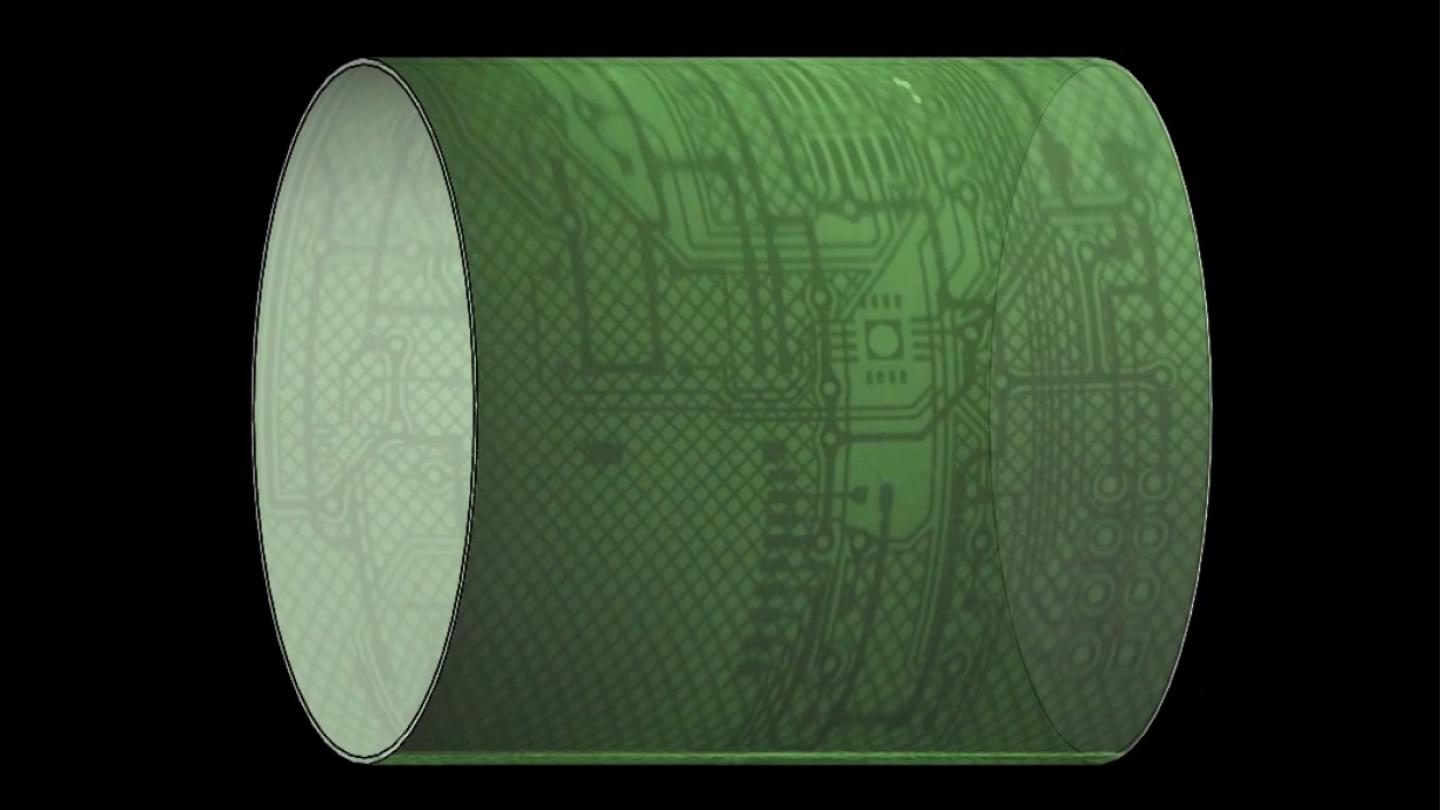
New flexible X-ray sensor suitable for next-generation medical and industrial applications
IMAGE

Credit: Ou Xiangyu

X-ray imaging is widely used in areas such as healthcare and forensic science, but existing X-ray machines are unable to capture curved three-dimensional (3D) objects at high resolution, and they are also relatively expensive. Now, an international team of researchers led by chemists from the National University of Singapore (NUS) has demonstrated a potential solution to overcome these limitations by using nanocrystals that can trap X-rays.

The research, which was conducted with collaborators from Fuzhou University and The Hong Kong Polytechnic University, could be used not only for healthcare but also to detect defects in electronics, authenticate valuable works of art, or examine archaeological objects at microscopic scale.

The findings were published in the prestigious journal Nature on 17 February 2021.

A piece of rubber that detects X-rays

In current machines, the X-ray detector is a flat panel where each pixel has its own integrated circuit. This makes the pixels bulky and limits the resolution of the detector. Furthermore, it cannot accurately capture images of curved objects, and the circuits can also get quite hot.

The research team led by Professor Liu Xiaogang from the NUS Department of Chemistry has created special nanocrystals that emit light after exposure to X-rays. This phenomenon, called persistent radioluminescence, is also exploited for luminescent clock faces but with different materials.

The scientists took tiny crystals of a substance called sodium lutetium fluoride, and introduced atoms of the rare-earth element terbium into these crystals. This process, called doping, is often used in semiconductor fabrication to alter the electrical properties of a substance. They then embedded the modified nanocrystals into silicone rubber, resulting in a highly flexible X-ray detector that can be wrapped around 3D objects.

The small crystal-embedded rubber gives a high resolution finer than human hair (approximately 30 micrometres in diameter). Furthermore, the terbium-doped nanocrystals have enhanced sensitivity to X-rays, and remain luminescent for more than two weeks. This allows the recorded image to be retrieved anytime within the two weeks upon heating. The team’s investigations revealed that X-rays cause atom displacement and generate electrons that “hop” slowly through the crystal scaffold towards terbium ions, which gives rise to prolonged luminescence.

Seeing the invisible in unprecedented detail

Researchers have previously discovered other persistent luminescent phosphors. However, those have either low sensitivity to X-rays or are difficult to manufacture at nanoscale, making them unsuitable for flexible detector fabrication.

On his team’s latest creation, Prof Liu said, “Over the past few years, many research groups, including ours, have been taking on challenges in X-ray imaging. Our reported technology may provide a much-needed solution for imaging highly curved 3D objects and enable the development of point-of-care X-ray detectors and flexible X-ray mammography devices.”

###

Media Contact
Huang Yifang
[email protected]

Original Source

https://news.nus.edu.sg/ultra-high-resolution-x-ray-imaging-of-3d-objects/

Related Journal Article

http://dx.doi.org/10.1038/s41586-021-03251-6

Tags: Chemistry/Physics/Materials SciencesNanotechnology/Micromachines
Share13Tweet8Share2ShareShareShare2

Related Posts

Cutaneous Lesion Location: Key to Head Injury Risk?

March 27, 2026
Biochar Boosts Forest Resilience Against Acid Rain by Restoring Essential Soil Nitrogen

Biochar Boosts Forest Resilience Against Acid Rain by Restoring Essential Soil Nitrogen

March 27, 2026

Two Salk Scientists Honored as 2025 AAAS Fellows

March 27, 2026

Starburst Winds Drain Supernova Energy Quickly

March 26, 2026
Please login to join discussion

POPULAR NEWS

  • blank

    Revolutionary AI Model Enhances Precision in Detecting Food Contamination

    96 shares
    Share 38 Tweet 24
  • Imagine a Social Media Feed That Challenges Your Views Instead of Reinforcing Them

    1004 shares
    Share 397 Tweet 248
  • Uncovering Functions of Cavernous Malformation Proteins in Organoids

    54 shares
    Share 22 Tweet 14
  • Promising Outcomes from First Clinical Trials of Gene Regulation in Epilepsy

    51 shares
    Share 20 Tweet 13

About

We bring you the latest biotechnology news from best research centers and universities around the world. Check our website.

Follow us

Recent News

In-Sensor Cryptography Links Physical Process to Digital Identity

Can Psychosocial Factors Influence Cancer Risk?

Depression Factors in Elderly: Pre vs. Post-COVID Analysis

Subscribe to Blog via Email

Enter your email address to subscribe to this blog and receive notifications of new posts by email.

Join 78 other subscribers
  • Contact Us

Bioengineer.org © Copyright 2023 All Rights Reserved.

Welcome Back!

Login to your account below

Forgotten Password?

Retrieve your password

Please enter your username or email address to reset your password.

Log In
No Result
View All Result
  • Homepages
    • Home Page 1
    • Home Page 2
  • News
  • National
  • Business
  • Health
  • Lifestyle
  • Science

Bioengineer.org © Copyright 2023 All Rights Reserved.