• HOME
  • NEWS
  • EXPLORE
    • CAREER
      • Companies
      • Jobs
    • EVENTS
    • iGEM
      • News
      • Team
    • PHOTOS
    • VIDEO
    • WIKI
  • BLOG
  • COMMUNITY
    • FACEBOOK
    • INSTAGRAM
    • TWITTER
Friday, December 19, 2025
BIOENGINEER.ORG
No Result
View All Result
  • Login
  • HOME
  • NEWS
  • EXPLORE
    • CAREER
      • Companies
      • Jobs
        • Lecturer
        • PhD Studentship
        • Postdoc
        • Research Assistant
    • EVENTS
    • iGEM
      • News
      • Team
    • PHOTOS
    • VIDEO
    • WIKI
  • BLOG
  • COMMUNITY
    • FACEBOOK
    • INSTAGRAM
    • TWITTER
  • HOME
  • NEWS
  • EXPLORE
    • CAREER
      • Companies
      • Jobs
        • Lecturer
        • PhD Studentship
        • Postdoc
        • Research Assistant
    • EVENTS
    • iGEM
      • News
      • Team
    • PHOTOS
    • VIDEO
    • WIKI
  • BLOG
  • COMMUNITY
    • FACEBOOK
    • INSTAGRAM
    • TWITTER
No Result
View All Result
Bioengineer.org
No Result
View All Result
Home NEWS Science News

Tweaking corn kernels with CRISPR

Bioengineer by Bioengineer
February 22, 2021
in Science News
Reading Time: 2 mins read
0
IMAGE
Share on FacebookShare on TwitterShare on LinkedinShare on RedditShare on Telegram

IMAGE

Credit: Jackson lab/CSHL, 2021

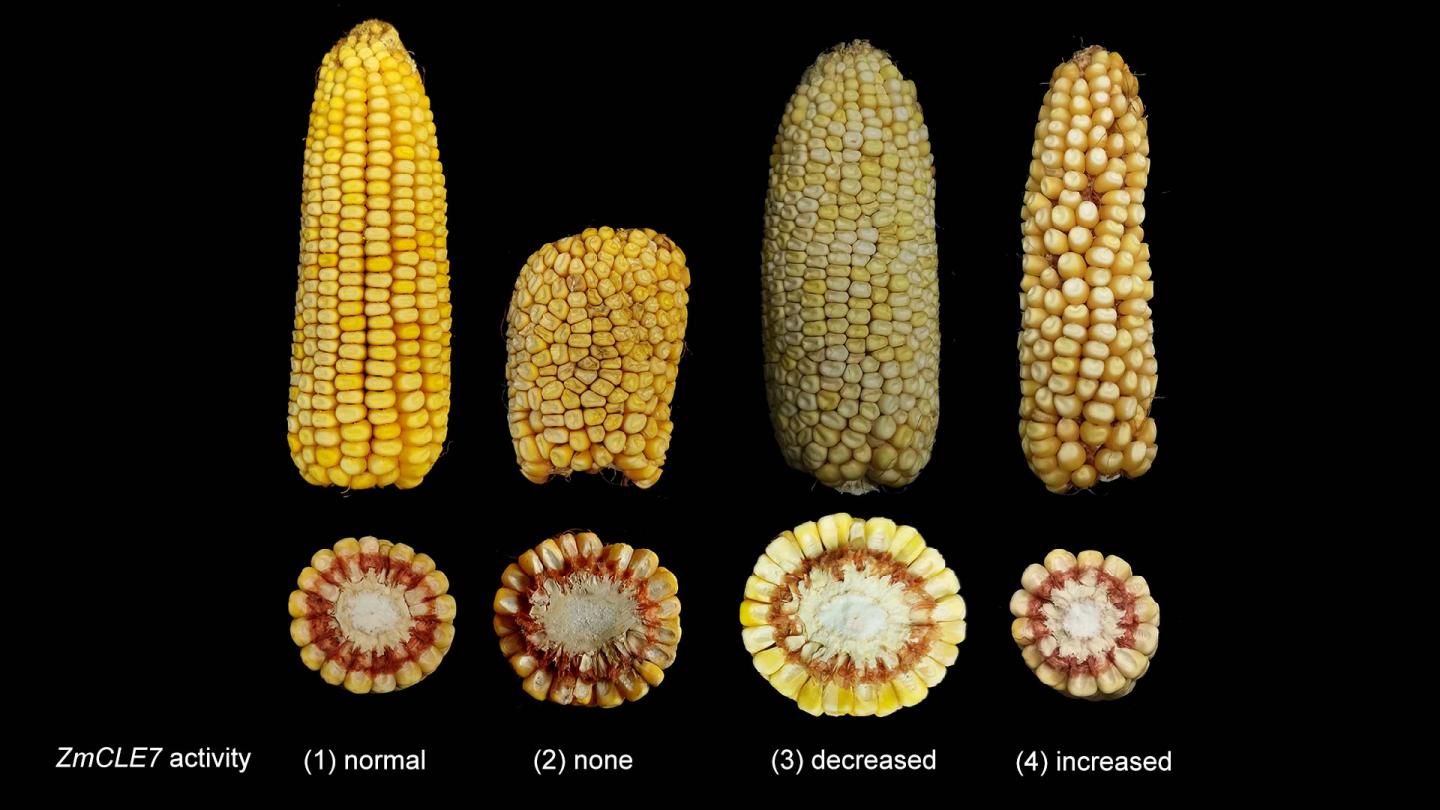
Corn–or maize–has changed over thousands of years from weedy plants that make ears with less than a dozen kernels to the cobs packed with hundreds of juicy kernels that we see on farms today. Powerful DNA-editing techniques such as CRISPR can speed up that process. Cold Spring Harbor Laboratory (CSHL) Professor David Jackson and his postdoctoral fellow Lei Liu collaborated with University of Massachusetts Amherst Associate Professor Madelaine Bartlett to use this highly specific technique to tinker with corn kernel numbers. Jackson’s lab is one of the first to apply CRISPR to corn’s very complex genome.

DNA is divided into two parts: the gene and the regulatory regions that promote or suppress gene activity. Jackson says:

“A lot of people were using CRISPR in a very simple sense just to disrupt genes completely, to knock out the gene. But we came up with this new idea to CRISPR the promoter regions that turn the gene on. And that is what gives this very interesting result where we can get the variation in traits that we need in agriculture.”

Jackson wanted to increase the number of kernels per cob. The corn kernel development pathway includes genes that promote stem cell growth and differentiation into distinct plant organs. Jackson and Liu focused on CLEs, a family of genes that act as a brake to stop stem cell growth. But the corn genome is complex. The CLE family contains almost 50 related genes, with promoter regions that vary from gene to gene. What parts are most important for kernel production? Liu says:

“So we basically randomly targeted the promoter region: we have no idea which part of the promoter is important. So probably the next step, we will focus more on figuring out which part of the promoter is critical. And, then we probably will make our promoter CRISPR more efficient. We can get a better allele which can produce more grain yield or ear size.”

Cereal crops like maize are a major source of food for humans and feed for livestock. Jackson and Liu hope their new CRISPR strategy will increase crop yield per acre and make agriculture more sustainable.

###

Media Contact
Sara Roncero-Menendez
[email protected]

Related Journal Article

http://dx.doi.org/10.1038/s41477-021-00858-5

Tags: AgricultureBiologyFood/Food ScienceGeneticsPlant Sciences
Share12Tweet8Share2ShareShareShare2

Related Posts

Acculturation and Support Influence South Asian Girls’ Activity

December 19, 2025

Nurses’ Insights on Mentorship Programs in Riyadh

December 19, 2025

Political Factors Shaping Cervical Cancer Control in Peru

December 19, 2025

Curcumin’s Promise for Eye Disease Treatment

December 19, 2025
Please login to join discussion

POPULAR NEWS

  • Nurses’ Views on Online Learning: Effects on Performance

    Nurses’ Views on Online Learning: Effects on Performance

    70 shares
    Share 28 Tweet 18
  • NSF funds machine-learning research at UNO and UNL to study energy requirements of walking in older adults

    70 shares
    Share 28 Tweet 18
  • Unraveling Levofloxacin’s Impact on Brain Function

    53 shares
    Share 21 Tweet 13
  • MoCK2 Kinase Shapes Mitochondrial Dynamics in Rice Fungal Pathogen

    72 shares
    Share 29 Tweet 18

About

We bring you the latest biotechnology news from best research centers and universities around the world. Check our website.

Follow us

Recent News

Acculturation and Support Influence South Asian Girls’ Activity

Nurses’ Insights on Mentorship Programs in Riyadh

Political Factors Shaping Cervical Cancer Control in Peru

Subscribe to Blog via Email

Enter your email address to subscribe to this blog and receive notifications of new posts by email.

Join 70 other subscribers
  • Contact Us

Bioengineer.org © Copyright 2023 All Rights Reserved.

Welcome Back!

Login to your account below

Forgotten Password?

Retrieve your password

Please enter your username or email address to reset your password.

Log In
No Result
View All Result
  • Homepages
    • Home Page 1
    • Home Page 2
  • News
  • National
  • Business
  • Health
  • Lifestyle
  • Science

Bioengineer.org © Copyright 2023 All Rights Reserved.