• HOME
  • NEWS
  • EXPLORE
    • CAREER
      • Companies
      • Jobs
    • EVENTS
    • iGEM
      • News
      • Team
    • PHOTOS
    • VIDEO
    • WIKI
  • BLOG
  • COMMUNITY
    • FACEBOOK
    • INSTAGRAM
    • TWITTER
Saturday, February 7, 2026
BIOENGINEER.ORG
No Result
View All Result
  • Login
  • HOME
  • NEWS
  • EXPLORE
    • CAREER
      • Companies
      • Jobs
        • Lecturer
        • PhD Studentship
        • Postdoc
        • Research Assistant
    • EVENTS
    • iGEM
      • News
      • Team
    • PHOTOS
    • VIDEO
    • WIKI
  • BLOG
  • COMMUNITY
    • FACEBOOK
    • INSTAGRAM
    • TWITTER
  • HOME
  • NEWS
  • EXPLORE
    • CAREER
      • Companies
      • Jobs
        • Lecturer
        • PhD Studentship
        • Postdoc
        • Research Assistant
    • EVENTS
    • iGEM
      • News
      • Team
    • PHOTOS
    • VIDEO
    • WIKI
  • BLOG
  • COMMUNITY
    • FACEBOOK
    • INSTAGRAM
    • TWITTER
No Result
View All Result
Bioengineer.org
No Result
View All Result
Home NEWS Science News Chemistry

Big Data to model the evolution of the cosmic web

Bioengineer by Bioengineer
February 22, 2021
in Chemistry
Reading Time: 3 mins read
0
IMAGE
Share on FacebookShare on TwitterShare on LinkedinShare on RedditShare on Telegram

IMAGE

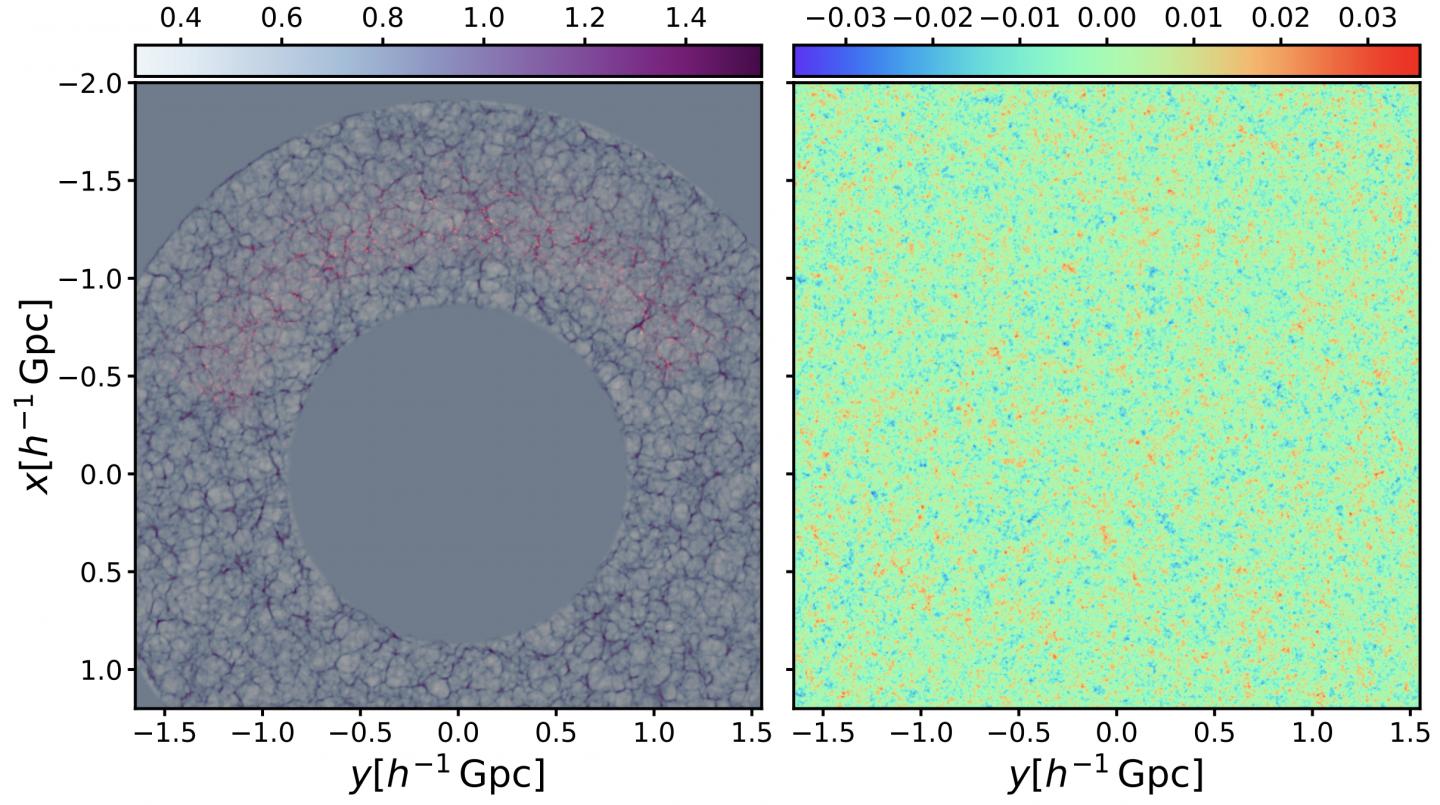
Credit: Francisco-Shu Kitaura (IAC).

The Instituto de Astrofísica de Canarias (IAC) has led an international team which has developed an algorithm called COSMIC BIRTH to analyse large scale cosmic structures. This new computation method will permit the analysis of the evolution of the structure of dark matter from the early universe until the formation of present day galaxies. This work was recently published in the journal Monthly Notices of the Royal Astronomical Society (MNRAS).

The IAC researcher, a co-author of the article and leader of the group of Cosmology and Large Scale Structure (LSS) Francisco-Shu Kitaura explains that one of the key aspects of this algorithm “consists in expressing the observations as if they had been detected in the early universe, which simplifies many of the calculations”.

“Our algorithm uses sampling techniques designed to deal with high dimensional spaces, and is the product of more than four years of development. That is why I thank the funding programmes Ramon y Cajal and Excelencia Severo Ochoa which have allowed us to make scientific journeys which are such a challenge and a risk”, he adds.

“It is fascinating to use the methods of classical mechanics to reconstruct the large scale structure of huge cosmic volumes”, says Mónica Hernández Sánchez, a doctoral student at the IAC and the University of La Laguna (ULL), and first author of another linked article, who has shown that an idea of the particle physicists from 30 years ago has proved useful in the present context.

“It has been exciting to explore, using Big Data techniques, the structures which include the formation of galaxy clusters emerging at “cosmic noon”. That is the moment when the Universe lit up the galaxies with stars”, notes Metin Ata, a researcher at the Kavli Institute for Physics and Mathematics of the Universe (IPMU), in Japan, and leader of the application of the COSMIC BIRTH algorithm to the combination of five studies of distant clusters in the COSMOS (Cosmic Evolution Survey) fields.

The authors have dedicated this last work to the French astrophysicist Olivier Le Fèver, who participated in the study and who unfortunately died while it was being completed.

###

Main article: Kitaura et al. “COSMIC BIRTH: Efficient Bayesian Inference of the Evolving Cosmic Web from Galaxy Surveys, MNRAS, 2021. https://ui.adsabs.harvard.edu/abs/2020MNRAS.tmp.3630K/abstract

– Arxiv: https://arxiv.org/pdf/1911.00284.pdf

Related articles:

1) Hernández-Sánchez, Kitaura et al 2021:

https://ui.adsabs.harvard.edu/abs/2021MNRAS.tmp..185H/abstract

2) Ata, Kitaura et al 2021:

https://ui.adsabs.harvard.edu/abs/2021MNRAS.500.3194A/abstract

Media Contact
Prensa IAC
[email protected]

Original Source

https://www.iac.es/en/outreach/news/big-data-model-evolution-cosmic-web

Related Journal Article

http://dx.doi.org/10.1093/mnras/staa3774

Tags: AstronomyAstrophysicsSpace/Planetary Science
Share12Tweet8Share2ShareShareShare2

Related Posts

blank

Breakthrough in Environmental Cleanup: Scientists Develop Solar-Activated Biochar for Faster Remediation

February 7, 2026
blank

Cutting Costs: Making Hydrogen Fuel Cells More Affordable

February 6, 2026

Scientists Develop Hand-Held “Levitating” Time Crystals

February 6, 2026

Observing a Key Green-Energy Catalyst Dissolve Atom by Atom

February 6, 2026
Please login to join discussion

POPULAR NEWS

  • Robotic Ureteral Reconstruction: A Novel Approach

    Robotic Ureteral Reconstruction: A Novel Approach

    82 shares
    Share 33 Tweet 21
  • Digital Privacy: Health Data Control in Incarceration

    63 shares
    Share 25 Tweet 16
  • Study Reveals Lipid Accumulation in ME/CFS Cells

    57 shares
    Share 23 Tweet 14
  • Breakthrough in RNA Research Accelerates Medical Innovations Timeline

    53 shares
    Share 21 Tweet 13

About

We bring you the latest biotechnology news from best research centers and universities around the world. Check our website.

Follow us

Recent News

Phage-Antibiotic Combo Beats Resistant Peritoneal Infection

Boosting Remote Healthcare: Stepped-Wedge Trial Insights

Barriers and Boosters of Seniors’ Physical Activity in Karachi

Subscribe to Blog via Email

Enter your email address to subscribe to this blog and receive notifications of new posts by email.

Join 73 other subscribers
  • Contact Us

Bioengineer.org © Copyright 2023 All Rights Reserved.

Welcome Back!

Login to your account below

Forgotten Password?

Retrieve your password

Please enter your username or email address to reset your password.

Log In
No Result
View All Result
  • Homepages
    • Home Page 1
    • Home Page 2
  • News
  • National
  • Business
  • Health
  • Lifestyle
  • Science

Bioengineer.org © Copyright 2023 All Rights Reserved.