• HOME
  • NEWS
  • EXPLORE
    • CAREER
      • Companies
      • Jobs
    • EVENTS
    • iGEM
      • News
      • Team
    • PHOTOS
    • VIDEO
    • WIKI
  • BLOG
  • COMMUNITY
    • FACEBOOK
    • INSTAGRAM
    • TWITTER
Monday, January 12, 2026
BIOENGINEER.ORG
No Result
View All Result
  • Login
  • HOME
  • NEWS
  • EXPLORE
    • CAREER
      • Companies
      • Jobs
        • Lecturer
        • PhD Studentship
        • Postdoc
        • Research Assistant
    • EVENTS
    • iGEM
      • News
      • Team
    • PHOTOS
    • VIDEO
    • WIKI
  • BLOG
  • COMMUNITY
    • FACEBOOK
    • INSTAGRAM
    • TWITTER
  • HOME
  • NEWS
  • EXPLORE
    • CAREER
      • Companies
      • Jobs
        • Lecturer
        • PhD Studentship
        • Postdoc
        • Research Assistant
    • EVENTS
    • iGEM
      • News
      • Team
    • PHOTOS
    • VIDEO
    • WIKI
  • BLOG
  • COMMUNITY
    • FACEBOOK
    • INSTAGRAM
    • TWITTER
No Result
View All Result
Bioengineer.org
No Result
View All Result
Home NEWS Science News Chemistry

Amination strategy improves efficiency of CO2 electrocatalytic reduction

Bioengineer by Bioengineer
February 19, 2021
in Chemistry
Reading Time: 2 mins read
0
IMAGE
Share on FacebookShare on TwitterShare on LinkedinShare on RedditShare on Telegram

IMAGE

Credit: CHEN Zhipeng

Carbon dioxide (CO2) electrocatalytic reduction driven by renewable electricity can solve the problem of excessive CO2 emissions. Since CO2 is thermodynamically stable, efficient catalysts are needed to reduce the energy consumption in the process.

The single-atom catalysts immobilized on nitrogen-doped carbon supports (M-N/C) have been widely used for CO2 electrocatalytic reduction reaction due to their high atom utilization efficiency.

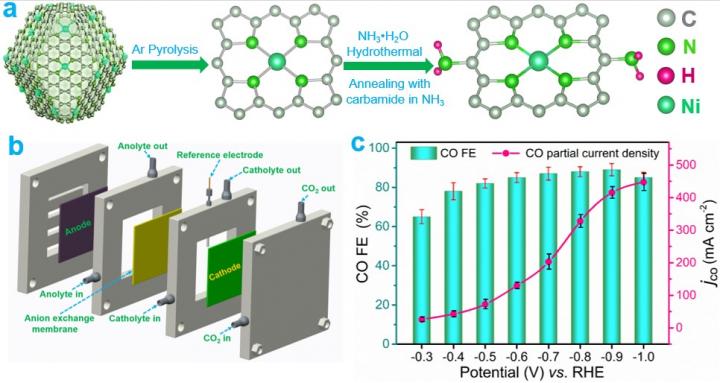
Recently, a research team led by Prof. LIU Licheng from the Qingdao Institute of Bioenergy and Bioprocess Technology (QIBEBT) of the Chinese Academy of Sciences (CAS) proposed a two-step amination strategy to regulate the electronic structure of M-N/C catalysts (M=Ni, Fe, Zn) and enhance the intrinsic activity of CO2 electrocatalytic reduction.

In the strategy, the M-N4/C was aminated by annealing with carbamide in NH3, impregnation and hydrothermal reaction in ammonia water to synthesize final M-N4/C-NH2 catalysts.

Although M-N/C catalysts are widely used, they demonstrate a poor reaction current density, which is much worse than the current density of industrial level.

In the study, the researchers used gas diffusion electrodes to create a reactive three-phase interface in a flow electrolyzer to increase the current density for CO production to industrial application level.

The aminated Ni single-atom catalyst demonstrated a remarkable current density of >400 mA cm-2 with a nearly 90% Faraday efficiency for CO production, which is 1.8 times of that before amination.

###

The study, published in Energy & Environmental Science, provides a method for increasing current density at industrial-relevant level of single-atom catalysts.

This work was supported by the National Natural Science Foundation of China, Dalian National Laboratory for Clean Energy Cooperation Fund, Special Research Assistant Funding Project of Chinese Academy of Sciences, and China Post-doctoral Science Foundation.

Media Contact
CHENG Jing
[email protected]

Related Journal Article

http://dx.doi.org/10.1039/D0EE04052E

Tags: Chemistry/Physics/Materials SciencesEnergy/Fuel (non-petroleum)
Share12Tweet8Share2ShareShareShare2

Related Posts

blank

Advancing Alkene Chemistry: Homologative Difunctionalization Breakthrough

January 8, 2026
Biocompatible Ligand Enables Safe In-Cell Protein Arylation

Biocompatible Ligand Enables Safe In-Cell Protein Arylation

January 8, 2026

Monovalent Pseudo-Natural Products Boost IDO1 Degradation

January 7, 2026

Catalytic Enantioselective [1,2]-Wittig Rearrangement Breakthrough

January 7, 2026
Please login to join discussion

POPULAR NEWS

  • Enhancing Spiritual Care Education in Nursing Programs

    154 shares
    Share 62 Tweet 39
  • PTSD, Depression, Anxiety in Childhood Cancer Survivors, Parents

    146 shares
    Share 58 Tweet 37
  • Robotic Ureteral Reconstruction: A Novel Approach

    70 shares
    Share 28 Tweet 18
  • Study Reveals Lipid Accumulation in ME/CFS Cells

    50 shares
    Share 20 Tweet 13

About

We bring you the latest biotechnology news from best research centers and universities around the world. Check our website.

Follow us

Recent News

Targeting SPAK Halts Liver Cancer Progression, Boosts Immunity

Gradient Graphene Powers Precise Directional Laser Printing

Machine Learning Unveils Unified Cell-State Landscape

Subscribe to Blog via Email

Enter your email address to subscribe to this blog and receive notifications of new posts by email.

Join 71 other subscribers
  • Contact Us

Bioengineer.org © Copyright 2023 All Rights Reserved.

Welcome Back!

Login to your account below

Forgotten Password?

Retrieve your password

Please enter your username or email address to reset your password.

Log In
No Result
View All Result
  • Homepages
    • Home Page 1
    • Home Page 2
  • News
  • National
  • Business
  • Health
  • Lifestyle
  • Science

Bioengineer.org © Copyright 2023 All Rights Reserved.