Current setback policy not most effective approach to protect people from exposure
Credit: Penn State
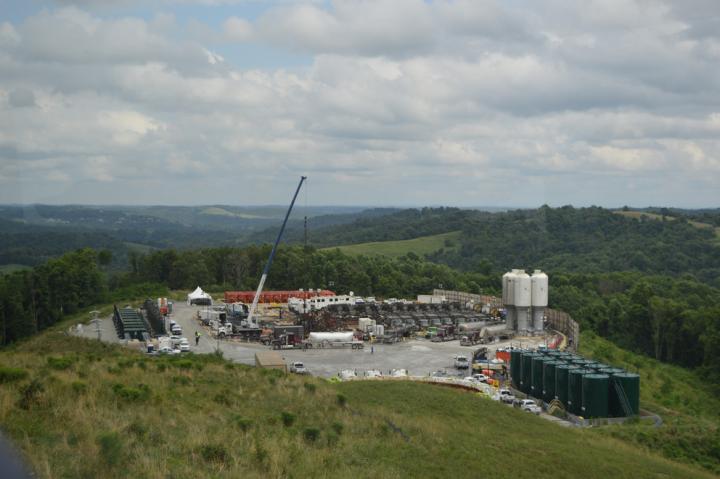
Air pollution levels may have exceeded air quality standards during the development of some Marcellus Shale natural gas wells in Pennsylvania, potentially impacting more than 36,000 people in one year alone during the drilling boom, according to Penn State scientists.
“The construction and drilling of these wells are a relatively short-term thing, and assessment of the impact on air quality is something that often falls through the cracks,” said Jeremy Gernand, associate professor of industrial health and safety at Penn State. “But there are thousands and thousands of wells drilled depending on the year, and we wanted to see what the impact would be if we added it all up.”
More than 20,000 unconventional Marcellus Shale gas wells have been drilled since Pennsylvania’s boom began around 2005. Large diesel-powered equipment and gas turbines used during the drilling and hydraulic fracturing stages of shale gas development emit air pollution, and these emissions can affect air quality within the vicinity of shale well sites and farther downwind, the scientists said.
The scientists found emissions at some of the sites could have impacted air quality for people who live beyond the 500-foot setbacks required by state regulations.
“We found in one year alone, 36,000 people, or about 1% of the population of Pennsylvania’s Marcellus Shale region, could have been exposed to pollution levels exceeding air quality standards,” Gernand said. “However, we found doubling the required setback distance reduced that number by about half.”
The scientists developed a dispersion model to estimate concentrations of fine particulate matter (PM 2.5) resulting from well development. One form of air pollution created by the burning of fossil fuels, PM 2.5 are tiny particles that can be inhaled and cause lung damage, according to the scientists.
“Very few studies have investigated local residents’ exposure to PM 2.5 emissions from shale gas development, specifically in the Marcellus region of Pennsylvania,” Gernand said.
The model considered meteorological conditions during well development, indicating how factors like wind carried emissions from individual well sites, the scientists said. The team then used census data to estimate how many people were in the areas affected by higher levels of air pollution.
Their findings, published in Energy Policy, showed a small number of wells near populated areas contributed to most of the exposures to elevated levels of air pollution.
“I think the main message is that a one-size-fits-all policy to constrain the impacts of industry probably isn’t the most effective approach,” Gernand said. “In this case, there are real benefits to making some alterations to setback regulations. We only need to push certain sites back farther from inhabited areas to see a big reduction in the number of people whose air quality is affected by this.”
Setback policy is shown to be an effective method to reduce exposure exceedances, but the scientists said their results indicate the policies should consider the number of wells per well pad and local conditions to further limit air quality impacts.
The scientists said drilling activity has moved closer to populated areas as Marcellus development progressed in Pennsylvania. And while the construction, drilling and fracking stages are relatively short, sites now often have multiple wells so development can extend for months.
“Staying back 500 feet was probably fine when we drilled one well per pad and moved on, but under the current conditions that’s not really sufficient anymore,” Gernand said. “We really need to take into consideration things like how much construction and drilling activity will take place and for how long and population density in the area and use those things in some kind of decision framework.”
###
Zoya Banan, an air quality specialist with South Coast Air Quality Management District, also conducted this research while a doctoral student at Penn State.
Media Contact
A’ndrea Elyse Messer
[email protected]
Related Journal Article
http://dx.