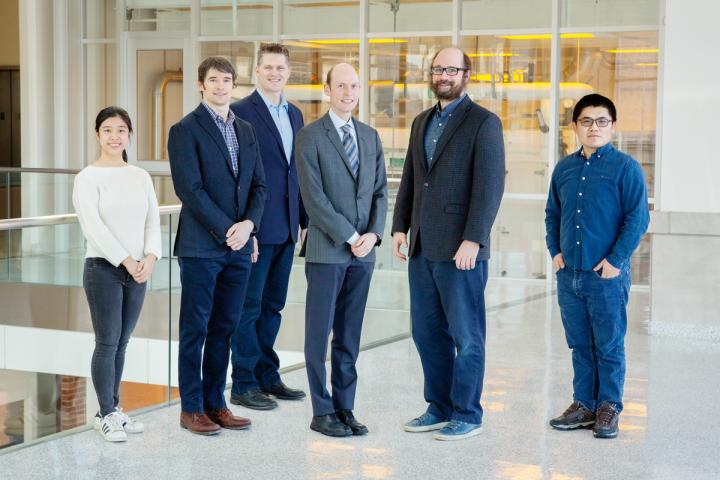
Credit: Photo by L. Brian Stauffer.
CHAMPAIGN, Ill. — Researchers who focus on fat know that some adipose tissue is more prone to inflammation-related comorbidities than others, but the reasons why are not well understood. Thanks to a new analytical technique, scientists are getting a clearer view of the microenvironments found within adipose tissue associated with obesity. This advance may illuminate why some adipose tissues are more prone to inflammation – leading to diseases like type 2 diabetes, cancer and cardiovascular disorders – and help direct future drug therapies to treat obesity.
In a new study, University of Illinois Urbana Champaign bioengineering professors Andrew Smith and Mark A. Anastasio, molecular and integrative physiology professor Erik Nelson and nutritional sciences professor Kelly Swanson detail the use of the new technique in mice. The results are published in the journal Science Advances.
Inflammation in adipose tissue presents itself as round complexes of inflammatory tissue called crownlike structures. Previous studies have shown that body fat that contains these structures is associated with worse outcomes of obesity and related metabolic disorders, the study reports.
Previously, researchers were confined to the use of 2D slices of tissue and traditional microscopy, limiting what researchers could learn about them.
To get a better view, the team combined a special type of microscopy that uses a 3D sheet of light rather than a beam, a fat-clearing technique that renders tissue optically transparent, and deep-learning algorithms that help process the large amount of imaging data produced.
The researchers found that the crownlike appearances that gives these structures their name are, in reality, more like 3D shells or concentric spheres surrounding an empty core, Smith said.
“Using our new technique, we can determine the crownlike structures’ volume, the specific number of cells associated with them, as well as their size, geometry and distribution,” Smith said.
This ability led the team to discover that obesity tends to be associated with a prevalence of rare, massive crownlike structures that are not present in the lean state.
“These very large crownlike structures are clustered together and located in the center of the tissue,” Smith said. “And there is no way we could have analyzed this before using our new technique.”
Smith said the research may lead to new drug therapies and new ways to evaluate patients’ metabolic health.
“Right now, we know that some patients are overweight but metabolically healthy, while others are underweight and metabolically unhealthy,” Smith said. “We believe that having the ability to look deep into the microenvironments with fat tissue may unlock some of the reasons why this is.”
###
The National Institutes of Health and the Beckman Institute for Advanced
Science and Technology support this study.
Smith also is affiliated with materials science and engineering, the Carl R. Woese Institute for Genomic Biology, the Technology Entrepreneur Center and the Carle Illinois College of Medicine. Anastasio also is affiliated with electrical and computer engineering, computer science, Carle Illinois College of Medicine and the Beckman Institute.
Editor’s notes:
To reach Andrew Smith, call 217-300-5638; email [email protected].
The paper “3D microscopy and deep learning reveal the heterogeneity of crown-like
structure microenvironments in intact adipose tissue” is available from the U. of I. News Bureau.
Media Contact
Lois Yoksoulian
[email protected]
Original Source
https:/
Related Journal Article
http://dx.