Archaeology shows that politics and economics played a major impact in choosing livestock
Credit: Ariadna Nieto-Espinet
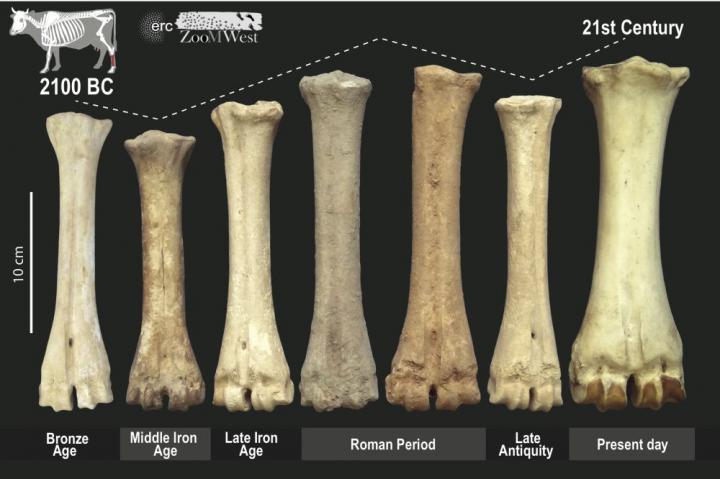
In ancient European settlements, livestock use was likely primarily determined by political structure and market demands, according to a study published February 17, 2021 in the open-access journal PLOS ONE by Ariadna Nieto-Espinet and colleagues of the Consejo Superior de Investigaciones Científicas, Barcelona.
Zooarchaeology – the study of animal remains from archaeological sites – has great potential to provide information on past human communities. Livestock preferences are known to have changed over time in Europe, but little is known about how much these changes are influenced by environmental, economic, or political conditions of ancient settlements.
In this study, Nieto-Espinet and colleagues gathered data from 101 archaeological sites across the northeastern Iberian Peninsula, ranging from the Late Bronze Age to Late Antiquity, a span of around 1700 years during which European cultural and agricultural practices underwent significant changes. At each site, they compared livestock remains with data on the local environment (including plant and climate data) and the economic and political conditions of the settlement.
These data show that political and economic factors were most important in determining the species distribution and body size of ancient livestock. During the Late Bronze Age and Late Antiquity, when political systems were more fragmented and food production was focused more on local markets, livestock choice was more dependent upon local environmental conditions. But during the later Iron Age and the time of the Roman Empire, the demands of a pan-Mediterranean market economy favored more changes in livestock use independent of environmental factors. Zooarchaeology is thus a vital source of information for understanding political and economic changes through time.
The authors add: “Archaeology reveals the influence of political systems on livestock practices over time.”
###
Citation: Nieto Espinet A, Huet T, Trentacoste A, Guimarães S, Orengo H, Valenzuela-Lamas S (2021) Resilience and livestock adaptations to demographic growth and technological change: A diachronic perspective from the Late Bronze Age to Late Antiquity in NE Iberia. PLoS ONE 16(2): e0246201. https:/
Funding: This work was financially supported by the ERC-Starting Grant ZooMWest – Zooarchaeology and Mobility in the Western Mediterranean: Husbandry production from the Late Bronze Age to the Late Antiquity (award number 716298), funded by the European Research Council Agency (ERCEA) under the direction of Sílvia Valenzuela-Lamas. In cooperation with PID2019-110022GB -100 MOBICEX (Ministerio de Ciencia e Innovación, ES); 2017 SGR 995-GRC-Archaeology of Social Dynamics (ASD)-CSIC (Generalitat de Catalunya, ES). The funders had no role in the study design, data collection and analysis, decision to publish, or preparation of the manuscript.
Competing Interests: The authors have declared that no competing interests exist.
In your coverage please use this URL to provide access to the freely available article in PLOS ONE: https:/
Media Contact
Silvia Valenzuela-Lamas
[email protected]
Related Journal Article
http://dx.