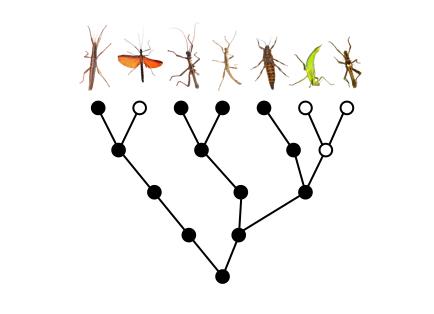
Credit: Mariolys Rivas
Montreal, December 14, 2016 — At this time of year, the words "Yule tree" may conjure images of brightly decorated balsam firs. But for Lea Popovic, an associate professor of mathematics and statistics in the Faculty of Arts and Science, a Yule tree is actually an advanced way to describe evolution.
In a new study published in Mathematical Biology, Popovic and recent Concordia graduate Mariolys Rivas (PhD 14) show how the present-day distribution of physical traits across species can help explain how the evolutionary process unfolded over time.
They used a tree-shaped graph called the Yule tree, first developed in 1924 by G. U. Yule to map genealogical history.
Visualizing how species change
"The full history of the evolutionary process of a given species can be neatly described by a Yule tree," says Popovic.
"We extended Yule's model so that we would be able to track evolutionary processes that are dependent on specific phenotypes."
Reconstructing the evolutionary process has been a major challenge to scientists for decades because so much is unknown. And with increased planetary changes resulting in growing numbers of extinctions, these questions are even more pressing.
"The evolution of the visible traits of species — their phenotypes — is responsible for the diversity of all living organisms and for their ability to adapt to new environments," says Popovic.
"Recent research has shown how differences in phenotypes can affect how quickly species evolve or become extinct. Mathematical models can go a long way in helping us determine various elements of this process. But the possibility that diversification may be trait dependent implies that standard methods are not adequate for measuring the rates of evolution."
To address these concerns, Popovic and Rivas used math to map the rate at which new species are created or become extinct. They developed a new mathematical model that describes evolution as a process in which the length of time that species live until they go extinct — or give rise to other species — depends on their phenotype. Their model includes the possibility for the phenotype of the new species to change.
The Yule tree graph
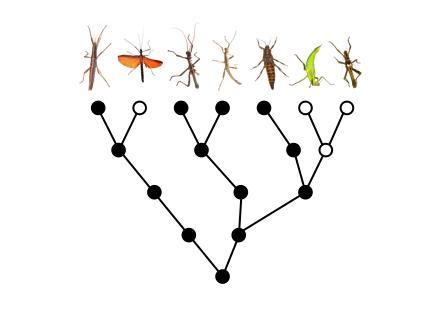
The Yule tree is a graph with one edge coming in and two edges coming out of each branch-point. The branches represent the time periods between the evolution of new species. If the branch leads to a branch-point, it means a new species evolved. If the branch leads to a leaf, it marks an extinction. The leaves represent the species present today.
The graph also features "cherries," which represent two present species that are the closest to each other in evolutionary terms, and "pendants," which represent the evolutionary connection to another species that is slightly further from them in evolutionary terms.
Counting the number of different types of cherries and pendants helps determine the particular dependence on the phenotype of new species being created or going extinct.
###
Related links:
"Topology and inference for Yule trees with multiple states" (cited study)
Department of Mathematics and Statistics
Lea Popovic
Mariolys Rivas
Media contact:
Cléa Desjardins
Senior advisor, media relations
University Communications Services
Concordia University
Phone: 514-848-2424, ext. 5068
Email: [email protected]
Web: http://www.concordia.ca/now/media-relations
Twitter: @CleaDesjardins
Media Contact
Cléa Desjardins
[email protected]
514-909-2999
@ConcordiaUnews
http://www.concordia.ca
############
Story Source: Materials provided by Scienmag