• HOME
  • NEWS
  • EXPLORE
    • CAREER
      • Companies
      • Jobs
    • EVENTS
    • iGEM
      • News
      • Team
    • PHOTOS
    • VIDEO
    • WIKI
  • BLOG
  • COMMUNITY
    • FACEBOOK
    • INSTAGRAM
    • TWITTER
Saturday, February 7, 2026
BIOENGINEER.ORG
No Result
View All Result
  • Login
  • HOME
  • NEWS
  • EXPLORE
    • CAREER
      • Companies
      • Jobs
        • Lecturer
        • PhD Studentship
        • Postdoc
        • Research Assistant
    • EVENTS
    • iGEM
      • News
      • Team
    • PHOTOS
    • VIDEO
    • WIKI
  • BLOG
  • COMMUNITY
    • FACEBOOK
    • INSTAGRAM
    • TWITTER
  • HOME
  • NEWS
  • EXPLORE
    • CAREER
      • Companies
      • Jobs
        • Lecturer
        • PhD Studentship
        • Postdoc
        • Research Assistant
    • EVENTS
    • iGEM
      • News
      • Team
    • PHOTOS
    • VIDEO
    • WIKI
  • BLOG
  • COMMUNITY
    • FACEBOOK
    • INSTAGRAM
    • TWITTER
No Result
View All Result
Bioengineer.org
No Result
View All Result
Home NEWS Science News

A population of neutron stars can generate gravitational waves continuously

Bioengineer by Bioengineer
December 14, 2016
in Science News
Reading Time: 2 mins read
0
Share on FacebookShare on TwitterShare on LinkedinShare on RedditShare on Telegram
IMAGE

Credit: Sudip Bhattacharyya

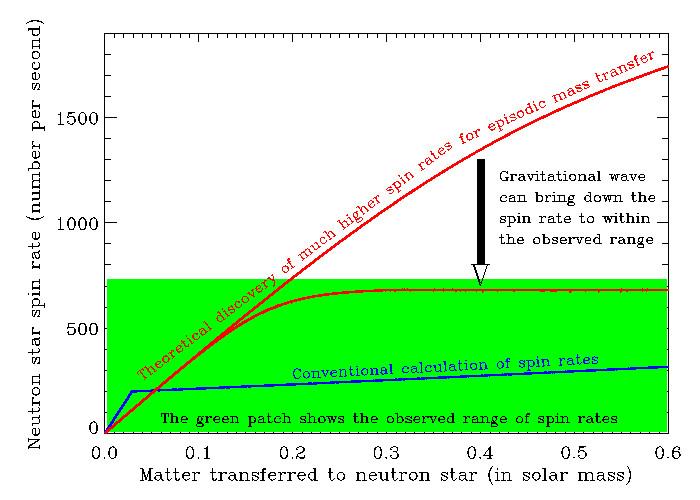
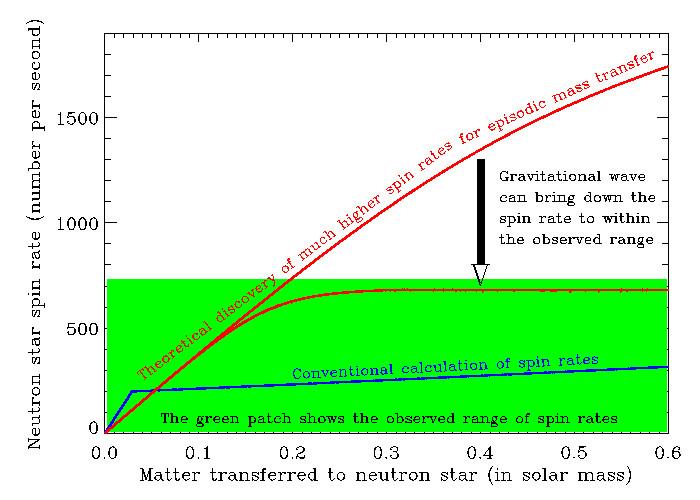
Professor Sudip Bhattacharyya of the Tata Institute of Fundamental Research (TIFR), Mumbai, India, and Professor Deepto Chakrabarty (MIT, USA), an adjunct visiting professor at the same institute, have shown that a population of neutron stars should spin around their axes much faster than the highest observed spin rate of any neutron star. They pointed out that the observed lower spin rates are possible if these neutron stars emit gravitational waves continuously, and hence spin down.

Neutron stars are the densest observable objects in the universe, with a fistful of stellar material outweighing a mountain on Earth. While such stars are not bigger than a city, in size, they have more material than in the Sun crammed inside them. A population of these stars can increase their spin rate by the transfer of matter from a normal companion star. Infact, some of them have been observed to spin several hundred times in a second around their own axes.

In the 1970s, it was theoretically worked out how fast these neutron stars could spin, and since then this has formed the basis of studies of these stars. But the new study led by Professor Bhattacharyya has shown that for episodic mass transfer, which happens for many neutron stars, the stellar spin rate should be much higher, and the star could easily attain a spin rate more than a thousand times per second. Since no neutron star has been observed with such a high spin rate, the team has pointed out that many of these stars are likely to be slowed down by continuously emitting gravitational waves.

Gravitational waves emitted by massive objects is a prediction of Einstein's general theory of relativity, which has recently been discovered during transient phenomena of black hole mergers. But the detection of continuous gravitational waves, which could provide an opportunity to study these waves almost permanently, is still elusive. The new study of Professors Bhattacharyya and Chakrabarty provide a strong indication that many fast spinning neutron stars generate gravitational waves continuously, and careful observations should be made to detect such waves.

###

Media Contact

Sudip Bhattacharyya
[email protected]

http://www.tifr.res.in

############

Story Source: Materials provided by Scienmag
Share12Tweet8Share2ShareShareShare2

Related Posts

Inflammasome Protein ASC Drives Pancreatic Cancer Metabolism

February 7, 2026

Phage-Antibiotic Combo Beats Resistant Peritoneal Infection

February 7, 2026

Boosting Remote Healthcare: Stepped-Wedge Trial Insights

February 7, 2026

Barriers and Boosters of Seniors’ Physical Activity in Karachi

February 7, 2026
Please login to join discussion

POPULAR NEWS

  • Robotic Ureteral Reconstruction: A Novel Approach

    Robotic Ureteral Reconstruction: A Novel Approach

    82 shares
    Share 33 Tweet 21
  • Digital Privacy: Health Data Control in Incarceration

    63 shares
    Share 25 Tweet 16
  • Study Reveals Lipid Accumulation in ME/CFS Cells

    57 shares
    Share 23 Tweet 14
  • Breakthrough in RNA Research Accelerates Medical Innovations Timeline

    53 shares
    Share 21 Tweet 13

About

We bring you the latest biotechnology news from best research centers and universities around the world. Check our website.

Follow us

Recent News

Inflammasome Protein ASC Drives Pancreatic Cancer Metabolism

Phage-Antibiotic Combo Beats Resistant Peritoneal Infection

Boosting Remote Healthcare: Stepped-Wedge Trial Insights

Subscribe to Blog via Email

Enter your email address to subscribe to this blog and receive notifications of new posts by email.

Join 73 other subscribers
  • Contact Us

Bioengineer.org © Copyright 2023 All Rights Reserved.

Welcome Back!

Login to your account below

Forgotten Password?

Retrieve your password

Please enter your username or email address to reset your password.

Log In
No Result
View All Result
  • Homepages
    • Home Page 1
    • Home Page 2
  • News
  • National
  • Business
  • Health
  • Lifestyle
  • Science

Bioengineer.org © Copyright 2023 All Rights Reserved.