• HOME
  • NEWS
  • EXPLORE
    • CAREER
      • Companies
      • Jobs
    • EVENTS
    • iGEM
      • News
      • Team
    • PHOTOS
    • VIDEO
    • WIKI
  • BLOG
  • COMMUNITY
    • FACEBOOK
    • INSTAGRAM
    • TWITTER
Saturday, February 7, 2026
BIOENGINEER.ORG
No Result
View All Result
  • Login
  • HOME
  • NEWS
  • EXPLORE
    • CAREER
      • Companies
      • Jobs
        • Lecturer
        • PhD Studentship
        • Postdoc
        • Research Assistant
    • EVENTS
    • iGEM
      • News
      • Team
    • PHOTOS
    • VIDEO
    • WIKI
  • BLOG
  • COMMUNITY
    • FACEBOOK
    • INSTAGRAM
    • TWITTER
  • HOME
  • NEWS
  • EXPLORE
    • CAREER
      • Companies
      • Jobs
        • Lecturer
        • PhD Studentship
        • Postdoc
        • Research Assistant
    • EVENTS
    • iGEM
      • News
      • Team
    • PHOTOS
    • VIDEO
    • WIKI
  • BLOG
  • COMMUNITY
    • FACEBOOK
    • INSTAGRAM
    • TWITTER
No Result
View All Result
Bioengineer.org
No Result
View All Result
Home NEWS Science News

New technology to detect bitter almonds in real time

Bioengineer by Bioengineer
January 29, 2021
in Science News
Reading Time: 2 mins read
0
IMAGE
Share on FacebookShare on TwitterShare on LinkedinShare on RedditShare on Telegram

IMAGE

Credit: University of Córdoba

Who hasn’t at some point been chewing on an almond and tasted an unpleasant and unexpected aftertaste that has nothing to do with the taste we are used to from one of the most consumed nuts in the world? The culprit has a name: amygdalin, a diglucoside that, when in contact with enzymes present in saliva, breaks down into glucose, benzaldehyde (the cause of the bitter taste) and hydrogen cyanide.

To reduce this unpleasant ‘surprise’, the Farming Systems Engineering (AGR-128) and Food Technology (AGR-193) research groups at the University of Cordoba’s School of Agricultural and Forestry Engineering, with collaboration from the Andalusian Institute of Agricultural Research and Training’s Alameda del Obispo Center, developed method that can predict levels of the abovementioned amygdalin present in the nuts analyzed both with and without shells, as well as correctly classify sweet almonds and bitter ones on an industrial scale, something that has only been done with shelled nuts, individual kernels or ground nuts to date.

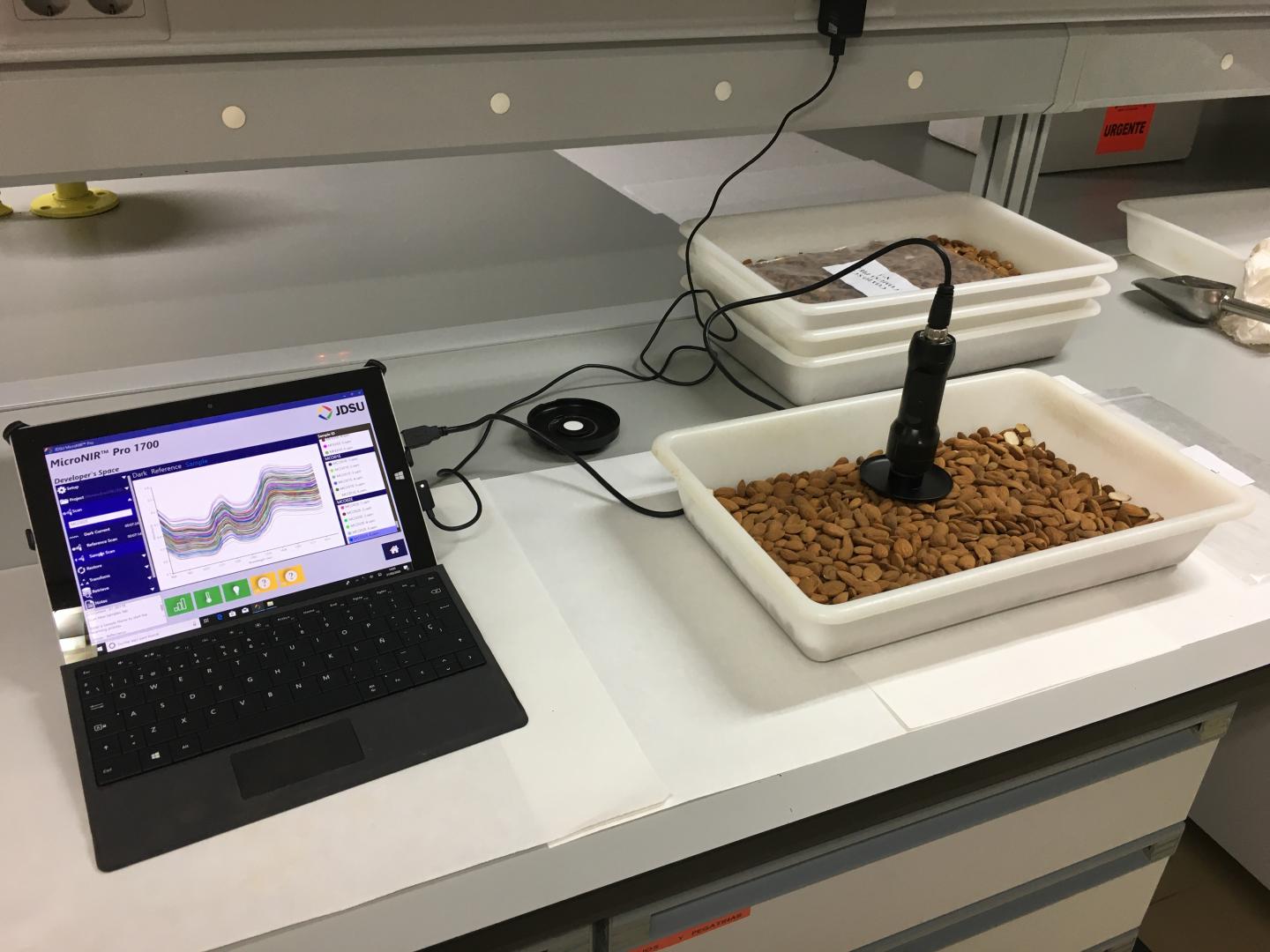
The new system uses portable equipment based on NIRS technology -Near Infrared Spectroscopy- which can analyze large amounts of a product in situ in real time, without having to go into a lab. This technological application is “of great interest to the farming sector”, explains Professor Dolores Pérez Marín, since almond bitterness in the wild can be helpful to prevent predators from ingesting the seeds of certain varieties, but on an industrial scale it offers no advantages and many disadvantages: an unpleasant taste, product devaluation and potential problems with food safety if consumption of bitter nuts occurs on a large scale.

Technically, the NIRS sensors use a beam of light that, when interacting with organic matter, returns a unique signal (spectrum) for each product sample, as in an unmistakable digital print that provides information and allows us to define the sample. In this case, as explained by doctoral student and first author of the research paper, Miguel Vega Castellote, the portable sensors, “whose signal along with the reference values allow for the development of prediction models”, are able to analyze different parameters by “scanning” the product quickly and noninvasively, as in without modifying it.

Food fraud

Using NIRS technology, in which the research team has vast experience with an array of food products, is especially useful in the early detection of possible fraud and in food authentication. Therefore, the team has initiated another research project aimed at detecting batches of sweet almonds adulterated with bitter ones and in which almost 90% of the fraudulent items were identified. The system tested in this research, explains Professor María Teresa Sánchez Pineda de las Infantas, another author of the paper “could be implemented at any point in the value chain, including upon reception, during processing and shipping, and could be used as a fast and affordable anti-fraud early warning method”.

###

Media Contact
Elena Lázaro Real
[email protected]

Related Journal Article

http://dx.doi.org/10.1016/j.jfoodeng.2020.110406

Tags: Chemistry/Physics/Materials SciencesFood/Food Science
Share12Tweet8Share2ShareShareShare2

Related Posts

Improving Dementia Care with Enhanced Activity Kits

February 7, 2026

Decoding Prostate Cancer Origins via snFLARE-seq, mxFRIZNGRND

February 7, 2026

Digital Health Perspectives from Baltic Sea Experts

February 7, 2026

Florida Cane Toad: Complex Spread and Selective Evolution

February 7, 2026
Please login to join discussion

POPULAR NEWS

  • Robotic Ureteral Reconstruction: A Novel Approach

    Robotic Ureteral Reconstruction: A Novel Approach

    82 shares
    Share 33 Tweet 21
  • Digital Privacy: Health Data Control in Incarceration

    63 shares
    Share 25 Tweet 16
  • Study Reveals Lipid Accumulation in ME/CFS Cells

    57 shares
    Share 23 Tweet 14
  • Breakthrough in RNA Research Accelerates Medical Innovations Timeline

    53 shares
    Share 21 Tweet 13

About

We bring you the latest biotechnology news from best research centers and universities around the world. Check our website.

Follow us

Recent News

Improving Dementia Care with Enhanced Activity Kits

Decoding Prostate Cancer Origins via snFLARE-seq, mxFRIZNGRND

Digital Health Perspectives from Baltic Sea Experts

Subscribe to Blog via Email

Enter your email address to subscribe to this blog and receive notifications of new posts by email.

Join 73 other subscribers
  • Contact Us

Bioengineer.org © Copyright 2023 All Rights Reserved.

Welcome Back!

Login to your account below

Forgotten Password?

Retrieve your password

Please enter your username or email address to reset your password.

Log In
No Result
View All Result
  • Homepages
    • Home Page 1
    • Home Page 2
  • News
  • National
  • Business
  • Health
  • Lifestyle
  • Science

Bioengineer.org © Copyright 2023 All Rights Reserved.