• HOME
  • NEWS
  • EXPLORE
    • CAREER
      • Companies
      • Jobs
    • EVENTS
    • iGEM
      • News
      • Team
    • PHOTOS
    • VIDEO
    • WIKI
  • BLOG
  • COMMUNITY
    • FACEBOOK
    • INSTAGRAM
    • TWITTER
Sunday, May 10, 2026
BIOENGINEER.ORG
No Result
View All Result
  • Login
  • HOME
  • NEWS
  • EXPLORE
    • CAREER
      • Companies
      • Jobs
        • Lecturer
        • PhD Studentship
        • Postdoc
        • Research Assistant
    • EVENTS
    • iGEM
      • News
      • Team
    • PHOTOS
    • VIDEO
    • WIKI
  • BLOG
  • COMMUNITY
    • FACEBOOK
    • INSTAGRAM
    • TWITTER
  • HOME
  • NEWS
  • EXPLORE
    • CAREER
      • Companies
      • Jobs
        • Lecturer
        • PhD Studentship
        • Postdoc
        • Research Assistant
    • EVENTS
    • iGEM
      • News
      • Team
    • PHOTOS
    • VIDEO
    • WIKI
  • BLOG
  • COMMUNITY
    • FACEBOOK
    • INSTAGRAM
    • TWITTER
No Result
View All Result
Bioengineer.org
No Result
View All Result
Home NEWS Science News Health

RIT professor developing drone imaging systems to help farmers monitor grapevine nutrients

Bioengineer by Bioengineer
January 28, 2021
in Health
Reading Time: 2 mins read
0
IMAGE
Share on FacebookShare on TwitterShare on LinkedinShare on RedditShare on Telegram

USDA awards Professor Jan van Aardt grant to help create practical systems to help vineyards
IMAGE

Credit: Rob Chancia/RIT

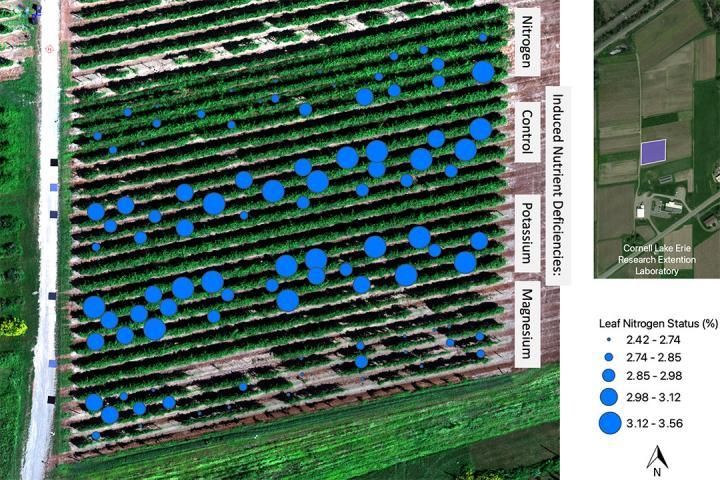
A Rochester Institute of Technology professor is helping to develop drone imaging systems aimed at empowering farmers to better manage the nutrients in their vineyards. Professor Jan van Aardt from the Chester F. Carlson Center for Imaging Science is receiving more than $357,000 in funding from the United States Department of Agriculture to help grape growers make data-driven nutrient-management decisions.

Van Aardt is part of a large consortium, led by Washington State University, working together to develop the novel approach. Farmers ideally need to analyze the levels of nutrients such as nitrogen, magnesium, potassium, and others to optimize fertilization efforts and subsequent yields, but current methods are expensive, time-consuming, and require destructive chemical analysis of leaves. The ultimate goal is to provide practical sensing tools that can help farmers improve vineyard productivity, berry and wine composition and quality, environmental sustainability, and business profitability.

“The goal is to use the traditional chemical analysis of in-field leaf tissue samples to develop drone-based solutions,” said van Aardt, who is on the sensors/engineering team working on ways to detect the health levels of the grapevines. “We can collect hundreds of spectral channels (or colors) and then distill the problem into a handful of channels that are necessary to estimate, say nitrogen levels, and then design an operational solution for a farmer or service provider to assess the nutrients. We’ll also look at what the flight parameters should look like – what time of year we should fly, how frequently, how fast, what the pixel size should be, and so on.”

Van Aardt is leveraging the expertise from RIT’s Digital Imaging and Remote Sensing Laboratory, including Research Scientist Nina Raqueno and Senior Lab Engineer Timothy Bauch. Rob Chancia, an imaging science MS student from Utica, N.Y., has already conducted several test drone flights over vineyards near Lake Erie using hyperspectral and light detection and ranging (LiDAR) imaging systems in conjunction with collaborators from Cornell (Professor Justine Vanden Heuvel and Senior Research Associate Terry Bates), who collected field samples of leaves at the same sites. The RIT College of Science researchers are using the data collected to develop algorithms this winter in preparation for more regular flights once the growing season resumes.

###

Media Contact
Luke Auburn
[email protected]

Original Source

https://www.rit.edu/news/rit-professor-developing-drone-imaging-systems-help-farmers-monitor-grapevine-nutrients

Tags: Agricultural Production/EconomicsCollaborationEcology/EnvironmentNutrition/NutrientsOpticsPlant SciencesTechnology/Engineering/Computer Science
Share12Tweet8Share2ShareShareShare2

Related Posts

Evaluating Digoxin Use in Patients with Symptomatic Rheumatic Heart Disease

May 10, 2026

Evaluating the Effectiveness and Safety of Digitalis Glycosides in Treating Heart Failure

May 10, 2026

Urdu Fall Risk Questionnaire Adapted for Elderly

May 10, 2026

Key Pharmacological Markers for HIV Prevention in MSM

May 10, 2026
Please login to join discussion

POPULAR NEWS

  • Research Indicates Potential Connection Between Prenatal Medication Exposure and Elevated Autism Risk

    840 shares
    Share 336 Tweet 210
  • New Study Reveals Plants Can Detect the Sound of Rain

    727 shares
    Share 290 Tweet 181
  • Scientists Investigate Possible Connection Between COVID-19 and Increased Lung Cancer Risk

    68 shares
    Share 27 Tweet 17
  • Salmonella Haem Blocks Macrophages, Boosts Infection

    61 shares
    Share 24 Tweet 15

About

We bring you the latest biotechnology news from best research centers and universities around the world. Check our website.

Follow us

Recent News

Evaluating Digoxin Use in Patients with Symptomatic Rheumatic Heart Disease

Evaluating the Effectiveness and Safety of Digitalis Glycosides in Treating Heart Failure

Urdu Fall Risk Questionnaire Adapted for Elderly

Subscribe to Blog via Email

Enter your email address to subscribe to this blog and receive notifications of new posts by email.

Join 82 other subscribers
  • Contact Us

Bioengineer.org © Copyright 2023 All Rights Reserved.

Welcome Back!

Login to your account below

Forgotten Password?

Retrieve your password

Please enter your username or email address to reset your password.

Log In
No Result
View All Result
  • Homepages
    • Home Page 1
    • Home Page 2
  • News
  • National
  • Business
  • Health
  • Lifestyle
  • Science

Bioengineer.org © Copyright 2023 All Rights Reserved.