• HOME
  • NEWS
  • EXPLORE
    • CAREER
      • Companies
      • Jobs
    • EVENTS
    • iGEM
      • News
      • Team
    • PHOTOS
    • VIDEO
    • WIKI
  • BLOG
  • COMMUNITY
    • FACEBOOK
    • INSTAGRAM
    • TWITTER
Thursday, March 26, 2026
BIOENGINEER.ORG
No Result
View All Result
  • Login
  • HOME
  • NEWS
  • EXPLORE
    • CAREER
      • Companies
      • Jobs
        • Lecturer
        • PhD Studentship
        • Postdoc
        • Research Assistant
    • EVENTS
    • iGEM
      • News
      • Team
    • PHOTOS
    • VIDEO
    • WIKI
  • BLOG
  • COMMUNITY
    • FACEBOOK
    • INSTAGRAM
    • TWITTER
  • HOME
  • NEWS
  • EXPLORE
    • CAREER
      • Companies
      • Jobs
        • Lecturer
        • PhD Studentship
        • Postdoc
        • Research Assistant
    • EVENTS
    • iGEM
      • News
      • Team
    • PHOTOS
    • VIDEO
    • WIKI
  • BLOG
  • COMMUNITY
    • FACEBOOK
    • INSTAGRAM
    • TWITTER
No Result
View All Result
Bioengineer.org
No Result
View All Result
Home NEWS Science News

Nuclear war could trigger big El Niño and decrease seafood

Bioengineer by Bioengineer
January 25, 2021
in Science News
Reading Time: 3 mins read
0
IMAGE
Share on FacebookShare on TwitterShare on LinkedinShare on RedditShare on Telegram

Unprecedented warming in equatorial Pacific Ocean could last up to seven years
IMAGE

Credit: Joshua Coupe

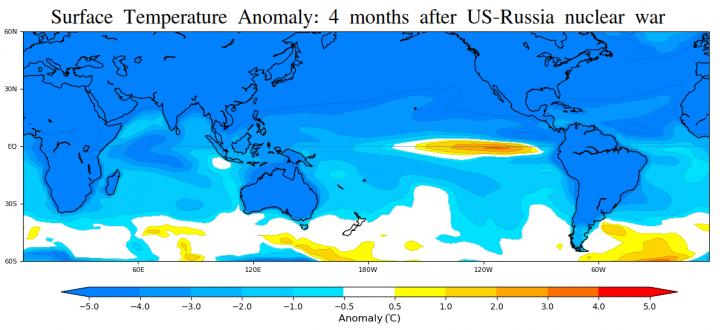
A nuclear war could trigger an unprecedented El Niño-like warming episode in the equatorial Pacific Ocean, slashing algal populations by 40 percent and likely lowering the fish catch, according to a Rutgers-led study.

The research, published in the journal Communications Earth & Environment, shows that turning to the oceans for food if land-based farming fails after a nuclear war is unlikely to be a successful strategy – at least in the equatorial Pacific.

“In our computer simulations, we see a 40 percent reduction in phytoplankton (algae) biomass in the equatorial Pacific, which would likely have downstream effects on larger marine organisms that people eat,” said lead author Joshua Coupe, a post-doctoral research associate in the Department of Environmental Sciences in the School of Environmental and Biological Sciences at Rutgers University-New Brunswick. “Previous research has shown that global cooling following a nuclear war could lead to crop failure on land, and our study shows we probably can’t rely on seafood to help feed people, at least in that area of the world.”

Scientists studied climate change in six nuclear war scenarios, focusing on the equatorial Pacific Ocean. The scenarios include a major conflict between the United States and Russia and five smaller wars between India and Pakistan. Such wars could ignite enormous fires that inject millions of tons of soot (black carbon) into the upper atmosphere, blocking sunlight and disrupting Earth’s climate.

With an Earth system model to simulate the six scenarios, the scientists showed that a large-scale nuclear war could trigger an unprecedented El Niño-like event lasting up to seven years. The El Niño-Southern Oscillation is the largest naturally occurring phenomenon that affects Pacific Ocean circulation, alternating between warm El Niño and cold La Niña events and profoundly influencing marine productivity and fisheries.

During a “nuclear Niño,” scientists found that precipitation over the Maritime Continent (the area between the Indian and Pacific oceans and surrounding seas) and equatorial Africa would be shut down, largely because of a cooler climate.

More importantly, a nuclear Niño would shut down upwelling of deeper, colder waters along the equator in the Pacific Ocean, reducing the upward movement of nutrients that phytoplankton – the base of the marine food web – need to survive. Moreover, the diminished sunlight after a nuclear war would drastically reduce photosynthesis, stressing and potentially killing many phytoplankton.

“Turning to the sea for food after a nuclear war that dramatically reduces crop production on land seems like it would be a good idea,” said co-author Alan Robock, a Distinguished Professor in the Department of Environmental Sciences at Rutgers-New Brunswick. “But that would not be a reliable source of the protein we need, and we must prevent nuclear conflict if we want to safeguard our food and Earth’s environment.”

###

Scientists at the University of California, Santa Barbara; University of Colorado, Boulder; Australian Antarctic Partnership Program; University of Texas, Rio Grande Valley; and National Center for Atmospheric Research contributed to the study.

Media Contact
Todd Bates
[email protected]

Original Source

https://www.rutgers.edu/news/nuclear-war-could-trigger-big-el-nino-and-decrease-seafood

Related Journal Article

http://dx.doi.org/10.1038/s43247-020-00088-1

Tags: Climate ChangeEarth ScienceEcology/EnvironmentEnvironmental HealthFisheries/AquacultureFood/Food ScienceNutrition/NutrientsOceanographyPublic HealthTemperature-Dependent Phenomena
Share12Tweet8Share2ShareShareShare2

Related Posts

Microtubules Found to Actively Ensure Accurate Chromosome Distribution During Cell Division

March 25, 2026

Aversive Learning Hijacks Brain Sugar Sensor

March 25, 2026

Isolated H2-Reduced Clusters Boost CO2-to-Methanol Catalysis

March 25, 2026

In-Sensor Cryptography Links Physical Process to Digital Identity

March 25, 2026
Please login to join discussion

POPULAR NEWS

  • blank

    Revolutionary AI Model Enhances Precision in Detecting Food Contamination

    96 shares
    Share 38 Tweet 24
  • Imagine a Social Media Feed That Challenges Your Views Instead of Reinforcing Them

    1003 shares
    Share 397 Tweet 248
  • Uncovering Functions of Cavernous Malformation Proteins in Organoids

    54 shares
    Share 22 Tweet 14
  • Promising Outcomes from First Clinical Trials of Gene Regulation in Epilepsy

    51 shares
    Share 20 Tweet 13

About

We bring you the latest biotechnology news from best research centers and universities around the world. Check our website.

Follow us

Recent News

In-Sensor Cryptography Links Physical Process to Digital Identity

Can Psychosocial Factors Influence Cancer Risk?

Depression Factors in Elderly: Pre vs. Post-COVID Analysis

Subscribe to Blog via Email

Success! An email was just sent to confirm your subscription. Please find the email now and click 'Confirm' to start subscribing.

Join 78 other subscribers
  • Contact Us

Bioengineer.org © Copyright 2023 All Rights Reserved.

Welcome Back!

Login to your account below

Forgotten Password?

Retrieve your password

Please enter your username or email address to reset your password.

Log In
No Result
View All Result
  • Homepages
    • Home Page 1
    • Home Page 2
  • News
  • National
  • Business
  • Health
  • Lifestyle
  • Science

Bioengineer.org © Copyright 2023 All Rights Reserved.