• HOME
  • NEWS
  • EXPLORE
    • CAREER
      • Companies
      • Jobs
    • EVENTS
    • iGEM
      • News
      • Team
    • PHOTOS
    • VIDEO
    • WIKI
  • BLOG
  • COMMUNITY
    • FACEBOOK
    • INSTAGRAM
    • TWITTER
Sunday, June 28, 2026
BIOENGINEER.ORG
No Result
View All Result
  • Login
  • HOME
  • NEWS
  • EXPLORE
    • CAREER
      • Companies
      • Jobs
        • Lecturer
        • PhD Studentship
        • Postdoc
        • Research Assistant
    • EVENTS
    • iGEM
      • News
      • Team
    • PHOTOS
    • VIDEO
    • WIKI
  • BLOG
  • COMMUNITY
    • FACEBOOK
    • INSTAGRAM
    • TWITTER
  • HOME
  • NEWS
  • EXPLORE
    • CAREER
      • Companies
      • Jobs
        • Lecturer
        • PhD Studentship
        • Postdoc
        • Research Assistant
    • EVENTS
    • iGEM
      • News
      • Team
    • PHOTOS
    • VIDEO
    • WIKI
  • BLOG
  • COMMUNITY
    • FACEBOOK
    • INSTAGRAM
    • TWITTER
No Result
View All Result
Bioengineer.org
No Result
View All Result
Home NEWS Science News

Supercomputer simulation reveals 2-D glass can go infinitely soft

Bioengineer by Bioengineer
December 13, 2016
in Science News
Reading Time: 2 mins read
0
Share on FacebookShare on TwitterShare on LinkedinShare on RedditShare on Telegram
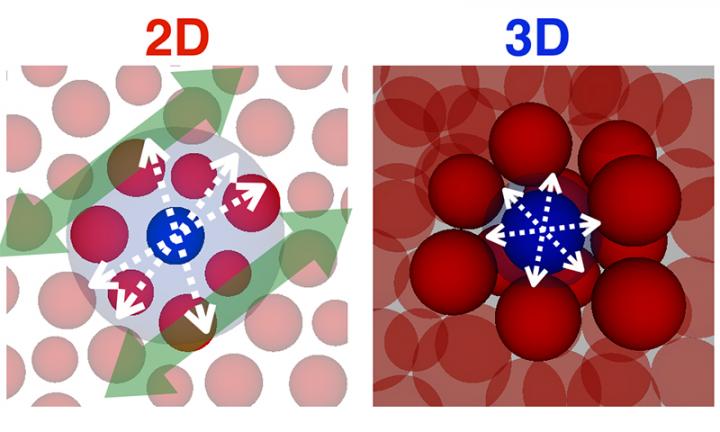
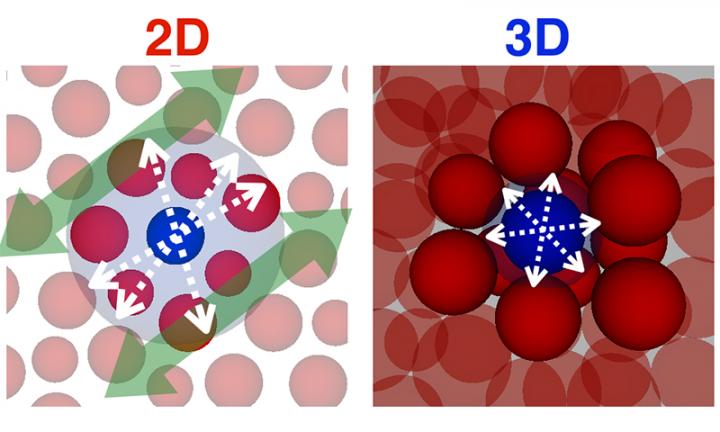
IMAGE

Credit: Hayato Shiba

Scientists in Japan have revealed that if a glassy solid possesses a planar (sheet-like) structure, it can exhibit enhanced thermal vibration motion due to the same mechanism known for the planar crystals (two-dimensional crystals), by using large-scale simulations on supercomputers.

"Imagine if we could make a sheet of glass, which has a two-dimensional (2D) planate shape," says Dr. Hayato Shiba, of Tohoku University's Institute for Materials Research (IMR). "In such a confined spatial dimension, a variety of novel phenomena takes place in usual "periodic" systems (crystals, spin systems etc.). This is due to the thermal motion of the constituents taking place on a larger scale because of the limited spatial dimensions."

Such enhanced thermal motion is known to induce new physical phenomena which Shiba, and his research team of Yasunori Yamada (IMR), Takeshi Kawasaki (Nagoya University) and Kang Kim (Osaka University), hope will lead the development of new functional materials and devices necessary for the realization of energy-saving societies.

However, it is still uncertain whether 2D glass, as an "non-periodic" system, exhibits such enhanced thermal motions.

"Our result indicates that 2D glass can become soft, gradually and forever, as we go to the macroscopic scales. Consequently, the vibration amplitude becomes infinite because of the large-scale motions," says Shiba.

"In other words, such materials might exhibit strong responses to external fields or deformation. The thermal vibration is perfectly different from that in a 3D glass, and it can even alter the fundamental nature of vitrification and glassy phase transition."

In the experiments, 2D glass was experimentally realized using colloidal systems, and can also be realized using other soft and hard materials.

###

Media Contact

Hayato Shiba
[email protected]
@TohokuUniPR

http://www.tohoku.ac.jp/en/

############

Story Source: Materials provided by Scienmag

Share12Tweet8Share2ShareShareShare2

Related Posts

Tracking Lanthanide-Labeled Microplastics in Plants

June 25, 2026

POSTECH Researchers Slash Cost of Reconstituted Cell-Free Systems by 95%

June 25, 2026

AI and Physics Collaborate to Design Advanced Hydrogen Storage Materials

June 25, 2026

Natural Hallucinogens: Evolution’s Ecological Tools, Not Mere Chemical Byproducts

June 25, 2026
Please login to join discussion

POPULAR NEWS

  • Saying Goodbye to PGY-6: Pediatric Fellowship Realities

    103 shares
    Share 41 Tweet 26
  • Multi-Hospital Study Reveals Long Covid Burden Is Twice as High as Current Estimates

    92 shares
    Share 36 Tweet 23
  • Detection of EDCs in Breast Milk and Infant Urine Up to Six Months Highlights Early Exposure Risks

    77 shares
    Share 31 Tweet 19
  • New Drug Candidate Developed at McMaster Shows Potential for Treating Brain Cancer

    58 shares
    Share 23 Tweet 15

About

We bring you the latest biotechnology news from best research centers and universities around the world. Check our website.

Follow us

Recent News

Tracking Lanthanide-Labeled Microplastics in Plants

POSTECH Researchers Slash Cost of Reconstituted Cell-Free Systems by 95%

AI and Physics Collaborate to Design Advanced Hydrogen Storage Materials

Subscribe to Blog via Email

Success! An email was just sent to confirm your subscription. Please find the email now and click 'Confirm' to start subscribing.

Join 82 other subscribers
  • Contact Us

Bioengineer.org © Copyright 2023 All Rights Reserved.

Welcome Back!

Login to your account below

Forgotten Password?

Retrieve your password

Please enter your username or email address to reset your password.

Log In
No Result
View All Result
  • Homepages
    • Home Page 1
    • Home Page 2
  • News
  • National
  • Business
  • Health
  • Lifestyle
  • Science

Bioengineer.org © Copyright 2023 All Rights Reserved.