• HOME
  • NEWS
  • EXPLORE
    • CAREER
      • Companies
      • Jobs
    • EVENTS
    • iGEM
      • News
      • Team
    • PHOTOS
    • VIDEO
    • WIKI
  • BLOG
  • COMMUNITY
    • FACEBOOK
    • INSTAGRAM
    • TWITTER
Sunday, May 10, 2026
BIOENGINEER.ORG
No Result
View All Result
  • Login
  • HOME
  • NEWS
  • EXPLORE
    • CAREER
      • Companies
      • Jobs
        • Lecturer
        • PhD Studentship
        • Postdoc
        • Research Assistant
    • EVENTS
    • iGEM
      • News
      • Team
    • PHOTOS
    • VIDEO
    • WIKI
  • BLOG
  • COMMUNITY
    • FACEBOOK
    • INSTAGRAM
    • TWITTER
  • HOME
  • NEWS
  • EXPLORE
    • CAREER
      • Companies
      • Jobs
        • Lecturer
        • PhD Studentship
        • Postdoc
        • Research Assistant
    • EVENTS
    • iGEM
      • News
      • Team
    • PHOTOS
    • VIDEO
    • WIKI
  • BLOG
  • COMMUNITY
    • FACEBOOK
    • INSTAGRAM
    • TWITTER
No Result
View All Result
Bioengineer.org
No Result
View All Result
Home NEWS Science News Chemistry

Study find physical weathering of rock breakdown more important than previously recognized

Bioengineer by Bioengineer
January 13, 2021
in Chemistry
Reading Time: 3 mins read
0
IMAGE
Share on FacebookShare on TwitterShare on LinkedinShare on RedditShare on Telegram

IMAGE

Credit: Sarah Granke

Research led by the University of Wyoming shows that physical weathering is far more important than previously recognized in the breakdown of rock in mountain landscapes. Because it is difficult to measure, physical weathering has commonly been assumed to be negligible in previous studies.

Cliff Riebe, a professor in UW’s Department of Geology and Geophysics, headed a research group that discovered that climate and erosion rates strongly regulate the relative importance of subsurface physical and chemical weathering of saprolite, the zone of weathered rock that retains the relative positions of mineral grains of the parent bedrock and lies between the layer of soil and harder rock underneath. Saprolite is much like the weathered granite found on the flat areas surrounding the hard granite of Vedauwoo.

“Our work shows that physical strain can no longer be ignored in studies of subsurface weathering. It’s not just a chemical process. It is physical as well,” Riebe says. “What we found is that anisovolumetric weathering is much more common than previously thought, and that variations in this process can be explained by climate and erosion.”

Riebe is lead author of a paper, titled “Anisovolumetric Weathering in Granitic Saprolite Controlled by Climate and Erosion Rates,” which was published in the Jan. 12 issue of Geology. The journal publishes timely, innovative and provocative articles relevant to its international audience, representing research from all fields of the geosciences.

The study looked at three sites — with differing climates and elevations of granitic bedrock — of the Sierra Nevada, a mountain range in California.

In the lingo of geochemists, weathering has long been assumed to be “isovolumetric,” meaning without a change in volume caused by physical strain.

“Our work shows that, to the contrary, weathering is commonly ‘anisovolumetric,’ meaning that strain caused by physical weathering is important,” Riebe says.

Riebe credits some of the tools and instruments that were purchased from the Wyoming Center for Environmental Hydrology and Geophysics (WyCEHG) EPSCoR (Established Program to Stimulate Competitive Research) project that ended a few years ago as the reason his team could measure both physical and chemical weathering at several sites in California.

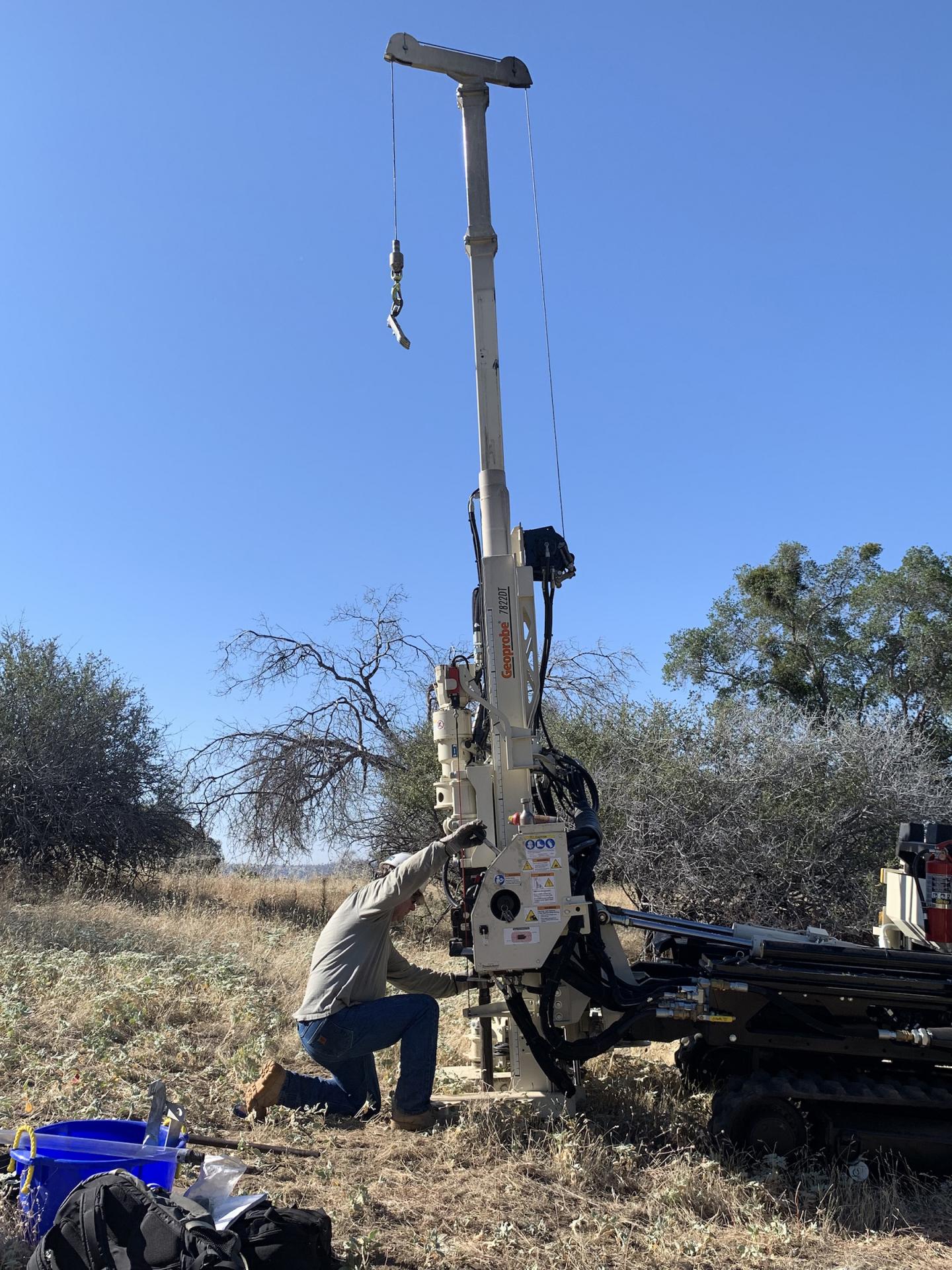
“The reason why weathering was difficult to measure in the past is you have to be able to access the deep subsurface and sample it without disturbing it,” Riebe explains. “You need a Geoprobe push coring system, which is basically a big track-mounted drill rig, to do this.

“It’s expensive work, especially if you do not happen to own a Geoprobe and have to hire someone to do the work,” he continues. “Fortunately, we have access to this equipment and the expertise to operate it through Wyoming’s Near Surface Geophysics facility, which is ably managed by Brad Carr, one of the study’s co-authors.”

The research was funded by grants from the National Science Foundation (NSF), NASA and the Natural Sciences and Engineering Research Council of Canada.

Riebe says there is a direct correlation between the research in this paper and the $5.33 million NSF grant he received last September. The grant focuses on connections among rock, water and life at Earth’s surface.

“This research is partly supported by that grant and also helped inspire it,” Riebe says.

###

Media Contact
Cliff Riebe
[email protected]

Original Source

http://www.uwyo.edu/uw/news/2021/01/uw-professor-leads-study-that-finds-physical-weathering-of-rock-breakdown-more-important-than-previously-recognized.html

Related Journal Article

http://dx.doi.org/10.1130/G48191.1

Tags: Climate ScienceEarth ScienceGeology/SoilGeophysics/GravityHydrology/Water Resources
Share12Tweet8Share2ShareShareShare2

Related Posts

Miniature Sensor Uses Light to Detect Touch — Chemistry

Miniature Sensor Uses Light to Detect Touch

May 8, 2026
Iron Minerals Determine Whether Dissolved Organic Matter Fuels Microbes or Becomes Long-Term Carbon Storage — Chemistry

Iron Minerals Determine Whether Dissolved Organic Matter Fuels Microbes or Becomes Long-Term Carbon Storage

May 8, 2026

Kate Evans Appointed Associate Lab Director for Biological and Environmental Systems Science at ORNL

May 8, 2026

Advancing Multiscale Modeling and Overcoming Operational Challenges in Autothermal COâ‚‚-to-Methanol Reactors

May 8, 2026
Please login to join discussion

POPULAR NEWS

  • Research Indicates Potential Connection Between Prenatal Medication Exposure and Elevated Autism Risk

    840 shares
    Share 336 Tweet 210
  • New Study Reveals Plants Can Detect the Sound of Rain

    727 shares
    Share 290 Tweet 181
  • Scientists Investigate Possible Connection Between COVID-19 and Increased Lung Cancer Risk

    68 shares
    Share 27 Tweet 17
  • Salmonella Haem Blocks Macrophages, Boosts Infection

    61 shares
    Share 24 Tweet 15

About

We bring you the latest biotechnology news from best research centers and universities around the world. Check our website.

Follow us

Recent News

Evaluating Digoxin Use in Patients with Symptomatic Rheumatic Heart Disease

Evaluating the Effectiveness and Safety of Digitalis Glycosides in Treating Heart Failure

Urdu Fall Risk Questionnaire Adapted for Elderly

Subscribe to Blog via Email

Enter your email address to subscribe to this blog and receive notifications of new posts by email.

Join 82 other subscribers
  • Contact Us

Bioengineer.org © Copyright 2023 All Rights Reserved.

Welcome Back!

Login to your account below

Forgotten Password?

Retrieve your password

Please enter your username or email address to reset your password.

Log In
No Result
View All Result
  • Homepages
    • Home Page 1
    • Home Page 2
  • News
  • National
  • Business
  • Health
  • Lifestyle
  • Science

Bioengineer.org © Copyright 2023 All Rights Reserved.