Credit: @Science China Press
With the rapid development of smart portable electronics and electric vehicles, the consumption of lithium resource will increase dramatically and the cost of lithium-ion batteries (LIBs) may increase significantly in the future. In addition, the shortage (0.0017 wt% in the earth’s crust) and uneven crustal distribution of lithium also limit its further development and application. As potassium (2.7 wt% in the earth’s crust) have properties similar to lithium and abundant reserves. Therefore, as an alternative to LIBs, potassium ion batteries (PIBs) have become the focus of research. Potassium (2.92 V vs. standard hydrogen electrode) has a standard electrode potential closer to Li (3.04 V vs. SHE) than the standard electrode potential of Na (2.71 V vs. SHE), Mg (2.37 V vs. SHE) and Al (1.66 V vs. SHE). This means that PIBs may provide a higher energy density and working voltage. Consequently, it is of great significance to explore excellent electrode materials and study their potassium storage mechanism.
Over billions of years, biological cells evolved effectively by natural selection and resulted in the creation of a variety of organisms, and cells such as human cells that can be regarded as perfect small systems. The structure of such cells is complex yet delicate with various well-coordinated structural components; for example, the cell membrane provides access to biomaterials and can discharge metabolic waste in a timely manner. Here we propose and demonstrate that such evolution-selected cells have important implications in the synthesis of battery materials.
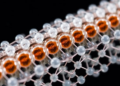
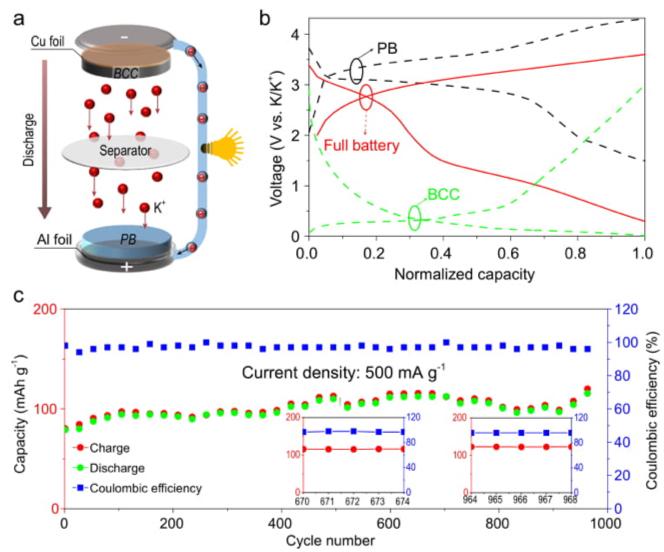
In a new research article published in the Beijing-based National Science Review, scientists at Hunan University, Central South University and Clemson University present a biomimetic carbon cells (BCCs) for robust potassium anode. Biomimetic carbon cells (BCCs) are composed of carbon sheets with high degree of graphitization and carbon nanotubes. Carbon nanotubes connect the inside and outside of carbon cells, providing a large number of ion channels. A large number of ion channels increase the diffusion path of ions and increase the transmission rate. The internal space possessed by the BCC provides a buffer for the volume change caused by the insertion of potassium ions into the graphite, carbon shell of the cell-like membrane can protect and support the internal materials and the overall structure, which greatly improves the cyclic stability of PIBs. The BCC-based electrodes demonstrated a superior cycling stability with a stable reversible capacity of 226 mAh g-1 after 2100 cycles at a current density of 500 mA g-1 and continuous running time of more than 15 months at a current density of 100 mA g-1. The present strategy provides a new way for the design and manufacture of new biomimetic battery materials in the future, and promotes collaborative research across multiple disciplines.
“Scientifically, we combine the biological field and the material synthesis field (biomimetic structure), and report the performance and stability of the synthesized carbon material as a potassium ion battery anode.” Prof. Bingan Lu said, “In a broader perspective, the study represents a new strategy for boosting the battery performance, and could pave the way for the next generation battery-powered applications.”
###
See the article:
Hongbo Ding, Jiang Zhou, Apparao M. Rao and Bingan Lu
Cell-like-carbon-micro-spheres for robust potassium anode
National Science Review, nwaa276, DOI: 10.1093/nsr/nwaa276
https:/
The National Science Review is the first comprehensive scholarly journal released in English in China that is aimed at linking the country’s rapidly advancing community of scientists with the global frontiers of science and technology. The journal also aims to shine a worldwide spotlight on scientific research advances across China.
Media Contact
Bingan Lu
[email protected]
Original Source
http://doi.
Related Journal Article
http://dx.