A novel material has been discovered that is characterized by the coupling of a charge density wave with the topology of the electronic structure
Credit: MPI of Microstructure Physics
Topological materials are characterised by unique electronic and physical properties that are determined by the underlying topology of their electronic systems. Scientists from the Max Planck Institutes for Microstructure Physics (Halle) and for Chemical Physics of Solids (Dresden) have now discovered that (TaSe4)2I is the first material in which a charge density wave induces a phase transition between the semimetal to insulator state.
An international team of scientists at the Max Planck Institute for Microstructure Physics, Halle (Saale), the Max Planck Institute for Chemical Physics of Solids in Dresden, Oxford University, Chinese Academy of Sciences, MIT, and Princeton University has discovered the first example of a correlation-driven topological semimetal to insulator phase transition in single crystals of the material (TaSe4)2I. Over the past few years there has been increasing interest in the field of topological materials that display unique electronic and physical properties derived from the underlying topology of their electronic systems. (TaSe4)2I is an unusual material which is known to undergo a structural distortion just below room temperature resulting from a charge density wave. Due to electron correlations the electron gas in the system becomes unstable to a long-range periodic variation of the electron charge density that is intimately coupled to a periodic modulation of the atomic positions in the crystal structure. At the same time this same material has been shown to be a topological metal of a particular type, namely a Weyl semi-metal. This type of topological metal has an electronic system that displays Weyl points where linearly dispersing electronic bands cross one another without forming an energy band gap. These Weyl points in (TaSe4)2I come in pairs, each of which has an opposite chirality, and the authors of the paper show that (TaSe4)2I has 24 pairs of such points with a corresponding enormous so-called chiral charge of +16.
In the study published in the journal Nature Physics, using a set of sophisticated experimental probes of the electronic and crystal structure, the international team, whose members include experimentalists Claudia Felser, Director at the Max Planck Institute for Chemical Physics of Solids , Holger Meyerheim, a researcher, and Stuart Parkin, Director, at the Max Planck Institute for Microstructure Physics, Yulin Chen from Oxford University, and theorist Andrei Bernevig from Princeton University, showed that the topological properties of this compound are intimately connected to the charge density wave, whose wave-vector is derived from the connections between Weyl points of opposite chiral charge.
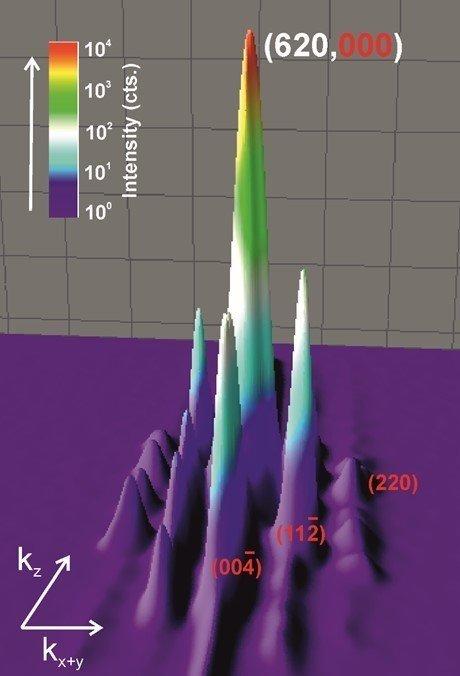
“It was very challenging, but very exciting, to identify the charge density wave in this material. We needed to use very brilliant x-ray sources available, for example, at the European Synchrotron Radiation Facility, Grenoble, to find the very weak diffraction peak signatures of the charge density wave”, Meyerheim pointed out. As the sample is cooled down strong electron correlations drive the system into the charge density wave state resulting in a transition from a topological Weyl semi-metal to an insulator. At the same time, new physics, reported in a previous paper by the same groups, appears below the transition.
“Who would have believed that we would have found such sophisticated correlated electron physics in such a 1D material”, remarks Felser. This work shows an intimate connection between topology and correlations and provides an avenue to observing condensed-matter realizations of axion electrodynamics – a novel type of coupling between electric and magnetic fields – in a regime that was previously inaccessible. While this is a first example, “our calculations of the electronic structures of many materials makes us certain that there must be many more such systems where correlations and topology intertwine” remarked Bernevig and “we are excited to look for them in experiments”, added Yulin. By manipulating the onset of the charge density wave one can gain direct access to the Topological Weyl Semimetal – Axion Insulator transition. “These materials are a rich playground for potential applications in future electronic devices, a new field of what you might call “topaxtronics!” Stuart Parkin predicts.
###
Original publication
Wujun Shi, Benjamin J. Wieder, Holger L. Meyerheim, Yan Sun, Yang Zhang Yiwei Li, Lei Shen, Yanpeng Qi, Lexian Yang, Jagannath Jena, Peter Werner, Klaus Koepernik, Stuart Parkin, Yulin Chen, Claudia Felser, B. Andrei Bernevig
A charge-density-wave topological semimetal
Nature Physics (2021)
Published 04 January 2021
Media Contact
Prof. Dr. Claudia Felser
[email protected]
Original Source
https:/
Related Journal Article
http://dx.