Credit: Jeremy Michalek
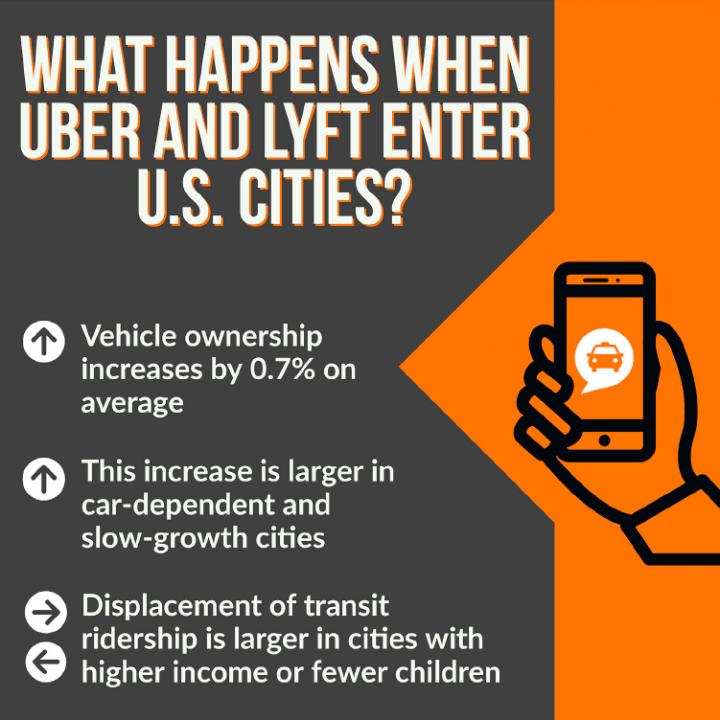
When ridesourcing companies Uber and Lyft show up in urban areas, vehicle registrations per capita increase by 0.7% on average, increasing even more in car-dependent cities. Researchers reporting in the journal iScience on January 6 made this discovery by analyzing data from major US cities between 2011 to 2017, comparing trends in cities where Uber and Lyft entered with those where they didn’t. They also found that Uber and Lyft displace transit more in cities with higher income and fewer children.
“I would have expected people to own fewer vehicles once they gain access to this alternative transportation mode,” says Jeremy Michalek, a professor of engineering and public policy at Carnegie Mellon University and co-author on the study. “But that’s not what we see in the data. One possible explanation could be that there’s an effect on the other side, where somebody who was on the verge of being able to afford a vehicle now has an incentive to buy one and earn some money with it. So vehicle adoption by Uber and Lyft drivers may outweigh the effect of riders getting rid of their personal vehicles.”
The researchers also investigated the impact of ridesourcing services on transit use. While there wasn’t a significant effect on average, they did find that cities with higher income and fewer children see a bigger reduction in transit use.
“What this suggests to me is that in a city where people have disposable income and fewer children, they don’t mind paying more for a more convenient mode of transportation, and they don’t have to worry about logistics like bringing a car seat,” says Michalek.
While the researchers were able to identify trends across cities in their data analysis, they are also interested in investigating how these trends stack up in specific cities. Additionally, their analysis only accounts for pre-pandemic patterns that have certainly changed because of COVID-19.
“Of course, the pandemic has caused enormous changes in ridesourcing, public transit, and transportation trends in general. With many employees working from home, and many others opting to use personal vehicles for travel, ridesourcing services have seen a drop in riders,” says Michalek. “The question is, once the pandemic is behind us, do we return to the kinds of travel patterns and choices we saw before the pandemic, or are there systemic changes that won’t go back to normal because people have permanently changed their behavior? We won’t know for sure until it happens.”
###
The authors were supported by the National Science Foundation, the U.S Environmental Protection Agency, the Alfred P. Sloan Foundation, the U.S. Department of Energy, and Carnegie Mellon University.
iScience, Michalek et al.: “The Impact of Uber and Lyft on Vehicle Ownership, Fuel Economy & Transit Across US Cities”
https://www.cell.com/iscience/fulltext/S2589-0042(20)31130-5
iScience (@iScience_CP) is an open-access journal from Cell Press that provides a platform for original research and interdisciplinary thinking in the life, physical, and earth sciences. The primary criterion for publication in iScience is a significant contribution to a relevant field combined with robust results and underlying methodology. Visit: http://www.
Media Contact
Miles Martin
[email protected]
Related Journal Article
http://dx.