• HOME
  • NEWS
  • EXPLORE
    • CAREER
      • Companies
      • Jobs
    • EVENTS
    • iGEM
      • News
      • Team
    • PHOTOS
    • VIDEO
    • WIKI
  • BLOG
  • COMMUNITY
    • FACEBOOK
    • INSTAGRAM
    • TWITTER
Monday, April 6, 2026
BIOENGINEER.ORG
No Result
View All Result
  • Login
  • HOME
  • NEWS
  • EXPLORE
    • CAREER
      • Companies
      • Jobs
        • Lecturer
        • PhD Studentship
        • Postdoc
        • Research Assistant
    • EVENTS
    • iGEM
      • News
      • Team
    • PHOTOS
    • VIDEO
    • WIKI
  • BLOG
  • COMMUNITY
    • FACEBOOK
    • INSTAGRAM
    • TWITTER
  • HOME
  • NEWS
  • EXPLORE
    • CAREER
      • Companies
      • Jobs
        • Lecturer
        • PhD Studentship
        • Postdoc
        • Research Assistant
    • EVENTS
    • iGEM
      • News
      • Team
    • PHOTOS
    • VIDEO
    • WIKI
  • BLOG
  • COMMUNITY
    • FACEBOOK
    • INSTAGRAM
    • TWITTER
No Result
View All Result
Bioengineer.org
No Result
View All Result
Home NEWS Science News Biology

Invasive in the U.S., lifesaver Down Under

Bioengineer by Bioengineer
December 21, 2020
in Biology
Reading Time: 2 mins read
0
IMAGE
Share on FacebookShare on TwitterShare on LinkedinShare on RedditShare on Telegram

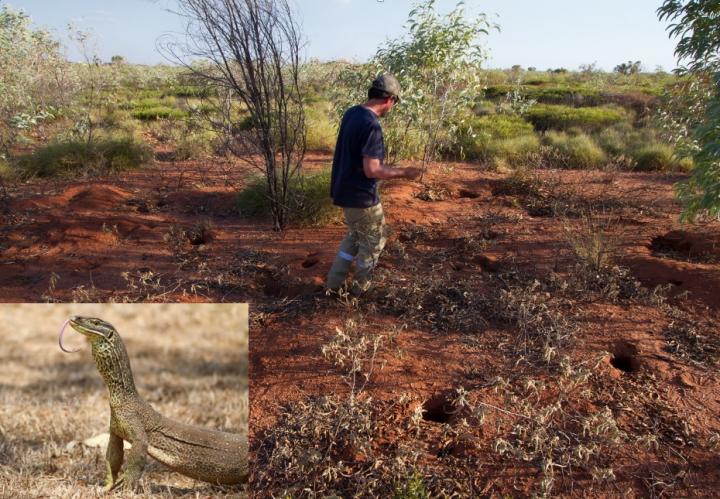
New study uncovers the ecological engineering capabilities of the monitor lizard
IMAGE

Credit: University of South Florida

Ten years of research led by the University of South Florida has revealed that a monitor lizard should be regarded as an “ecosystem engineer,” a rarity for reptiles. Tortoises and sea turtles are the only reptiles considered to be ecosystem engineers, a term used to describe organisms that have a great impact on their environment based on their ability to create, modify, maintain or destroy a habitat. Sean Doody, assistant professor and graduate director of integrative biology at the USF St. Petersburg campus, discovered that while a related species is considered invasive in the United States, in Australia, small animal communities rely on the monitor lizards’ burrow system, called a warren, using it as a habitat, a place to forage for food and nesting.

In his study published in Ecology, Doody and his Australian collaborators investigated the nesting biology of the Yellow-Spotted monitor lizard, which can measure nearly five feet, and its smaller, sister species, the Gould’s monitor lizard. The team had recently discovered that the lizards are unique in that they lay their eggs as deep as 13 feet, easily the deepest vertebrate nests on earth. They loosen the soil, creating warm, moist conditions, which are ideal for laying eggs and trapping viable seeds and fruits. But now, the researchers have discovered that the burrows hosted a wide range of animals, including reptiles, frogs, insects and even marsupial mammals. The team found 747 individual species of 28 types of vertebrates.

The timing of the research revealed clues as to why certain species utilized the warrens. For example, throughout the winter dry season, the researchers found hibernating frogs using the burrows to maintain their body moisture. During one excavation, Doody and his team discovered 418 individual frogs in a single warren.

“The finding is significant as it shows that nesting warrens provide critical shelter and other resources for the small animal community,” Doody said. “The invasive cane toad is decimating the monitor lizards in some areas, meaning that these nesting warrens, which are re-used year after year, will disappear. This can impact the relative number of predators and prey, which can have unexpected consequences for the ecosystem, such as an overabundance of one species at the cost of another, which in other systems has threatened species with local extinction.

The arrival of the toxic cane toad emphasized the extent of the monitor lizard’s impact on the food web. In studies conducted between 2009 and 2017, Doody’s research team uncovered abandoned burrows and an increase in the lizard’s prey, including smaller lizards, snakes, turtles and birds. Australian researchers and natural resource managers have been unable to successfully control cane toads.

Doody is now expanding his research to include the perentie, another large monitoring lizard that likely nests at great depths in the Australian desert, to see if it too should be deemed an ecological engineer. His team is also looking at how climate warming will impact the facilitation of these animal communities.

###

Media Contact
Tina Meketa
[email protected]

Tags: Biology
Share12Tweet8Share2ShareShareShare2

Related Posts

Zinc, Immune Stress, and COVID-19: MT2A Identified as a Key Cross-Compartment Marker Associated with Disease Severity

Zinc, Immune Stress, and COVID-19: MT2A Identified as a Key Cross-Compartment Marker Associated with Disease Severity

April 6, 2026
Halt the Inflammatory Cascade: Xuebijing’s Role in Safeguarding the Lung Barrier During Acute Lung Injury

Halt the Inflammatory Cascade: Xuebijing’s Role in Safeguarding the Lung Barrier During Acute Lung Injury

April 6, 2026

A Rare Cause of Cryptorchidism: Recognizing Persistent Müllerian Duct Syndrome

April 6, 2026

Drug–Microbiome Interactions Affect Parkinson’s Medications

April 6, 2026
Please login to join discussion

POPULAR NEWS

  • blank

    Revolutionary AI Model Enhances Precision in Detecting Food Contamination

    97 shares
    Share 39 Tweet 24
  • Promising Outcomes from First Clinical Trials of Gene Regulation in Epilepsy

    51 shares
    Share 20 Tweet 13
  • Imagine a Social Media Feed That Challenges Your Views Instead of Reinforcing Them

    1009 shares
    Share 399 Tweet 249
  • Popular Anti-Aging Compound Linked to Damage in Corpus Callosum, Study Finds

    44 shares
    Share 18 Tweet 11

About

We bring you the latest biotechnology news from best research centers and universities around the world. Check our website.

Follow us

Recent News

Sonar-Enabled Stock Smartwatches Pave the Way for Breakthroughs in Hand-Tracking Technology

Genetics, Medication, Lifestyle in Epilepsy-Related Obesity

Zinc, Immune Stress, and COVID-19: MT2A Identified as a Key Cross-Compartment Marker Associated with Disease Severity

Subscribe to Blog via Email

Enter your email address to subscribe to this blog and receive notifications of new posts by email.

Join 78 other subscribers
  • Contact Us

Bioengineer.org © Copyright 2023 All Rights Reserved.

Welcome Back!

Login to your account below

Forgotten Password?

Retrieve your password

Please enter your username or email address to reset your password.

Log In
No Result
View All Result
  • Homepages
    • Home Page 1
    • Home Page 2
  • News
  • National
  • Business
  • Health
  • Lifestyle
  • Science

Bioengineer.org © Copyright 2023 All Rights Reserved.