Credit: @Science China Press
Waveguides and resonators are core components in electronics, photonics, and phononics, both in existing and future scenarios. In certain situations (space or frequency), critical coupling can occur between the two components, i.e., no energy passes through the waveguide after the incoming wave is coupled into the resonator. The transmission spectral characteristics resulting from this phenomenon are highly advantageous for signal filtering, switching, multiplexing, sensing, etc. However, under the existing mechanism, the occurrence of critical couplings always leads to increased reflection in the input channel due to the inevitable backscattering in practical. These reflection will further induce both intra- and interchannel crosstalk (noise) in an integrated system, whose accumulation will tend to generate large performance degradations, or even result in rapid failure of system functions. Unlike the electronic system, a passive integrated photonic or phononic diode has not been put into practical use thus far, although massive notable attempts have been made. Therefore, avoiding input reflections, especially in spectral functional devices, poses a challenge for further development of integrated photonic or phononic circuitry.
Recently, Yu and his colleagues at Nanjing University have designed a brand-new waveguide-resonator by using the principle of topological insulator (TI), which solves the above “input reflection” problem fundamentally. As a major achievement in condensed matter physics since this century, TI materials are promising to create future high-performance electronics and computers, since electrons with spin ±½ at the TI boundaries are lossless one-way conducting as they are moving on a superhighway. By constructing artificial spin ±½, photonic and phononic TIs also have been proposed and created in recent years, offering revolutionarily waveguides for photons and phonons with spin-direction locking at the TI boundaries. Photon/phonons transports on these waveguides are backscattering-free to defects such as fabrication imperfections or arbitrary bends, without any losses induced to their transmission energy.
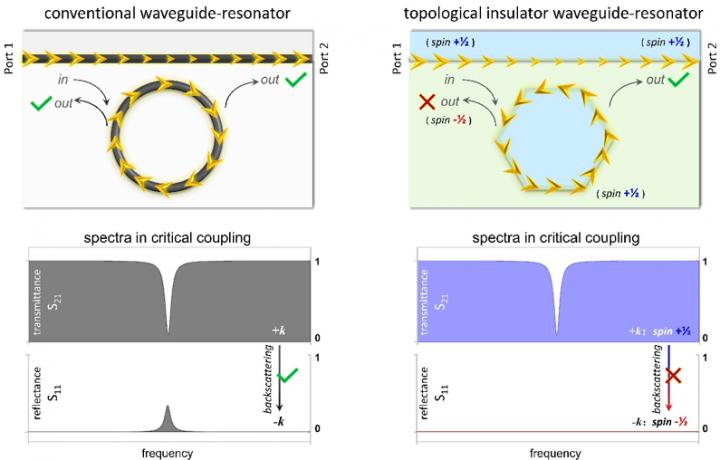
Following these ideal waveguides, a thought-provoking application-driven question is whether spectral functions can be implemented inside them. Specifically, it is asked whether there is a resonator solution that matches these TI waveguides. An effective way is to wrap the TI waveguides themselves into closed loops, creating TI ring-resonators like whispering galleries in many acoustic and optical scenarios. The research at Nanjing University found that, unlike conventional ring resonators, a TI ring-resonator unavoidably supports two kinds of modes simultaneously, i.e., travelling-wave whispering-gallery modes (WGMs) and split standing wave modes (SWMs). In the TI resonator, these two kinds of modes support different spin quantum numbers (±½ and 0), respectively, thus need to meet different conditions for critical coupling to the TI waveguide.
When a TI-SWM resonator is coupled to a TI waveguide, because the spin-less SWM (spin 0) can be converted with both forward (with spin +½) and backward (with spin -½) modes in the TI waveguide, even if the initial state of the whole system has only one arbitrary spin (+½, 0, or -½), eventually, all three spins (+½, 0, and -½) can be excited. Consequently, there is always input reflection when critical coupling occurs, similar to conventional scenarios. Advantageously, when a TI-WGM resonator is coupled to a TI waveguide, because both of them support the same spins ±½ locked with wave direction, if the initial state of the system has only one spin, then back reflections with the opposite spin are unable to be excited, even in the case of critical coupling. The latter critical coupling is of particular favorable because when it meets: 1) reflections and induced noise are completely eliminated while the required transmission spectral characteristics are retained and 2) the incident energy is bound entirely inside the resonator with no channel through which to exit, resulting in an extremely high energy capacity/density. All these advantages make the TI waveguide-resonator exceed the performance of all conventional designs.
This research provides strong support for applying the principle of topological insulator to practical device performance and functionalities. It opens an avenue for integrated topological photonics and phononics for e.g., advanced signal processing, sensing, lasering, in both classical and quantum regions.
###
See the article:
Critical couplings in topological-insulator waveguide-resonator systems observed in elastic waves
https:/
Media Contact
Si-Yuan Yu
[email protected]
Related Journal Article
http://dx.