Credit: Hemanth Gudapati, Penn State
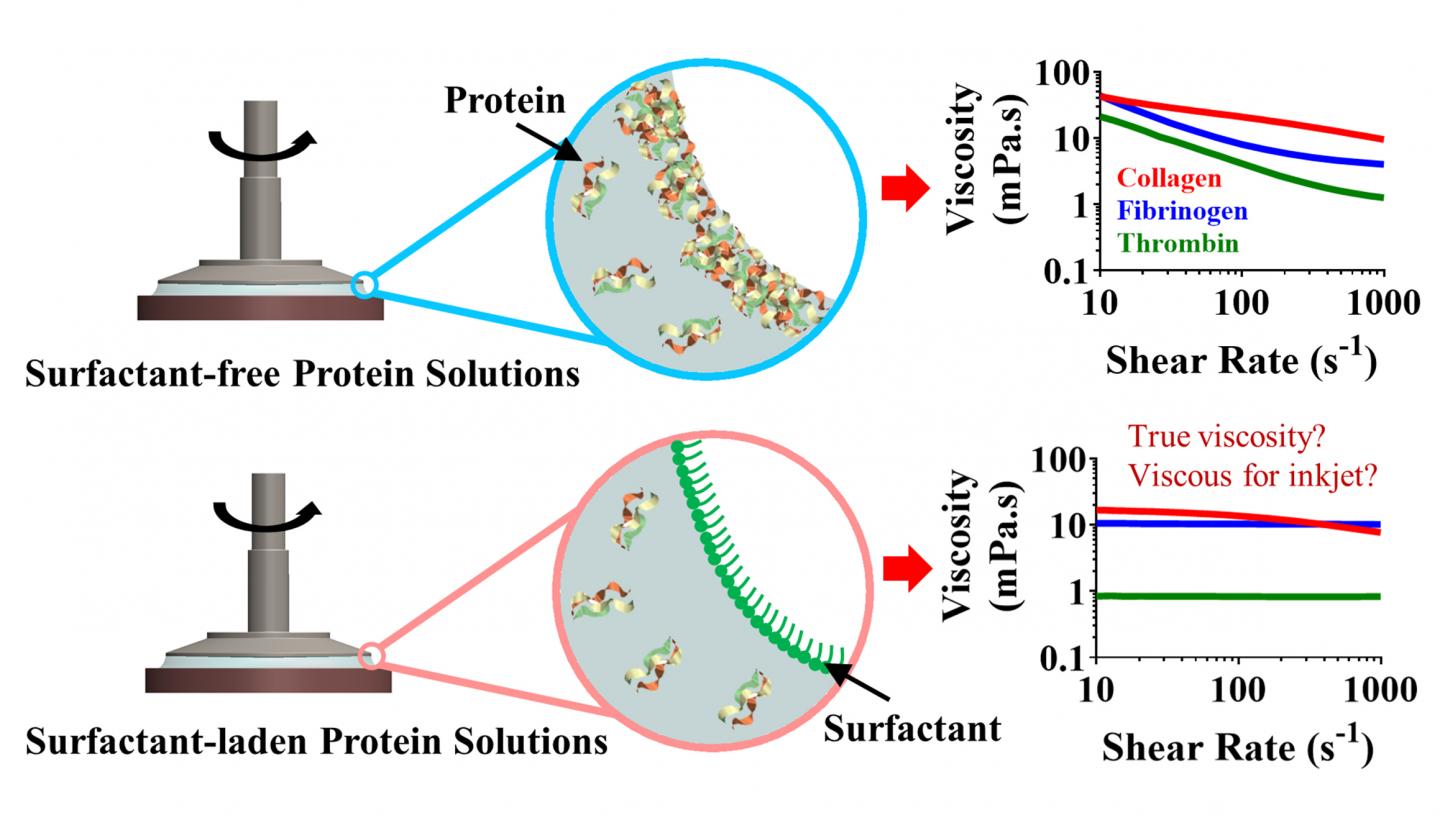
Fibrous proteins such as collagen and fibrinogen form a thin solid layer on the surface of an aqueous solution similar to the “skin” that forms on warm milk, according to a team of Penn State Researchers, who believe this finding could lead to more efficient bioprinting and tissue engineering.
In the human body, fibrous proteins provide structural support for cells and tissues and aid in biomechanics. Collagen makes up 80% of our skin and 10% of our muscles, while fibrinogen helps in blood clotting by forming the hydrogel fibrin.
“Collagen and fibrinogen protein solutions are widely used as precursors of collagen and fibrin hydrogels in tissue engineering applications,” said Hemanth Gudapati, graduate student in engineering science and mechanics. “This is because collagen and fibrin, which are used as structural materials for tissue engineering similar to their role in the human body, are nontoxic, biodegradable and mimics the natural microenvironments of cells.”
Gudapati and fellow researchers report, in Soft Matter, for the first time that fibrous proteins form a solid layer on the surface of water due to aggregation of proteins at the air/water interface. This solid layer interferes with accurate measurements of the solution’s rheology, which is the study of fluid properties such as flow. Previously, it was only demonstrated that the other main type of protein, globular proteins, formed these solid layers at the air/water interface.
Accurate rheology measurements are vital for successful bioprinting. Measurement of viscosity is important for identifying what protein solutions are potentially printable, and for detecting inconsistencies in flow behavior among different batches of fibrous proteins.
“Collagen and fibrinogen are extracted from animals, and their flow behavior changes from batch to batch and with time,” Gudapati said.
This in turn leads to a challenge for consistent bioprinting results.
“Accurate measurement of flow behavior helps in reliable or consistent delivery of the protein solutions during bioprinting,” Gudapati said. “This helps in fabrication of things such as reliable organ-on-chip devices and disease models.”
A potential solution for accurate measurement is to add a surfactant such as polysorbate 80 to prevent the formation of film at the air/water interface.
The research also identifies the concentrations of protein solutions which are potentially printable via inkjet bioprinting, along with identifying bioprinting operating parameters.
Gudapati said there were other findings in their research that will require further investigation. These included the possibility that the aggregated fibrous proteins at the air/water interface may get released from the interface and that these protein aggregates may cause further accumulation of the proteins in the solutions.
“The further bulk aggregation could be one of the reasons for poor alignment of collagen fibers or poor mechanical strength of fibrin outside the body, i.e., in vitro, which are the challenges facing tissue engineering applications at present,” Gudapati said.
The work was done in the lab of Ibrahim Ozbolat, Hartz Family Career Development Associate Professor of Engineering Science and Mechanics, in collaboration with Ralph Colby, professor of materials science and engineering and chemical engineering.
“Dr. Colby’s work with globular protein solutions influenced our work,” Gudapati said. “For example, we realized that the fibrous proteins could be behaving similar to globular proteins at the air/water interface at the beginning of our research.”
###
Along with Colby, Ozbolat and Gudapati, other authors of the Soft Matter paper include Daniele Parisi, graduate student in materials science and engineering.
The Osteology Foundation in Switzerland, the Hartz Family Career Development Professorship in Engineering and the Penn State Department of Engineering Science and Mechanics supported this research.
Media Contact
A’ndrea Elyse Messer
[email protected]
Related Journal Article
http://dx.