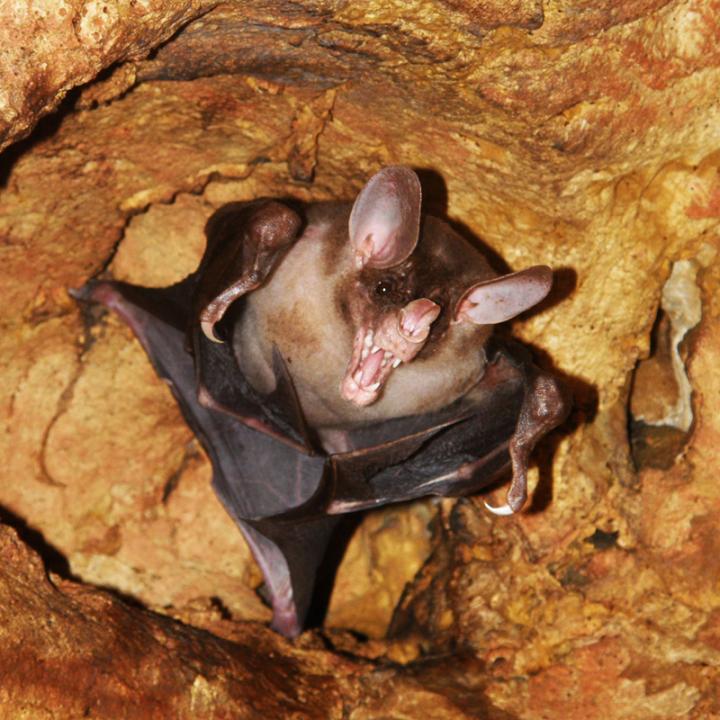
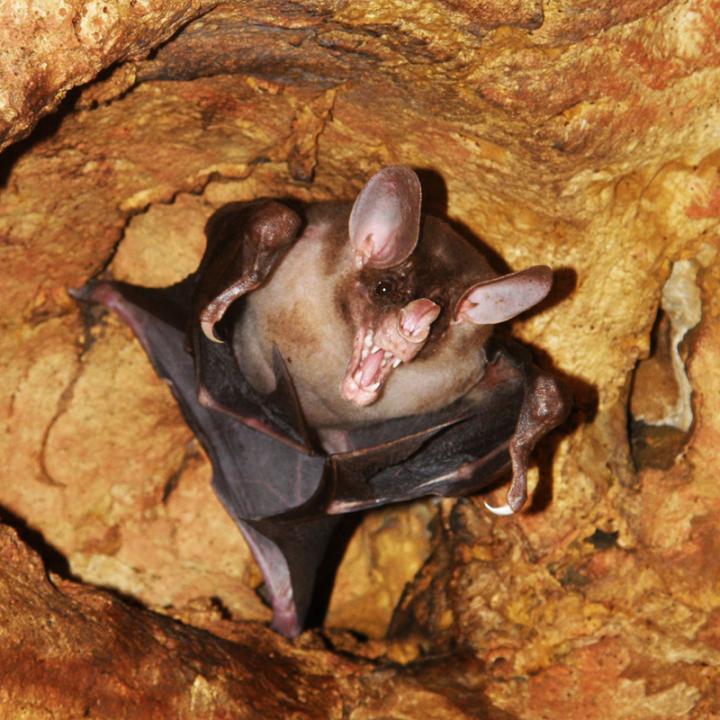
Credit: Vladimir Dinets, research assistant professor of psychology at the University of Tennessee, Knoxville.
KNOXVILLE–Spectral bats, also called false vampire bats for their imposing size–with a wingspan of over three feet–are the largest bats in the Americas and typically roost in trees in lowland forests.
Vladimir Dinets, research assistant professor of psychology at the University of Tennessee, Knoxville, has discovered evidence that the species also can live in caves and is more adaptable than previously thought, thanks to personal observation and information gleaned from social media accounts of tourists.
The study was recently published in the journal Mammalia.
Dinets initially came upon a spectral bat in 2008 while exploring bat caves in Utila, a small island off the coast of Honduras populated by descendants of 16th-century British pirates. He found the bat in one of the caves, hanging from the ceiling. Underneath it was a pile of bones and feathers, which were leftovers of the bat's meals.
He photographed the bat and moved on. He didn't realize how unusual his find was until a few years later, when he read a book on Central American bats and learned that spectral bats had never before been found in caves.
Dinets began looking for more information and found that the bat he photographed had become a tourist attraction. Utila is a popular scuba diving destination, and a local tour company advertised trips to the cave to see the predator. Dinets combed through tourists' online photos of the animal and concluded that the bat was the same one he had photographed, based on the distinctive pattern of spots on the bat's ears. This gave him data on its longevity, and he knew the spectral bat had been roosting in exactly the same spot for eight years.
"This is the first bit of data on this species' longevity in the wild," Dinets said. "All photos are from February, March or April, suggesting that for the rest of the year the bat migrates elsewhere. Until now spectral bats were believed to be sedentary. Nobody has ever seen another spectral bat on Utila — so it is possible that only one animal visits the island, because normally spectral bats are found in family groups."
Spectral bats are typically found in undisturbed primary rainforests. Yet Utila contains only secondary forests, plantations and pastures.
"It looks like this species is more adaptable than previously thought, which is a good thing because much of its rainforest habitat is being destroyed," Dinets said.
He added that because so many people today visit remote locations and take countless photos, their accounts become more and more useful to scientists.
"Browsing social networks might be almost as productive for a scientist as traveling," Dinets said. "Although I'd rather travel myself."
###
CONTACT:
Lola Alapo (865-974-3993, [email protected])
Vladimir Dinets ([email protected])
Media Contact
Lola Alapo
[email protected]
865-974-3993
@UTKnoxville
############
Story Source: Materials provided by Scienmag