• HOME
  • NEWS
  • EXPLORE
    • CAREER
      • Companies
      • Jobs
    • EVENTS
    • iGEM
      • News
      • Team
    • PHOTOS
    • VIDEO
    • WIKI
  • BLOG
  • COMMUNITY
    • FACEBOOK
    • INSTAGRAM
    • TWITTER
Tuesday, August 11, 2026
BIOENGINEER.ORG
No Result
View All Result
  • Login
  • HOME
  • NEWS
  • EXPLORE
    • CAREER
      • Companies
      • Jobs
        • Lecturer
        • PhD Studentship
        • Postdoc
        • Research Assistant
    • EVENTS
    • iGEM
      • News
      • Team
    • PHOTOS
    • VIDEO
    • WIKI
  • BLOG
  • COMMUNITY
    • FACEBOOK
    • INSTAGRAM
    • TWITTER
  • HOME
  • NEWS
  • EXPLORE
    • CAREER
      • Companies
      • Jobs
        • Lecturer
        • PhD Studentship
        • Postdoc
        • Research Assistant
    • EVENTS
    • iGEM
      • News
      • Team
    • PHOTOS
    • VIDEO
    • WIKI
  • BLOG
  • COMMUNITY
    • FACEBOOK
    • INSTAGRAM
    • TWITTER
No Result
View All Result
Bioengineer.org
No Result
View All Result
Home NEWS Science News

Scientists discover a new complex europium hydride

Bioengineer by Bioengineer
December 15, 2020
in Science News
Reading Time: 2 mins read
0
IMAGE
Share on FacebookShare on TwitterShare on LinkedinShare on RedditShare on Telegram

IMAGE

Credit: Dmitrii V. Semenok et al/The Journal of Physical Chemistry Letters

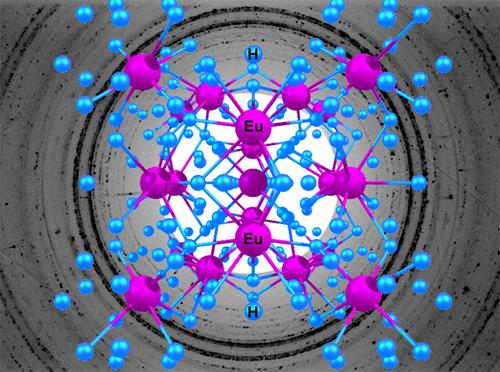
A team of researchers from Russia, the United States, and China led by Skoltech Professor Artem R. Oganov has discovered an unexpected very complex europium hydride, Eu8H46. The paper detailing the discovery has been published in The Journal of Physical Chemistry Letters.

Superhydrides of rare-earth metals are interesting compounds that form under pressure: some exhibit high-temperature superconductivity that scientists have been chasing for over 100 years, and some possess magnetic properties. Although devoid of superconductivity, europium hydrides are very interesting in view of chemical anomalies that make europium different from other rare-earth atoms.

Armed with the efficient and reliable USPEX crystal structure prediction tool developed by Oganov and his students, the team predicted the structure of the remarkably complex compound, Eu8H46, which helped understand and explain experimental data.

“I am pleasantly surprised that USPEX has easily predicted a highly complex structure of 54 atoms, which is quite a lot. Curiously enough, our colleagues obtained this hydride in an experiment earlier but got the structure and composition wrong, assuming it was EuH5. Now we know that the compound is much trickier,” Oganov comments.

“Such unusual compounds can be predicted in theory and proved by experiment, but there is no simple rule for identifying probable chemical compositions of stable compounds without performing arduous calculations,” says Dmitrii Semenok, the first author of the paper and a PhD student at Skoltech.

###

Artem R. Oganov is a Professor at Skoltech, a member of Academia Europaea, a Fellow of the Royal Society of Chemistry, a Fellow of the American Physical Society, a Fellow of the Mineralogical Society of America, and a Professor of the Russian Academy of Sciences.

Media Contact
Ilyana Zolotareva
[email protected]

Original Source

https://www.skoltech.ru/en/2020/12/scientists-discover-a-new-complex-europium-hydride/

Related Journal Article

http://dx.doi.org/10.1021/acs.jpclett.0c03331

Tags: Algorithms/ModelsAtomic/Molecular/Particle PhysicsChemistry/Physics/Materials SciencesComputer ScienceMaterialsMathematics/StatisticsResearch/DevelopmentSoftware Engineering
Share12Tweet8Share2ShareShareShare2

Related Posts

Biomedical Imaging Foundation Models: Separating Hype from Reality

August 11, 2026

SELENOF and unfolded protein response crosstalk determines breast epithelial cell fate

August 11, 2026

Brain Lipid Imbalances Differentiate Parkinson’s Disease from Multiple System Atrophy

August 11, 2026

Plasma protein signatures linked to extubation outcomes in extremely premature infants

August 11, 2026
Please login to join discussion

POPULAR NEWS

  • Biomedical Imaging Foundation Models: Separating Hype from Reality

    29 shares
    Share 12 Tweet 7
  • SELENOF and unfolded protein response crosstalk determines breast epithelial cell fate

    29 shares
    Share 12 Tweet 7
  • Brain Lipid Imbalances Differentiate Parkinson’s Disease from Multiple System Atrophy

    29 shares
    Share 12 Tweet 7
  • Plasma protein signatures linked to extubation outcomes in extremely premature infants

    29 shares
    Share 12 Tweet 7

About

We bring you the latest biotechnology news from best research centers and universities around the world. Check our website.

Follow us

Recent News

Biomedical Imaging Foundation Models: Separating Hype from Reality

SELENOF and unfolded protein response crosstalk determines breast epithelial cell fate

Brain Lipid Imbalances Differentiate Parkinson’s Disease from Multiple System Atrophy

Subscribe to Blog via Email

Enter your email address to subscribe to this blog and receive notifications of new posts by email.

Join 86 other subscribers
  • Contact Us

Bioengineer.org © Copyright 2023 All Rights Reserved.

Welcome Back!

Login to your account below

Forgotten Password?

Retrieve your password

Please enter your username or email address to reset your password.

Log In
No Result
View All Result
  • Homepages
    • Home Page 1
    • Home Page 2
  • News
  • National
  • Business
  • Health
  • Lifestyle
  • Science

Bioengineer.org © Copyright 2023 All Rights Reserved.