• HOME
  • NEWS
  • EXPLORE
    • CAREER
      • Companies
      • Jobs
    • EVENTS
    • iGEM
      • News
      • Team
    • PHOTOS
    • VIDEO
    • WIKI
  • BLOG
  • COMMUNITY
    • FACEBOOK
    • INSTAGRAM
    • TWITTER
Tuesday, December 23, 2025
BIOENGINEER.ORG
No Result
View All Result
  • Login
  • HOME
  • NEWS
  • EXPLORE
    • CAREER
      • Companies
      • Jobs
        • Lecturer
        • PhD Studentship
        • Postdoc
        • Research Assistant
    • EVENTS
    • iGEM
      • News
      • Team
    • PHOTOS
    • VIDEO
    • WIKI
  • BLOG
  • COMMUNITY
    • FACEBOOK
    • INSTAGRAM
    • TWITTER
  • HOME
  • NEWS
  • EXPLORE
    • CAREER
      • Companies
      • Jobs
        • Lecturer
        • PhD Studentship
        • Postdoc
        • Research Assistant
    • EVENTS
    • iGEM
      • News
      • Team
    • PHOTOS
    • VIDEO
    • WIKI
  • BLOG
  • COMMUNITY
    • FACEBOOK
    • INSTAGRAM
    • TWITTER
No Result
View All Result
Bioengineer.org
No Result
View All Result
Home NEWS Science News Chemistry

‘Chaotic’ way to create insectlike gaits for robots

Bioengineer by Bioengineer
December 15, 2020
in Chemistry
Reading Time: 3 mins read
0
IMAGE
Share on FacebookShare on TwitterShare on LinkedinShare on RedditShare on Telegram

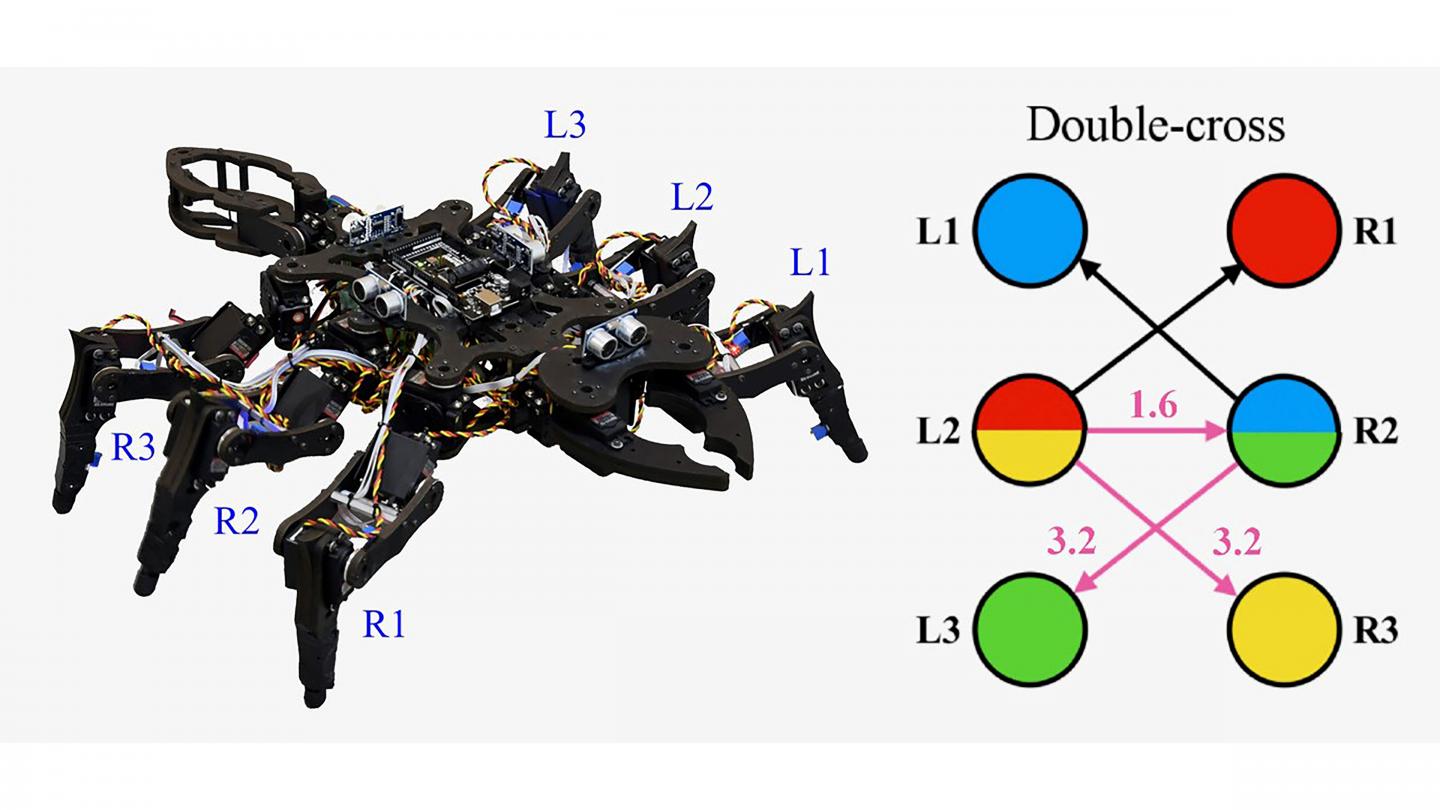
By using small networks of Rössler systems, a locomotion controller enables a brain-machine interface for a six-legged antlike robot.
IMAGE

Credit: Ludovico Minati

WASHINGTON, December 15, 2020 — Researchers in Japan and Italy are embracing chaos and nonlinear physics to create insectlike gaits for tiny robots — complete with a locomotion controller to provide a brain-machine interface.

Biology and physics are permeated by universal phenomena fundamentally grounded in nonlinear physics, and it inspired the researchers’ work.

In the journal Chaos, from AIP Publishing, the group describes using the Rössler system, a system of three nonlinear differential equations, as a building block for central pattern generators (CPGs) to control the gait of a robotic insect.

“The universal nature of underlying phenomena allowed us to demonstrate that locomotion can be achieved via elementary combinations of Rössler systems, which represent a cornerstone in the history of chaotic systems,” said Ludovico Minati, of Tokyo Institute of Technology and the University of Trento.

Phenomena related to synchronization allow the group to create very simple networks that generate complex rhythmic patterns.

“These networks, CPGs, are the basis of legged locomotion everywhere within nature,” he said.

The researchers started with a minimalistic network in which each instance is associated with one leg. Changing the gait or creating a new one can be accomplished by simply making small changes to the coupling and associated delays.

In other words, irregularity can be added by making individual systems or the entire network more chaotic. For nonlinear systems, a change of output is not proportional to a change of input.

This work shows that the Rössler system, beyond its many interesting and intricate properties, “can also be successfully used as a substrate to construct a bioinspired locomotion controller for an insect robot,” Minati said.

Their controller is built with an electroencephalogram to enable a brain-computer interface.

“Neuroelectrical activity from a person is recorded and nonlinear concepts of phase synchronization are used to extract a pattern,” said Minati. “This pattern is then used as a basis to influence the dynamics of the Rössler systems, which generate the walking pattern for the insect robot.”

The researchers tap into the fundamental ideas of nonlinear dynamics twice.

“First, we use them to decode biological activity, then in the opposite direction to generate bioinspired activity,” he said.

The key implication of this work is that it “demonstrates the generality of nonlinear dynamic concepts such as the ability of the Rössler system, which is often studied in an abstract scenario,” Minati said, “but is used here as a basis to generate biologically plausible patterns.”

###

The article, “Generation of diverse insect-like gait patterns using networks of coupled Rössler systems,” is authored by Shunki Kitsunai, Woorim Cho, Chihiro Sano, Supat Saetia, Zixuan Qin, Yasuharu Koike, Mattia Frasca, Natsue Yoshimura, and Ludovico Minati. The article will appear in Chaos on Dec. 15, 2020 (DOI: 10.1063/5.0021694). After that date, it can be accessed at https://aip.scitation.org/doi/10.1063/5.0021694.

ABOUT THE JOURNAL

Chaos is devoted to increasing the understanding of nonlinear phenomena in all areas of science and engineering and describing their manifestations in a manner comprehensible to researchers from a broad spectrum of disciplines. See https://aip.scitation.org/journal/cha.

Media Contact
Larry Frum
[email protected]

Related Journal Article

http://dx.doi.org/10.1063/5.0021694

Tags: BiologyChemistry/Physics/Materials SciencesMathematics/StatisticsRobotry/Artificial IntelligenceSystems/Chaos/Pattern Formation/ComplexityTechnology/Engineering/Computer Science
Share12Tweet8Share2ShareShareShare2

Related Posts

Cutting Electrolyte Reduction Boosts High-Energy Battery Performance

Cutting Electrolyte Reduction Boosts High-Energy Battery Performance

December 19, 2025
Microenvironment Shapes Gold-Catalysed CO2 Electroreduction

Microenvironment Shapes Gold-Catalysed CO2 Electroreduction

December 11, 2025

Photoswitchable Olefins Enable Controlled Polymerization

December 11, 2025

Cation Hydration Entropy Controls Chloride Ion Diffusion

December 10, 2025
Please login to join discussion

POPULAR NEWS

  • Nurses’ Views on Online Learning: Effects on Performance

    Nurses’ Views on Online Learning: Effects on Performance

    70 shares
    Share 28 Tweet 18
  • NSF funds machine-learning research at UNO and UNL to study energy requirements of walking in older adults

    71 shares
    Share 28 Tweet 18
  • Unraveling Levofloxacin’s Impact on Brain Function

    54 shares
    Share 22 Tweet 14
  • Exploring Audiology Accessibility in Johannesburg, South Africa

    51 shares
    Share 20 Tweet 13

About

We bring you the latest biotechnology news from best research centers and universities around the world. Check our website.

Follow us

Recent News

A Decade of Progress in Eating Disorder Research

Sustainable Farming Solutions Amid Climate Change Challenges

Unraveling Naringin’s Toxic Effects on Liver Injury

Subscribe to Blog via Email

Enter your email address to subscribe to this blog and receive notifications of new posts by email.

Join 70 other subscribers
  • Contact Us

Bioengineer.org © Copyright 2023 All Rights Reserved.

Welcome Back!

Login to your account below

Forgotten Password?

Retrieve your password

Please enter your username or email address to reset your password.

Log In
No Result
View All Result
  • Homepages
    • Home Page 1
    • Home Page 2
  • News
  • National
  • Business
  • Health
  • Lifestyle
  • Science

Bioengineer.org © Copyright 2023 All Rights Reserved.