Credit: TalTech
Modern warfare is day by day shifting away from man-to-man combat towards electronic warfare. The end result of military operations is increasingly dependent on the high-tech equipment available to the military and the ability to use the equipment.
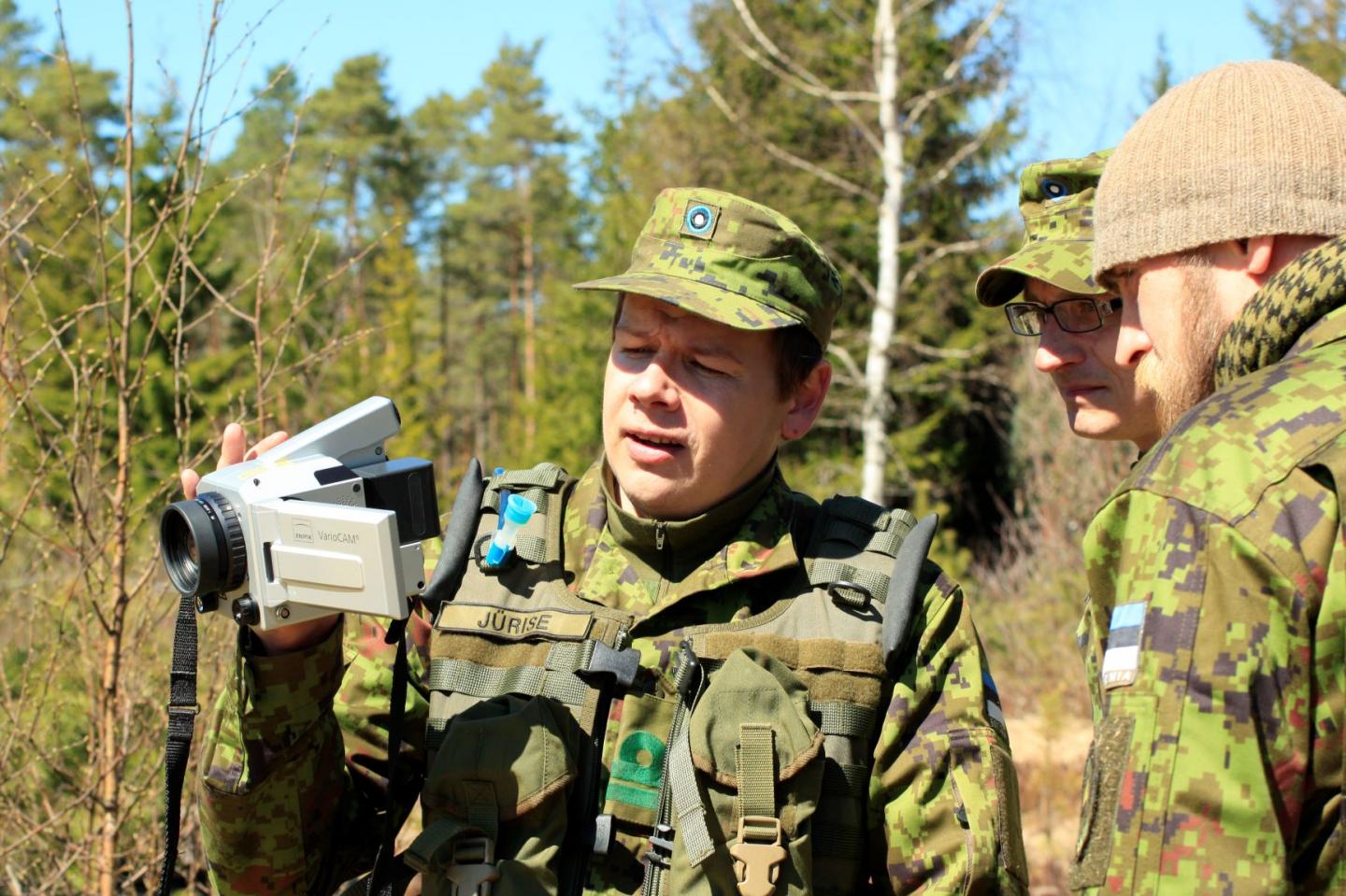
Recently Martin Jürise defended his doctoral thesis “Hyperspectral Signatures of Military Objects in Battlefield, Radiation Field and Information Field Integrated Model” at TalTech Department of Mechanical and Industrial Engineering.
“The aim of the doctoral thesis was to assess the equipment of the Defence Forces from the viewpoint of modern electronic warfare and its masking quality in the field of view of high-tech cameras and sensors. To this end, the PhD student carried out numerous experimental measurements in field exercises using a high-tech hyperspectral camera. In the course of the experiments, signatures of military objects of the Defence Forces were collected and compared with the typical natural background in Estonia,” said the supervisor of the doctoral thesis, Programme Director of Product Development and Robotics at TalTech Department of Mechanical and Industrial Engineering Raivo Sell.
A hyperspectral signature is a set of spectral characteristics obtained of the objects being observed. Hyperspectral signatures are generated as a result of reflectance of objects with respect to wavelengths in a wide range of the spectrum invisible to the human eye.
For example, a military camouflage uniform used for concealment is difficult to spot by human eye in natural conditions, but modern hyperspectral imaging cameras find the object easily and, in case of the right signatures, are able to identify the object even from a distance of several kilometers.
Raivo Sell said, “As the price range of such special cameras is relatively high (60,000-200,000 euros), they are not widely used. One such camera purchased with support from Enterprise Estonia (EAS) is in use at TalTech School of Engineering and was also employed to carry out the doctoral thesis. Since it is an expensive technological device, the Estonian Defence Forces cannot purchase it for use in the battlefield just like that. At the same time, it can be assumed that our opponent’s military forces can afford employment of these special cameras. Therefore, the Estonian Defence Forces should have at least basic knowledge of the mechanism of such surveillance activities.
The hyperspectral signatures of objects measured and analysed in the doctoral thesis allow mapping of the entire technical and masking equipment of the Defence Forces.
“The Estonian Defence Forces can take advantage of the results of the test carried out for the first time in Estonia e.g. upon purchasing their equipment and uniforms and improving their masking quality. It was also found, for example, that the wear of equipment caused by exposure to weather, which can be invisible to the human eye, increases significantly the visibility of the equipment to hyperspectral cameras,” Raivo Sell said.
The data presented in the doctoral thesis were collected in the military training exercises of the Estonian Defence Forces carried out in the years 2015-2020. In this period, the Estonian Defence Forces conducted nine field exercises and three laboratory experiment series. As a result of the doctoral thesis, a novel compact model COMSPECT for green vegetation reflection spectrum modelling in the wavelength range 400 nm – 900 nm was developed. The model may be used in compact form with four parameters defined and also in a maximally compact form with only two most important parameters defined.
###
The supervisors of the doctoral thesis were Raivo Sell from the Department of Mechanical and Industrial Engineering and Andres Udal from the Department of Software Sciences. The doctoral thesis is for internal use only and is not accessible to the public. An abstract and additional information are available in the TalTech digital collection 05.11.2020: https:/
Additional information: Programme Director of Product Development and Robotics at TalTech Department of Mechanical and Industrial Engineering Raivo Sell, [email protected]
Kersti Vähi, TalTech Research Administration Office
Media Contact
Raivo Sell
[email protected]