• HOME
  • NEWS
  • EXPLORE
    • CAREER
      • Companies
      • Jobs
    • EVENTS
    • iGEM
      • News
      • Team
    • PHOTOS
    • VIDEO
    • WIKI
  • BLOG
  • COMMUNITY
    • FACEBOOK
    • INSTAGRAM
    • TWITTER
Saturday, February 7, 2026
BIOENGINEER.ORG
No Result
View All Result
  • Login
  • HOME
  • NEWS
  • EXPLORE
    • CAREER
      • Companies
      • Jobs
        • Lecturer
        • PhD Studentship
        • Postdoc
        • Research Assistant
    • EVENTS
    • iGEM
      • News
      • Team
    • PHOTOS
    • VIDEO
    • WIKI
  • BLOG
  • COMMUNITY
    • FACEBOOK
    • INSTAGRAM
    • TWITTER
  • HOME
  • NEWS
  • EXPLORE
    • CAREER
      • Companies
      • Jobs
        • Lecturer
        • PhD Studentship
        • Postdoc
        • Research Assistant
    • EVENTS
    • iGEM
      • News
      • Team
    • PHOTOS
    • VIDEO
    • WIKI
  • BLOG
  • COMMUNITY
    • FACEBOOK
    • INSTAGRAM
    • TWITTER
No Result
View All Result
Bioengineer.org
No Result
View All Result
Home NEWS Science News Chemistry

Using light, red blood cells and a honey bee peptide to deliver therapeutic proteins

Bioengineer by Bioengineer
December 9, 2020
in Chemistry
Reading Time: 2 mins read
0
IMAGE
Share on FacebookShare on TwitterShare on LinkedinShare on RedditShare on Telegram

IMAGE

Credit: Adapted from ACS Central Science 2020, DOI: 10.1021/acscentsci.0c01151

Protein therapies are often more potent and selective toward their biochemical targets than other types of drugs, particularly small molecules. However, proteins are also more likely to be quickly degraded by enzymes or cleared from blood by the kidneys, which has limited their clinical use. Now, researchers reporting in ACS Central Science have engineered red blood cell (RBC) carriers that release therapeutic proteins when stimulated by light, with the help of a honey bee peptide.

Because protein drugs are unstable in the body, they must be given at high levels, which can cause side effects. Scientists have tried to protect protein therapies from degradation by encapsulating them in carriers, such as liposomes, nanoparticles and RBCs. But it has been challenging to make the carriers release their cargo at the appropriate place and time. Brianna Vickerman, David Lawrence and colleagues wanted to engineer RBCs to release therapeutic proteins at specific regions of the body when triggered by certain wavelengths of light.

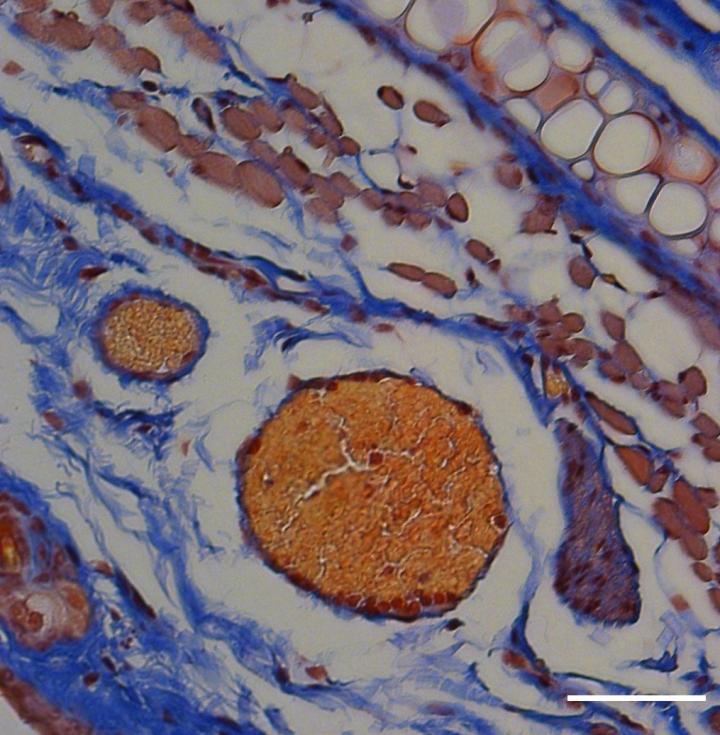
The researchers embedded a peptide, called melittin, into the cell membrane of RBCs. A component of European honey bee venom, melittin normally causes RBCs to rupture. But the team modified the peptide so that it would do so only when illuminated by a specific wavelength of light. As a proof of concept, the researchers loaded thrombin — a blood-clotting enzyme that is used to prevent excessive bleeding — into the engineered RBCs and injected them into mice. They then shone a light on a small region of each mouse’s ear and examined sections of the tissue. The analysis showed thrombin-related blood clotting only at the illuminated sites. The strategy could prove useful for the light-triggered release of protein, peptide and nucleic acid therapeutics from a variety of lipid-based carriers, the researchers say.

###

The authors acknowledge funding from the Eshelman Institute for Innovation and the American Heart Association.

The paper’s abstract will be available on December 9 at 8 a.m. Eastern time here: http://pubs.acs.org/doi/abs/10.1021/acscentsci.0c01151

The American Chemical Society (ACS) is a nonprofit organization chartered by the U.S. Congress. ACS’ mission is to advance the broader chemistry enterprise and its practitioners for the benefit of Earth and its people. The Society is a global leader in providing access to chemistry-related information and research through its multiple research solutions, peer-reviewed journals, scientific conferences, eBooks and weekly news periodical Chemical & Engineering News. ACS journals are among the most cited, most trusted and most read within the scientific literature; however, ACS itself does not conduct chemical research. As a specialist in scientific information solutions (including SciFinder® and STN®), its CAS division powers global research, discovery and innovation. ACS’ main offices are in Washington, D.C., and Columbus, Ohio.

To automatically receive news releases from the American Chemical Society, contact [email protected].

Follow us: Twitter | Facebook

Media Contact
Katie Cottingham
[email protected]

Tags: BiochemistryChemistry/Physics/Materials SciencesGenesHematologyPharmaceutical ChemistryPharmaceutical SciencePharmaceutical SciencesPharmaceutical/Combinatorial Chemistry
Share12Tweet8Share2ShareShareShare2

Related Posts

blank

Breakthrough in Environmental Cleanup: Scientists Develop Solar-Activated Biochar for Faster Remediation

February 7, 2026
blank

Cutting Costs: Making Hydrogen Fuel Cells More Affordable

February 6, 2026

Scientists Develop Hand-Held “Levitating” Time Crystals

February 6, 2026

Observing a Key Green-Energy Catalyst Dissolve Atom by Atom

February 6, 2026
Please login to join discussion

POPULAR NEWS

  • Robotic Ureteral Reconstruction: A Novel Approach

    Robotic Ureteral Reconstruction: A Novel Approach

    82 shares
    Share 33 Tweet 21
  • Digital Privacy: Health Data Control in Incarceration

    63 shares
    Share 25 Tweet 16
  • Study Reveals Lipid Accumulation in ME/CFS Cells

    57 shares
    Share 23 Tweet 14
  • Breakthrough in RNA Research Accelerates Medical Innovations Timeline

    53 shares
    Share 21 Tweet 13

About

We bring you the latest biotechnology news from best research centers and universities around the world. Check our website.

Follow us

Recent News

Evaluating Pediatric Emergency Care Quality in Ethiopia

TPMT Expression Predictions Linked to Azathioprine Side Effects

Improving Dementia Care with Enhanced Activity Kits

Subscribe to Blog via Email

Success! An email was just sent to confirm your subscription. Please find the email now and click 'Confirm' to start subscribing.

Join 73 other subscribers
  • Contact Us

Bioengineer.org © Copyright 2023 All Rights Reserved.

Welcome Back!

Login to your account below

Forgotten Password?

Retrieve your password

Please enter your username or email address to reset your password.

Log In
No Result
View All Result
  • Homepages
    • Home Page 1
    • Home Page 2
  • News
  • National
  • Business
  • Health
  • Lifestyle
  • Science

Bioengineer.org © Copyright 2023 All Rights Reserved.