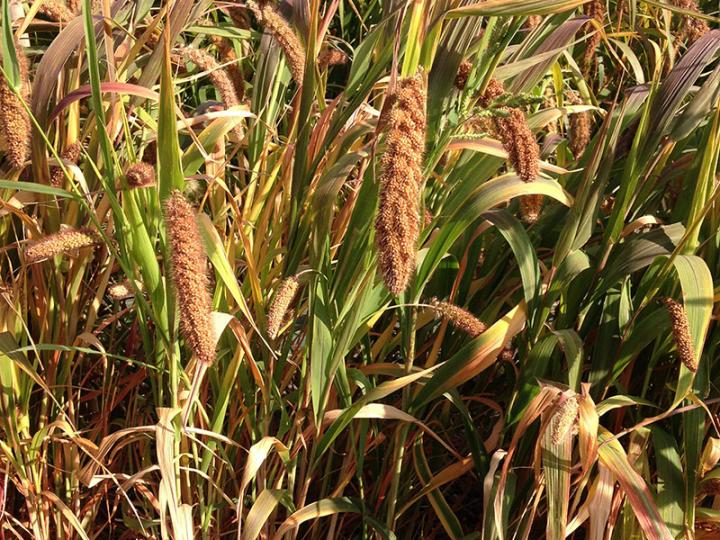
Credit: Devin Coleman-Derr
Drought stress has been a major roadblock in crop success, and this obstacle will not disappear anytime soon. Luckily, a dynamic duo like Batman and Robin, certain root-associated microbes and the plants they inhabit, are here to help.
Plants and animals have a close connection to the microbes like bacteria living on them. The microbes, the creatures they inhabit, and the environment they create all play a critical role for life on Earth.
“We know that microbiomes, which are the communities of microorganisms in a given environment, are very important for the health of plants,” said Devin Coleman-Derr.
Coleman-Derr, a scientist at University of California, Berkeley, studies how drought impacts the microbiome of sorghum. He recently presented his research at the virtual 2020 ASA-CSSA-SSSA Annual Meeting.
Findings show that certain bacteria living in the roots of sorghum, a crop commonly grown for animal feed, work together with the plant to reduce drought stress. This unique pairing leads to overall plant success.
“Plants have hormones, which help plants decide how to spend their energy,” says Coleman-Derr. “Microbes can manipulate the system and cause the decision-making process of plants to be altered.”
Some bacteria and fungi are destined to inhabit certain plants. And, bacteria want the roots they inhabit to be their dream homes. If a bacterium partners with a plant to help it grow during dry weather, it is essentially building a better home for itself.
Virtually all aspects of the plant’s life are connected to the microbes present. When a plant gets thirsty, it can send the entire microbiome into action.
Drought causes dramatic changes in how bacteria and plant partners interact. Additional bacteria may be recruited to help the plant survive the dry weather. These microbes can influence the plant’s hormones to encourage more root growth, which will help the plant reach more water.
“We want to know if we can control this,” said Coleman-Derr. “Is there the possibility to manipulate the microbiome present to help sorghum cope with drought stress?”
The resiliency of crops to environmental stress is of growing concern to both researchers and farmers, especially with the changes in global climates. New research findings are important to develop crops that can maintain productivity, even in harsher conditions.
“We recognize that the microbiome is dynamic and changes over time,” said Coleman-Derr. “While the jury is still out on if we can control sorghum microbiomes, several labs have shown that some bacteria present during drought stress lead to positive outcomes for plants.”
Understanding plant microbiomes is a large part of determining factors of crop productivity. Fortunately, plants are excellent models for studying microbiomes.
The next step in this quest is to determine if microbiomes can be manipulated and used as a solution for drought in crop production systems.
“By determining if we can alter the microbiome, we can work towards achieving our goal of creating better producing crops with less inputs,” said Coleman-Derr.
###
Devin Coleman-Derr is a researcher for the Department of Plant and Microbial Biology at University of California, Berkeley. This research was supported by the United States Department of Agriculture Agricultural Research Service and the United States Department of Energy. The ASA-CSSA-SSSA Annual Meeting was hosted by the American Society of Agronomy, Crop Science Society of America, and Soil Science Society of America.
Media Contact
Rachel Schutte
[email protected]