High-sensitivity, optically pumped magnetometers are used in a wide array of applications from monitoring magnetic disturbances in near space to detecting neural activity
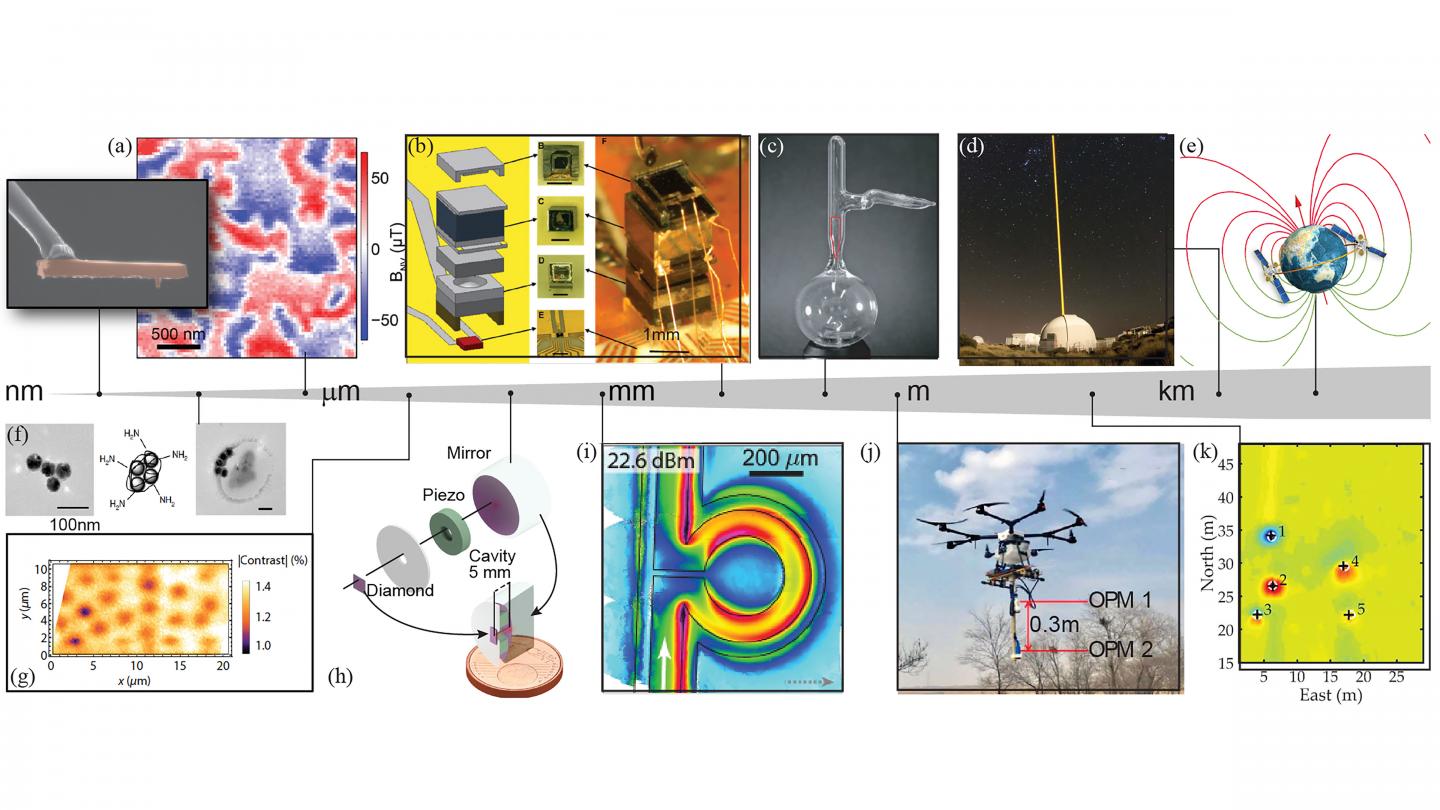
Credit: Arne Wickenbrock
WASHINGTON, December 8, 2020 — Researchers routinely measure magnetic fields to better understand a vast array of natural phenomena including geological movements, solar flares, neuronal communication in the brain, and molecular-scale chemical processes.
Many state-of-the-art magnetic field measurements are performed in shielded environments with carefully controlled conditions. Yet significant advances in magnetometer sensitivity have also been accompanied by serious attempts to bring these magnetometers into challenging working environments.
In AVS Quantum Science, by AIP Publishing, researchers from the University of Washington, Johannes Gutenberg-Universitat, and the University of California, Berkeley provide an overview of how the research community has achieved these sensitive measurements in extreme environments as well as outside of highly controlled environments. The researchers discuss ways in which various predominantly optically pumped magnetometer technologies have been adapted for use in a wide range of noisy and physically demanding environments.
“You will see some images and discussion of magnetometer deployments that are not commonly seen in standard scientific journal articles,” said author Kai-Mei Fu. “We wanted to highlight all the things that can go ‘wrong’ in order to motivate the deployment of the tools and tricks the community has developed to mitigate these challenges.”
While magnetometers with high sensitivity are attractive for measuring minute signals, experimenters must also contend with the environment in which the measurement will be made.
The researchers explore relevant magnetic noise sources that are ubiquitous in the laboratory, field, and urban environments, such as a car passing or an elevator moving. The researchers explore the common techniques to enhance the signal and reduce the noise, shedding light on emerging hybrid sensors in which correlating different sensor modalities may be particularly useful when dealing with challenging environments.
The researchers examine the physical challenges presented in practical, high-sensitivity magnetometry, particularly in one of the major areas of magnetometry, the study of materials. For these studies, sensors must be able to operate in extreme temperatures, from extreme heat to cryogenic cold, and in pressures ranging from very high to very low.
They also explore magnetometry at the cellular level, because significant interest has arisen in the use of magnetometry to study biological processes and biomolecular structures of living organisms, including magnetometry of the brain, nerves, and muscle.
“The current breadth of applications in optically pumped magnetometers is truly vast — from monitoring magnetic disturbances in near space to detecting neural activity,” said Fu. “We hope that this review would provide the reader with a set of general and specific ideas of how to meet various diverse challenges arising in the way of real-life precision magnetic or other measurements.”
###
The article, “Sensitive magnetometry in challenging environments,” is authored by Kai-Mei C. Fu, Geoffrey Z. Iwata, Arne Wickenbrock, and Dmitry Budker. The article will appear in AVS Quantum Science on Dec. 8, 2020 (DOI: 10.1116/5.0025186). After that date, it can be accessed at https:/
ABOUT THE JOURNAL
AVS Quantum Science, co-published by AIP Publishing and AVS, is a truly intradisciplinary journal that reaches from its foundations in quantum science into a breadth of areas from condensed matter and atomic, molecular and optical physics, to biology, chemistry, and materials science, as well as computer science and engineering. The journal places a strong emphasis on focused and comprehensive reviews and features perspectives and original research.
ABOUT AVS
AVS is an interdisciplinary, professional society with some 4,500 members worldwide. Founded in 1953, AVS hosts local and international meetings, publishes four journals, serves members through awards, training and career services programs and supports networking among academic, industrial, government, and consulting professionals. Its members come from across the fields of chemistry, physics, biology, mathematics, engineering and business and share a common interest in basic science, technology development and commercialization related to materials, interfaces, and processing. https:/
Media Contact
Larry Frum
[email protected]
Related Journal Article
http://dx.