• HOME
  • NEWS
  • EXPLORE
    • CAREER
      • Companies
      • Jobs
    • EVENTS
    • iGEM
      • News
      • Team
    • PHOTOS
    • VIDEO
    • WIKI
  • BLOG
  • COMMUNITY
    • FACEBOOK
    • INSTAGRAM
    • TWITTER
Monday, August 17, 2026
BIOENGINEER.ORG
No Result
View All Result
  • Login
  • HOME
  • NEWS
  • EXPLORE
    • CAREER
      • Companies
      • Jobs
        • Lecturer
        • PhD Studentship
        • Postdoc
        • Research Assistant
    • EVENTS
    • iGEM
      • News
      • Team
    • PHOTOS
    • VIDEO
    • WIKI
  • BLOG
  • COMMUNITY
    • FACEBOOK
    • INSTAGRAM
    • TWITTER
  • HOME
  • NEWS
  • EXPLORE
    • CAREER
      • Companies
      • Jobs
        • Lecturer
        • PhD Studentship
        • Postdoc
        • Research Assistant
    • EVENTS
    • iGEM
      • News
      • Team
    • PHOTOS
    • VIDEO
    • WIKI
  • BLOG
  • COMMUNITY
    • FACEBOOK
    • INSTAGRAM
    • TWITTER
No Result
View All Result
Bioengineer.org
No Result
View All Result
Home NEWS Science News

The world’s smallest high-performance magnetic tunnel junction

Bioengineer by Bioengineer
December 8, 2020
in Science News
Reading Time: 2 mins read
0
IMAGE
Share on FacebookShare on TwitterShare on LinkedinShare on RedditShare on Telegram

IMAGE

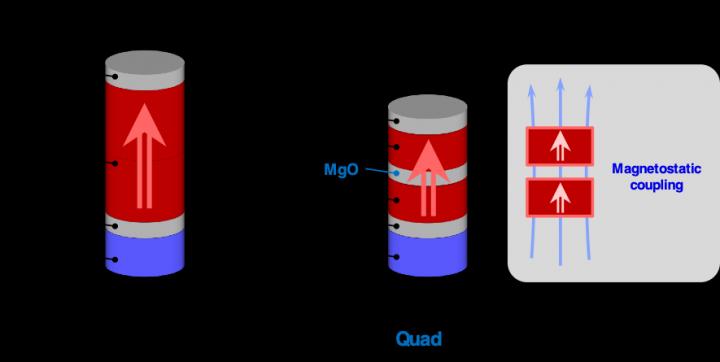
Credit: Butsurin Jinnai and Shunsuke Fukami

A research group from Tohoku University led by current president Hideo Ohno has developed the world’s smallest (2.3 nm) high-performance magnetic tunnel junctions (MTJs). This work is expected to accelerate the advancement of ultrahigh-density, low-power, high-performance non-volatile memory for a variety of applications, such as IoT, AI, and automobiles.

The development of STT-MRAM–non-volatile spintronics memory–helps reduce the increasing power consumption in semiconductor device scaling. Crucial to integrating STT-MRAM in advanced integrated circuits is scaling magnetic tunnel junction–a core component of STT-MRAM–while improving its performance in data retention and write operation.

Shape-anisotropy MTJ, proposed by the same group in 2018, has shown MTJ scaling down to single-digit nanometers while achieving sufficient data-retention (thermal-stability) properties. In the shape-anisotropy MTJ, thermal stability is enhanced by making the ferromagnetic layer thick. Once the thickness goes beyond a certain point, however, device reliability becomes degraded.

To address the issue in the conventional shape-anisotropy MTJ with a single ferromagnetic structure [Fig. 1(a)], the group employed a new structure that uses magnetostatically coupled multilayered ferromagnets [Fig. 1(b)]. The developed MTJs were successfully scaled down to 2.3 nm in diameter -the world’s smallest MTJ size. They also exhibited high data retention properties up to 200°C and high-speed and low-voltage write operation down to 10 ns below 1 V at a single-digit-nanometer scale.

“The performance proves the developed MTJs’ capability to work with the future-generation advanced integrated circuits,” said Butsurin Jinnai, first author of the study. “Because of its material compatibility with the standard MTJ material system, CoFeB/MgO, the proposed MTJ structure can be easily adopted in existing MTJ technology.” The group believes that this will speed up the development of ultrahigh-density, low-power, high-performance memory for a variety of applications, such as IoT, AI, and automobiles.

###

Media Contact
Shunsuke Fukami
[email protected]

Original Source

https://www.tohoku.ac.jp/en/press/worlds_smallest_high_peformance_mtj.html

Tags: Computer ScienceTechnology/Engineering/Computer Science
Share12Tweet8Share2ShareShareShare2

Related Posts

Pilot Study Examines Personal Care Use, Social Media Engagement Among NJ Students

August 17, 2026
KAIST develops semiconductor neuron that harnesses noise to selectively process signals

KAIST develops semiconductor neuron that harnesses noise to selectively process signals

August 16, 2026

Imagining natural and extra robotic thumbs together strengthens kinesthetic sensorimotor networks

August 16, 2026

PARP1 Drives Neuropathic Pain Through GPX4-Dependent Ferroptosis in Injured Mice’s Sensory Neurons

August 15, 2026
Please login to join discussion

POPULAR NEWS

  • Pilot Study Examines Personal Care Use, Social Media Engagement Among NJ Students

    29 shares
    Share 12 Tweet 7
  • KAIST develops semiconductor neuron that harnesses noise to selectively process signals

    29 shares
    Share 12 Tweet 7
  • Imagining natural and extra robotic thumbs together strengthens kinesthetic sensorimotor networks

    29 shares
    Share 12 Tweet 7
  • PARP1 Drives Neuropathic Pain Through GPX4-Dependent Ferroptosis in Injured Mice’s Sensory Neurons

    29 shares
    Share 12 Tweet 7

About

We bring you the latest biotechnology news from best research centers and universities around the world. Check our website.

Follow us

Recent News

Pilot Study Examines Personal Care Use, Social Media Engagement Among NJ Students

KAIST develops semiconductor neuron that harnesses noise to selectively process signals

Imagining natural and extra robotic thumbs together strengthens kinesthetic sensorimotor networks

Subscribe to Blog via Email

Enter your email address to subscribe to this blog and receive notifications of new posts by email.

Join 85 other subscribers
  • Contact Us

Bioengineer.org © Copyright 2023 All Rights Reserved.

Welcome Back!

Login to your account below

Forgotten Password?

Retrieve your password

Please enter your username or email address to reset your password.

Log In
No Result
View All Result
  • Homepages
    • Home Page 1
    • Home Page 2
  • News
  • National
  • Business
  • Health
  • Lifestyle
  • Science

Bioengineer.org © Copyright 2023 All Rights Reserved.