Credit: RUDN University
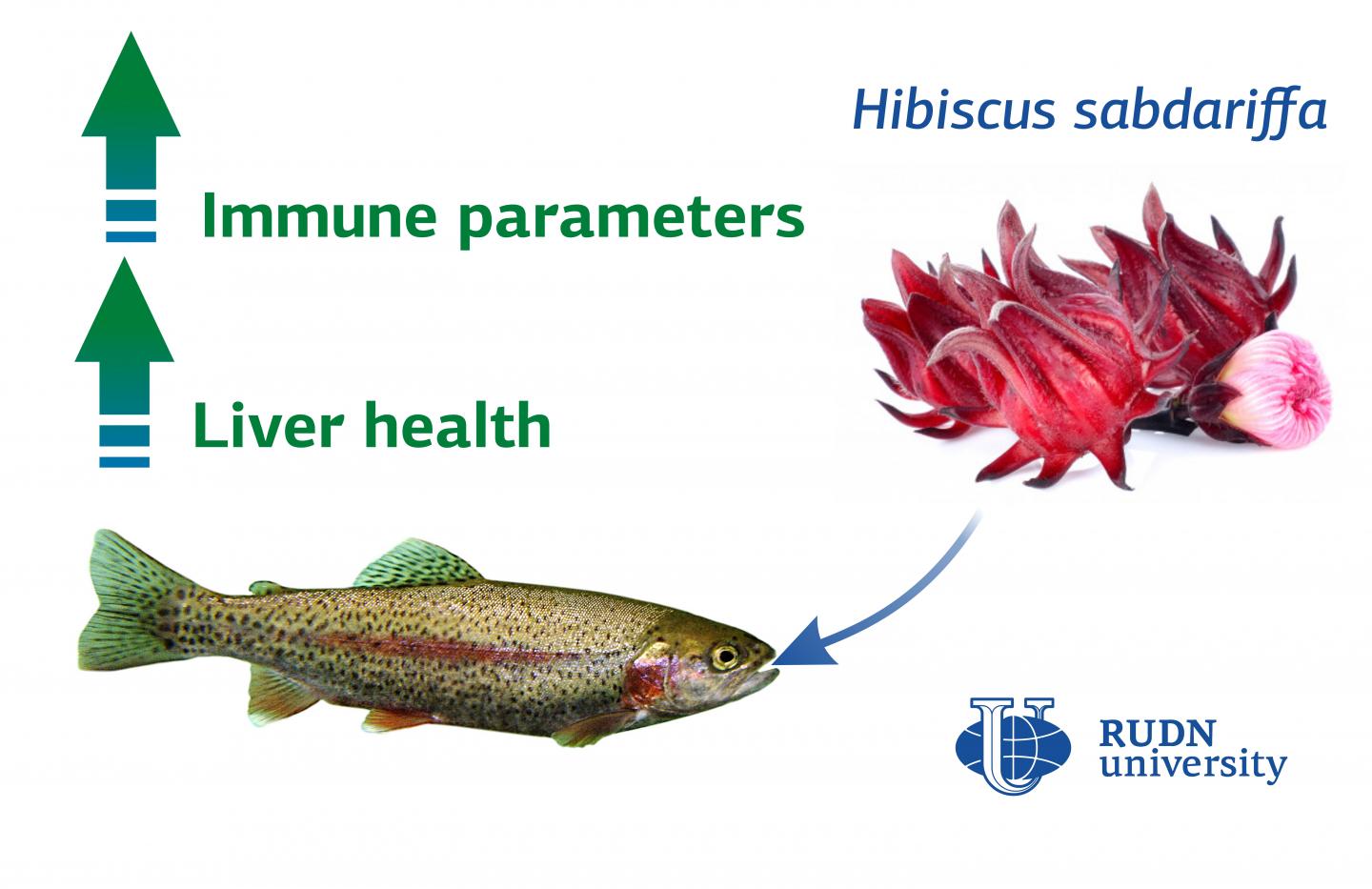
A team of biologists from RUDN University developed a hibiscus-based dietary supplement for trout that makes the fish less sensitive to ammonia pollution and more stress-resistant. The results of the study were published in the Aquaculture journal.
Rainbow trout (from the genus of Pacific salmons) is one of the most popular species in fish farms. When bred on a farm, a trout can grow up to 6-8 kg, while in nature they are usually smaller. In the course of their lives, all fish produce ammonia, and because of an unbalanced diet, high density, and lack of fresh water the pools at fish farms are often rich in it. In these concentrations, ammonia becomes poisonous: it suppresses the immune systems of the fish and provokes inflammations, making the fish susceptible to various diseases. A team of biologists from RUDN University found out that the toxicity of ammonia can be reduced with the help of a natural supplement made of hibiscus powder.
“Our goal was to analyze the immune-stimulating and anti-inflammatory effect of Hibiscus sabdariffa for rainbow trout Oncorhynchus mykiss. The tests were carried out both in regular conditions and after the addition of ammonia,” said Yuri Vatnikov, a Ph.D. in Veterinary Medicine, and the Head of the Department of Veterinary Medicine at RUDN University.
Roselle or Hibiscus sabdariffa is a shrub of the family Malvaceae. It is known for its antispastic, diuretic, and antifebrile properties. Its flowers are used to make carcade, and the leaves are edible with their sepals rich in organic acids, sugars, vitamins, and nutrients. That is why the team from RUDN University chose hibiscus as a dietary supplement for rainbow trout.
To test its effect on the fish, the team conducted an experiment: 480 young rainbow trouts weighing about 8 g each were divided into three groups and put into 12 60-liter aquariums (40 fish in each). The first group got no hibiscus in its diet; the second received 0.5% and the third 1% of the natural supplement. The dietary regime was maintained for 60 days. After that, the trouts were moved to aquariums with 0.3 mg/l ammonia concentration (0.52 mg/l being lethal for the fish) for 24 hours.
Ammonia increased the activity of inflammation agents (plasma alanine aminotransferase (ALT) and aspartate aminotransferase (AST)) and the production of inflammatory proteins in the liver of all fish. At the same time, the levels of lysozyme, immunoglobulins. and other protective molecules in their bodies decreased. However, by the end of the experiment, the fish that received 0.5% of hibiscus powder gained the most weight and grew the fastest among all three groups (showing 471% growth compared to 385% and 395% in the first and third group, respectively). The fish that received the supplement also turned out to have healthier livers and stronger immune systems, and their blood contained less inflammation marker proteins and more immunoglobulins. Moreover, their skin mucus was more effective against bacteria.
“Our study confirms that hibiscus is capable of improving the immune response and reducing inflammation in rainbow trout thus supporting the health of the fish after it is exposed to the toxic influence of ammonia. We recommend adding 0.5-1% of this supplement to the diet of the trout,” added Yuri Vatnikov.
###
Media Contact
Valeriya Antonova
[email protected]
Related Journal Article
http://dx.
https://scienmag.com/hibiscus-reduces-the-toxicity-of-ammonia-for-rainbow-trout-say-rudn-university-biologists/