The first experimental observation of three-dimensional magnetic ‘vortex rings’ provides fundamental insight into intricate nanoscale structures inside bulk magnets, and offers fresh perspectives for magnetic devices.
Credit: Credit: Claire Donnelly
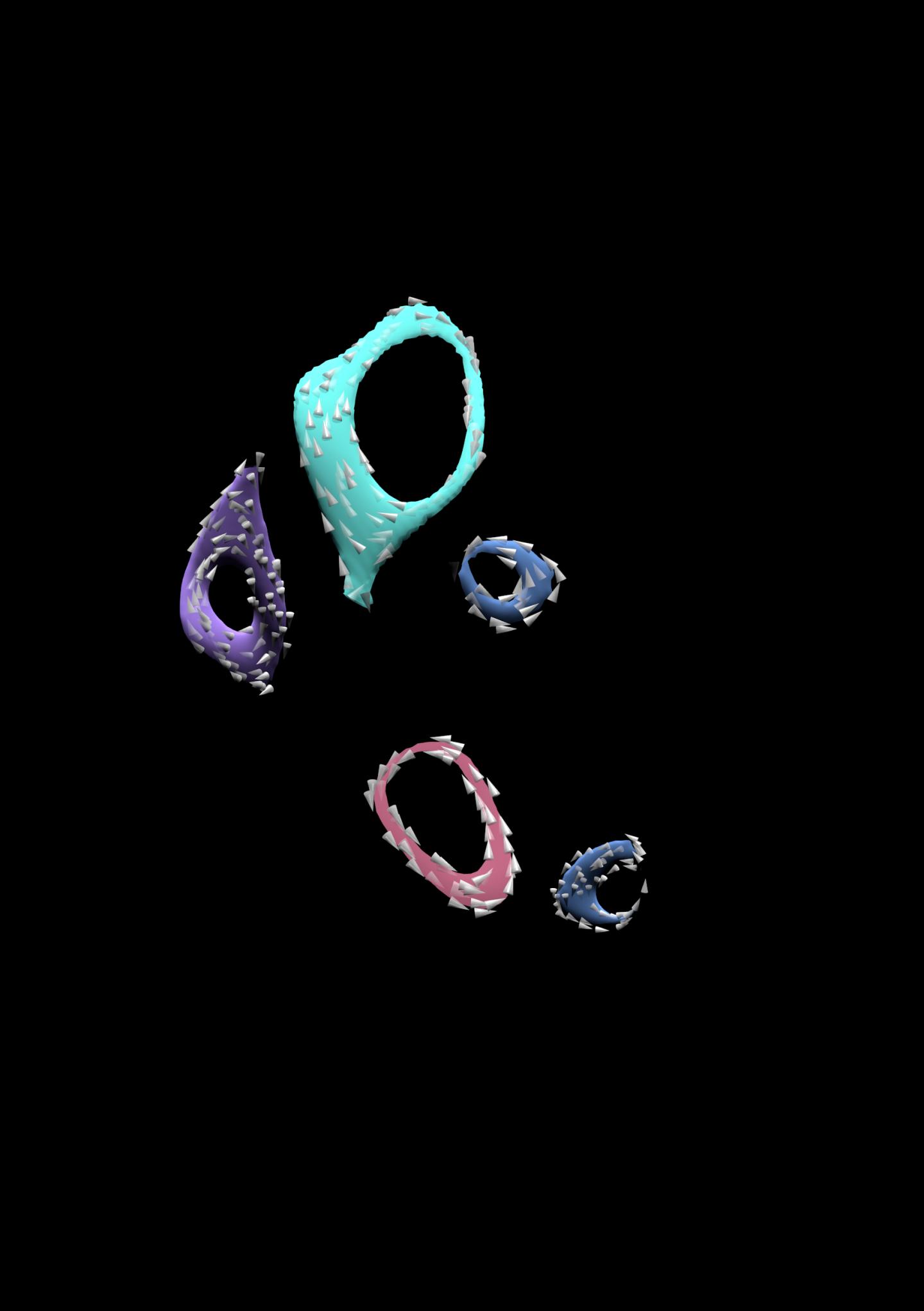
Magnets often harbour hidden beauty. Take a simple fridge magnet: Somewhat counterintuitively, it is ‘sticky’ on one side but not the other. The secret lies in the way the magnetisation is arranged in a well-defined pattern within the material. More intricate magnetization textures are at the heart of many modern technologies, such as hard disk drives. Now, an international team of scientists at the Paul Scherrer Institute PSI, ETH Zurich, the University of Cambridge, the Donetsk Institute for Physics and Engineering and the Institute for Numerical Mathematics RAS in Moscow report the discovery of unexpected magnetic structures inside a tiny pillar made of the magnetic material gadolinium cobalt. As they write in a paper published today in the journal Nature Physics [1], the researchers observed sub-micrometre loop-shaped configurations, which they identified as magnetic vortex rings. Far beyond their aesthetic appeal, these textures might point the way to further complex three-dimensional structures arising in the bulk of magnets, and could one day form the basis for novel technological applications.
Mesmerising insights
Determining the magnetisation arrangement within a magnet is extraordinarily challenging, in particular for structures at the micro- and nanoscale, for which studies have been typically limited to looking at a shallow layer just below the surface. That changed in 2017 when researchers at PSI and ETH Zurich introduced a novel X-ray method for the nanotomography of bulk magnets, which they demonstrated in experiments at the Swiss Light Source SLS [2]. That advance opened up a unique window into the inner life of magnets, providing a tool for determining three-dimensional magnetic configurations at the nanoscale within micrometre-sized samples.
Utilizing these capabilities, members of the original team, together with international collaborators, now ventured into new territory. The stunning loop shapes they observed appear in the same gadolinium cobalt micropillar samples in which they had before detected complex magnetic configurations consisting of vortices — the sort of structures seen when water spirals down from a sink — and their topological counterparts, antivortices. That was a first, but the presence of these textures has not been surprising in itself. Unexpectedly, however, the scientists also found loops that consist of pairs of vortices and antivortices. That observation proved to be puzzling initially. With the implementation of novel sophisticated data-analysis techniques they eventually established that these structures are so-called vortex rings — in essence, doughnut-shaped vortices.
A new twist on an old story
Vortex rings are familiar to everyone who has seen smoke rings being blown, or who watched dolphins producing loop-shaped air bubbles, for their own amusement as much as to that of their audience. The newly discovered magnetic vortex rings are captivating in their own right. Not only does their observation verify predictions made some two decades ago, settling the question whether such structures can exist. They also offered surprises. In particular, magnetic vortex rings have been predicted to be a transient phenomenon, but in the experiments now reported, these structures turned out to be remarkably stable.
The stability of magnetic vortex rings should have important practical implications. For one, they could potentially move through magnetic materials, as smoke rings move stably though air, or air-bubble rings through water. Learning how to control the rings within the volume of the magnet can open interesting prospects for energy-efficient 3D data storage and processing. There is interest in the physics of these new structures, too, as magnetic vortex rings can take forms not possible for their smoke and bubble counterparts. The team has already observed some unique configurations, and going forward, their further exploration promises to bring to light yet more magnetic beauty.
###
1. Experimental observation of vortex rings in a bulk magnet
Claire Donnelly, Konstantin L. Metlov, Valerio Scagnoli, Manuel Guizar-Sicairos?, Mirko Holler, Nicholas S. Bingham, Jörg Raabe?, Laura J. Heyderman?, Nigel R. Cooper?, Sebastian Gliga
Nature Physics 30 November 2020 (online)
DOI: 10.1038/s41567-020-01057-3
2. Three-dimensional magnetization structures revealed with X-ray vector nanotomography
Claire Donnelly, Manuel Guizar-Sicairos, Valerio Scagnoli, Sebastian Gliga, Mirko Holler, Jörg Raabe, Laura J. Heyderman
Nature 547, 328-331(2017)
DOI: 10.1038/nature23006
Media Contact
Dr. Mirjam van Daalen
[email protected]
Related Journal Article
http://dx.