• HOME
  • NEWS
  • EXPLORE
    • CAREER
      • Companies
      • Jobs
    • EVENTS
    • iGEM
      • News
      • Team
    • PHOTOS
    • VIDEO
    • WIKI
  • BLOG
  • COMMUNITY
    • FACEBOOK
    • INSTAGRAM
    • TWITTER
Saturday, February 7, 2026
BIOENGINEER.ORG
No Result
View All Result
  • Login
  • HOME
  • NEWS
  • EXPLORE
    • CAREER
      • Companies
      • Jobs
        • Lecturer
        • PhD Studentship
        • Postdoc
        • Research Assistant
    • EVENTS
    • iGEM
      • News
      • Team
    • PHOTOS
    • VIDEO
    • WIKI
  • BLOG
  • COMMUNITY
    • FACEBOOK
    • INSTAGRAM
    • TWITTER
  • HOME
  • NEWS
  • EXPLORE
    • CAREER
      • Companies
      • Jobs
        • Lecturer
        • PhD Studentship
        • Postdoc
        • Research Assistant
    • EVENTS
    • iGEM
      • News
      • Team
    • PHOTOS
    • VIDEO
    • WIKI
  • BLOG
  • COMMUNITY
    • FACEBOOK
    • INSTAGRAM
    • TWITTER
No Result
View All Result
Bioengineer.org
No Result
View All Result
Home NEWS Science News

Teaching computers the meaning of sensor names in smart home

Bioengineer by Bioengineer
November 30, 2020
in Science News
Reading Time: 2 mins read
0
IMAGE
Share on FacebookShare on TwitterShare on LinkedinShare on RedditShare on Telegram

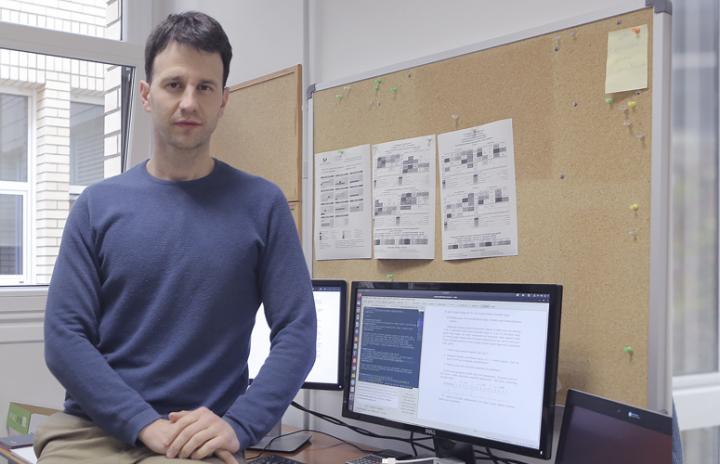
The University of the Basque Country (UPV/EHU) is using language processing techniques to represent sensors and human activity in smart environment
IMAGE

Credit: UPV/EHU

The aim of smart homes is to make life easier for those living in them. Applications for environment-aided daily life may have a major social impact, fostering active ageing and enabling older adults to remain independent for longer. One of the keys to smart homes is the system’s ability to deduce the human activities taking place. To this end, different types of sensors are used to detect the changes triggered by inhabitants in this environment (turning lights on and off, opening and closing doors, etc.).

Normally, the information generated by these sensors is processed using data analysis methods, and the most successful systems are based on supervised learning techniques (i.e., knowledge), with someone supervising the data and an algorithm automatically learning the meaning. Nevertheless, one of the main problems with smart homes is that a system trained in one environment is not valid in another one: ‘Algorithms are usually closely linked to a specific smart environment, to the types of sensor existing in that environment and their configuration, as well as to the concrete habits of one individual. The algorithm learns all this easily, but is then unable to transfer it to a different environment,’ explains Gorka Azkune, a member of the UPV/EHU’s IXA group.

Giving sensors names

To date, sensors have been identified using numbers, meaning that ‘they lost any meaning they may have had,’ continues Dr Azkune. ‘We propose using sensor names instead of identifiers, to enable their meaning, their semantics, to be used to determine the activity to which they are linked. Thus, what the algorithm learns in one environment may be valid in a different one, even if the sensors are not the same, because their semantics are similar. This is why we use natural language processing techniques.’

The researcher also explains that the techniques used are totally automatic. ‘At the end of the day, the algorithm learns the words first and then the representation that we develop using those words. There is no human intervention. This is important from the perspective of scalability, since it has been proven to overcome the aforementioned difficulty.’ Indeed, the new approach has achieved similar results to those obtained using the knowledge-based method.

Complementary information

This study was carried out by the IXA research group at the UPV/EHU, in collaboration with the DeustoTech Institute of Technology at Deusto University.

###

Media Contact
Matxalen Sotillo
[email protected]

Original Source

https://www.ehu.eus/en/-/teaching-computers-the-meaning-of-sensor-names-in-smart-homes

Related Journal Article

http://dx.doi.org/10.1016/j.neucom.2020.08.044

Tags: Computer ScienceTechnology/Engineering/Computer ScienceTheory/Design
Share12Tweet8Share2ShareShareShare2

Related Posts

Evaluating Pediatric Emergency Care Quality in Ethiopia

February 7, 2026

TPMT Expression Predictions Linked to Azathioprine Side Effects

February 7, 2026

Improving Dementia Care with Enhanced Activity Kits

February 7, 2026

Decoding Prostate Cancer Origins via snFLARE-seq, mxFRIZNGRND

February 7, 2026
Please login to join discussion

POPULAR NEWS

  • Robotic Ureteral Reconstruction: A Novel Approach

    Robotic Ureteral Reconstruction: A Novel Approach

    82 shares
    Share 33 Tweet 21
  • Digital Privacy: Health Data Control in Incarceration

    63 shares
    Share 25 Tweet 16
  • Study Reveals Lipid Accumulation in ME/CFS Cells

    57 shares
    Share 23 Tweet 14
  • Breakthrough in RNA Research Accelerates Medical Innovations Timeline

    53 shares
    Share 21 Tweet 13

About

We bring you the latest biotechnology news from best research centers and universities around the world. Check our website.

Follow us

Recent News

Evaluating Pediatric Emergency Care Quality in Ethiopia

TPMT Expression Predictions Linked to Azathioprine Side Effects

Improving Dementia Care with Enhanced Activity Kits

Subscribe to Blog via Email

Enter your email address to subscribe to this blog and receive notifications of new posts by email.

Join 73 other subscribers
  • Contact Us

Bioengineer.org © Copyright 2023 All Rights Reserved.

Welcome Back!

Login to your account below

Forgotten Password?

Retrieve your password

Please enter your username or email address to reset your password.

Log In
No Result
View All Result
  • Homepages
    • Home Page 1
    • Home Page 2
  • News
  • National
  • Business
  • Health
  • Lifestyle
  • Science

Bioengineer.org © Copyright 2023 All Rights Reserved.