Improving lithium-ion battery performance, cell lifetime with graphene-coated nickel, cobalt, aluminum nanoparticle cathodes
Credit: Jin-Myoung Lim and Norman S. Luu, Northwestern University
WASHINGTON, November 24, 2020 — Lithium-ion batteries (LIBs) that function as high-performance power sources for renewable applications, such as electric vehicles and consumer electronics, require electrodes that deliver high energy density without compromising cell lifetimes.
In the Journal of Vacuum Science and Technology A, by AIP Publishing, researchers investigate the origins of degradation in high energy density LIB cathode materials and develop strategies for mitigating those degradation mechanisms and improving LIB performance.
Their research could be valuable for many emerging applications, particularly electric vehicles and grid-level energy storage for renewable energy sources, such as wind and solar.
“Most of the degradation mechanisms in LIBs occur at the electrode surfaces that are in contact with the electrolyte,” said author Mark Hersam. “We sought to understand the chemistry at these surfaces and then develop strategies for minimizing degradation.”
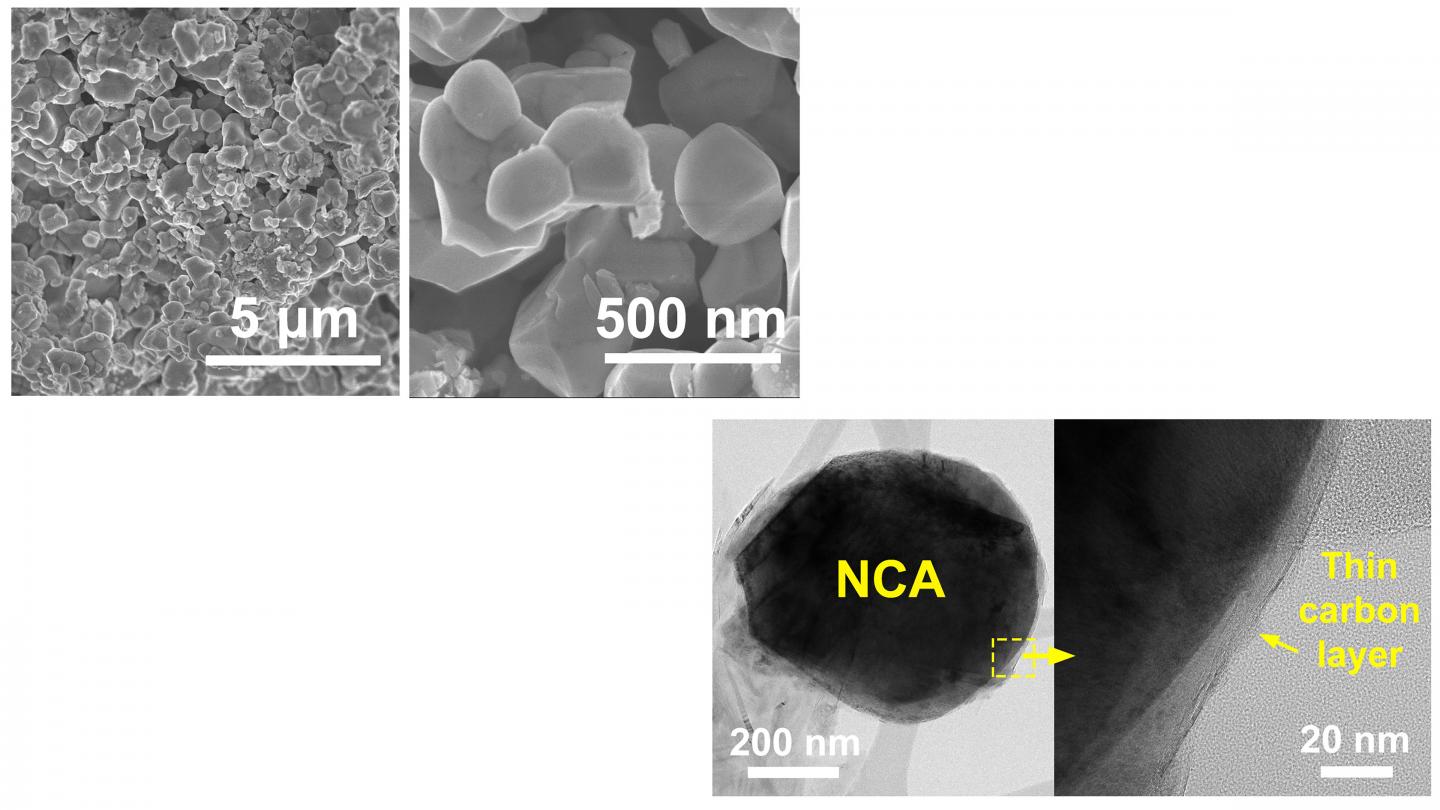
The researchers employed surface chemical characterization as a strategy for identifying and minimizing residual hydroxide and carbonate impurities from the synthesis of NCA (nickel, cobalt, aluminum) nanoparticles. They realized the LIB cathode surfaces first needed to be prepared by suitable annealing, a process by which the cathode nanoparticles are heated to remove surface impurities, and then locked into the desirable structures with an atomically thin graphene coating.
The graphene-coated NCA nanoparticles, which were formulated into LIB cathodes, showed superlative electrochemical properties, including low impedance, high rate performance, high volumetric energy and power densities, and long cycling lifetimes. The graphene coating also acted as a barrier between the electrode surface and the electrolyte, which further improved cell lifetime.
While the researchers had thought the graphene coating alone would be sufficient to improve performance, their results revealed the importance of pre-annealing the cathode materials in order to optimize their surface chemistry before the graphene coating was applied.
While this work focused on nickel-rich LIB cathodes, the methodology could be generalized to other energy storage electrodes, such as sodium-ion or magnesium-ion batteries, that incorporate nanostructured materials possessing high surface area. Consequently, this work establishes a clear path forward for the realization of high-performance, nanoparticle-based energy storage devices.
“Our approach can also be applied to improve the performance of anodes in LIBs and related energy storage technologies,” said Hersam. “Ultimately, you need to optimize both the anode and cathode to achieve the best possible battery performance.”
###
The article, “Enhancing nanostructured nickel-rich lithium-ion battery cathodes via surface stabilization,” is authored by Jin-Myoung Lim, Norman S. Luu, Kyu-Young Park, Mark T. Z. Tan, Sungkyu Kim, Julia R. Downing, Kai He, Vinayak P. Dravid, and Mark C. Hersam. The article will appear in Journal of Vacuum Science & Technology A on Nov. 24, 2020 (DOI: 10. 10.1116/6.0000580). After that date, it can be accessed at https:/
ABOUT THE JOURNAL
Journal of Vacuum Science & Technology A, an AVS journal published by AIP Publishing, features reports of original research, letters, and review articles on interfaces and surfaces of materials, thin films, and plasmas. JVST A publishes reports that advance the fundamental understanding of interfaces and surfaces at a fundamental level and that use this understanding to advance the state of the art in various technological applications. See https:/
ABOUT AVS
AVS is an interdisciplinary, professional society with some 4,500 members worldwide. Founded in 1953, AVS hosts local and international meetings, publishes five journals, serves members through awards, training and career services programs and supports networking among academic, industrial, government, and consulting professionals. Its members come from across the fields of chemistry, physics, biology, mathematics, engineering and business and share a common interest in basic science, technology development and commercialization related to materials, interfaces, and processing. https:/
Media Contact
Larry Frum
[email protected]
Related Journal Article
http://dx.