• HOME
  • NEWS
  • EXPLORE
    • CAREER
      • Companies
      • Jobs
    • EVENTS
    • iGEM
      • News
      • Team
    • PHOTOS
    • VIDEO
    • WIKI
  • BLOG
  • COMMUNITY
    • FACEBOOK
    • INSTAGRAM
    • TWITTER
Saturday, February 7, 2026
BIOENGINEER.ORG
No Result
View All Result
  • Login
  • HOME
  • NEWS
  • EXPLORE
    • CAREER
      • Companies
      • Jobs
        • Lecturer
        • PhD Studentship
        • Postdoc
        • Research Assistant
    • EVENTS
    • iGEM
      • News
      • Team
    • PHOTOS
    • VIDEO
    • WIKI
  • BLOG
  • COMMUNITY
    • FACEBOOK
    • INSTAGRAM
    • TWITTER
  • HOME
  • NEWS
  • EXPLORE
    • CAREER
      • Companies
      • Jobs
        • Lecturer
        • PhD Studentship
        • Postdoc
        • Research Assistant
    • EVENTS
    • iGEM
      • News
      • Team
    • PHOTOS
    • VIDEO
    • WIKI
  • BLOG
  • COMMUNITY
    • FACEBOOK
    • INSTAGRAM
    • TWITTER
No Result
View All Result
Bioengineer.org
No Result
View All Result
Home NEWS Science News Chemistry

New type of ultrahigh piezoelectricity in hydrogen-bonded ferroelectrics

Bioengineer by Bioengineer
November 20, 2020
in Chemistry
Reading Time: 2 mins read
0
IMAGE
Share on FacebookShare on TwitterShare on LinkedinShare on RedditShare on Telegram

IMAGE

Credit: ©Science China Press

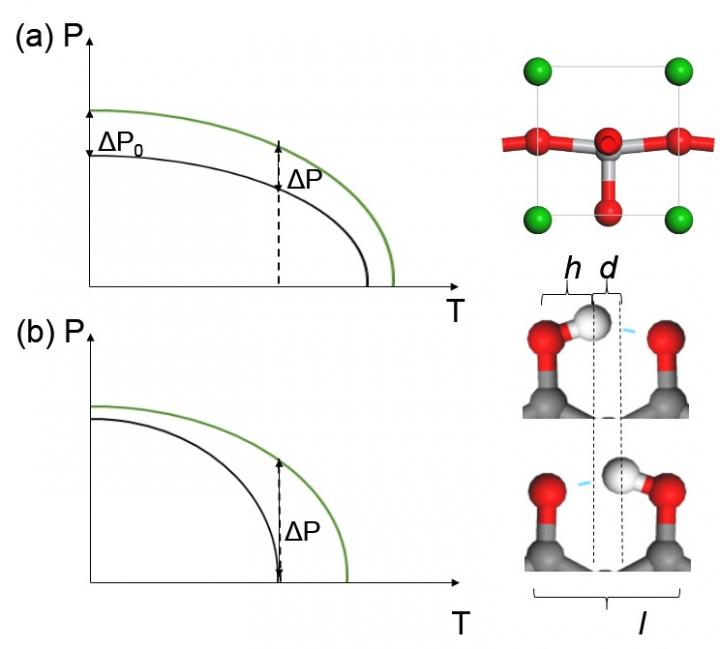
Prevalent piezoelectric materials like barium titanate (BaTiO3) and lead zirconate titanate (PZT) possess high piezoelectric coefficients 20-800 pC/N, which are also ferroelectric. The Curie temperature of those ferroelectrics are mostly far above room temperature, so the change of polarization ΔP upon a strain at room temperature is approximately the same as ΔP0 at 0K.

Recently, scientists at Huazhong University of Science and Technology and at the Nanjing University in China proposed a new possibility of inducing ultra-high piezoelectric coefficient, which will be theoretically infinitely large if the Curie temperature is right at the working temperature and sensitive to strain. Well-known ferroelectric perovskites like BaTiO3 or PZT are not such candidates due to their high Curie temperature that is insensitive to strain. However, many hydrogen-bonded ferroelectrics with Curie temperature ranging from 200 to 400K can be ideal candidates, which are also soft, flexible and lead-free. For examples, the measured Curie temperature of organic PhMDA and [H-55DMBP][Hia] were respectively 363 and 268K. For hydrogen bonds like O-H…O, each proton will be covalently bonded to only one side of O atom due to the saturation of covalent bond. The O-H bond is on the verge of breaking at the hopping transition state where the proton locates at the midpoint. Due to the brittle nature of covalent bond, if the O-H…O bonds are prolonged upon a tensile strain, the hopping barrier as well as Curie temperature may be greatly enhanced with a much larger transfer distance. Meanwhile their hydrogen-bonded network can be easily compressed or stretched due to low bulk modulus.

The authors have shown first-principles evidence combined with Monte Carlo simulation, that the proton-transfer barriers as well as the Curie temperature of some hydrogen-bonded ferroelectrics can be approximately doubled upon a tensile strain of as low as 2 %. Their Curie temperature can be tuned exactly to room-temperature by applying a fixed strain in one direction, and the systems will exhibit ultra-high piezoelectricity in another direction. The unprecedented piezoelectric coefficient of 2058 pC/N obtained in PhMDA is more than 3 times higher than PZT, and an order of magnitude higher than the highest value obtained in current lead-free piezoelectrics. This value is even underestimated and can be greatly enhanced upon smaller strain. Since this proposed principle for such piezoelectricity can be applied to most hydrogen-bonded ferroelectrics, the large number of organic or inorganic candidates should facilitate its experimental realizations and optimizations in future, which will be a breakthrough for the long-sought lead-free high-coefficient piezoelectrics. This mechanism may also clarify the previously reported drastic rise in piezoelectric coefficient for SbSI when approaching its Curie temperature.

###

See the article:

Yangyang Ren, Menghao Wu, Jun-Ming Liu

Ultra-High Piezoelectric Coefficients and Strain-Sensitive Curie Temperature in Hydrogen-Bonded Systems

Natl Sci Rev (2020)

https://doi.org/10.1093/nsr/nwaa203

Media Contact
Menghao Wu
[email protected]

Related Journal Article

http://dx.doi.org/10.1093/nsr/nwaa203

Tags: Chemistry/Physics/Materials Sciences
Share12Tweet8Share2ShareShareShare2

Related Posts

blank

Breakthrough in Environmental Cleanup: Scientists Develop Solar-Activated Biochar for Faster Remediation

February 7, 2026
blank

Cutting Costs: Making Hydrogen Fuel Cells More Affordable

February 6, 2026

Scientists Develop Hand-Held “Levitating” Time Crystals

February 6, 2026

Observing a Key Green-Energy Catalyst Dissolve Atom by Atom

February 6, 2026
Please login to join discussion

POPULAR NEWS

  • Robotic Ureteral Reconstruction: A Novel Approach

    Robotic Ureteral Reconstruction: A Novel Approach

    82 shares
    Share 33 Tweet 21
  • Digital Privacy: Health Data Control in Incarceration

    63 shares
    Share 25 Tweet 16
  • Study Reveals Lipid Accumulation in ME/CFS Cells

    57 shares
    Share 23 Tweet 14
  • Breakthrough in RNA Research Accelerates Medical Innovations Timeline

    53 shares
    Share 21 Tweet 13

About

We bring you the latest biotechnology news from best research centers and universities around the world. Check our website.

Follow us

Recent News

Personalized Guide to Understanding and Reducing Chemicals

Inflammasome Protein ASC Drives Pancreatic Cancer Metabolism

Phage-Antibiotic Combo Beats Resistant Peritoneal Infection

Subscribe to Blog via Email

Enter your email address to subscribe to this blog and receive notifications of new posts by email.

Join 73 other subscribers
  • Contact Us

Bioengineer.org © Copyright 2023 All Rights Reserved.

Welcome Back!

Login to your account below

Forgotten Password?

Retrieve your password

Please enter your username or email address to reset your password.

Log In
No Result
View All Result
  • Homepages
    • Home Page 1
    • Home Page 2
  • News
  • National
  • Business
  • Health
  • Lifestyle
  • Science

Bioengineer.org © Copyright 2023 All Rights Reserved.