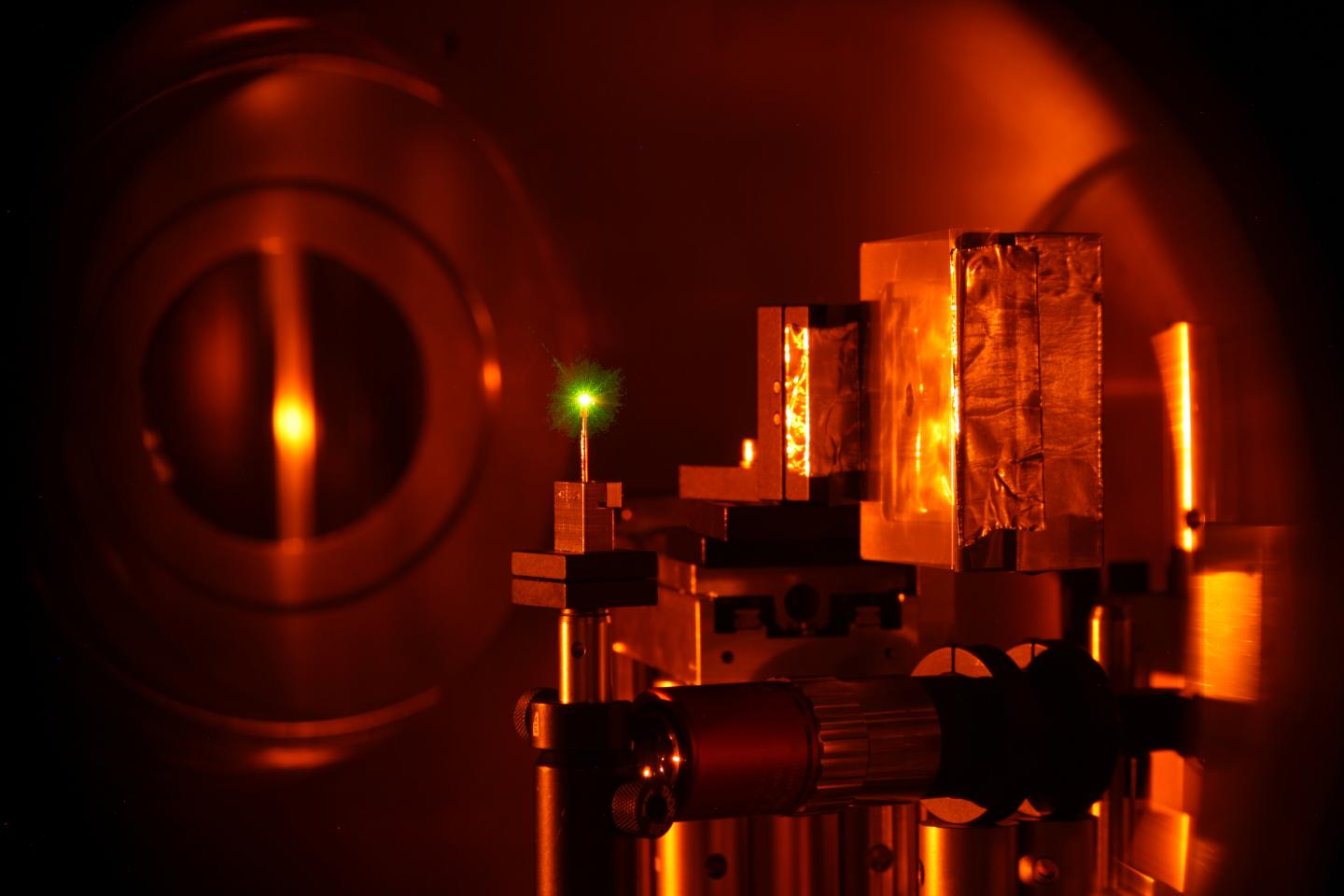
Credit: Photo: V. Bagnoud, edit: P. Boller / GSI
Bringing huge amounts of protons up to speed in the shortest distance in fractions of a second — that’s what laser acceleration technology, greatly improved in recent years, can do. An international research team from the GSI Helmholtzzentrum für Schwerionenforschung and the Helmholtz Institute Jena, a branch of GSI, in collaboration with the Lawrence Livermore National Laboratory, USA, has succeeded in using protons accelerated with the GSI high-power laser PHELIX to split other nuclei and to analyze them. The results have now been published in the journal Nature Scientific Reports and could provide new insights into astrophysical processes.
For less than one picosecond (one trillionth of a second), the PHELIX laser shines its extremely intense light pulse onto a very thin gold foil. This is enough to eject about one trillion hydrogen nuclei (protons), which are only slightly attached to the gold, from the back-surface of the foil, and accelerate them to high energies. “Such a large number of protons in such a short period of time cannot be achieved with standard acceleration techniques,” explains Pascal Boller, who is researching laser acceleration in the GSI research department Plasma Physics/PHELIX as part of his graduate studies. “With this technology, completely new research areas can be opened that were previously inaccessible”.
These include the generation of nuclear fission reactions. For this purpose, the researchers let the freshly generated fast protons impinge on uranium material samples. Uranium was chosen as a case study material because of its large reaction cross-section and the availability of published data for benchmarking purposes. The samples have to be close to the proton production to guarantee a maximum yield of reactions. The protons generated by the PHELIX laser are fast enough to induce the fission of uranium nuclei into smaller fission products, which remain then to be identified and measured. However, the laser impact has unwanted side effects: It generates a strong electromagnetic pulse and a gammy-ray flash that interfere with the sensitive measuring instruments used for this detection.
At this stage, the researchers are assisted by the expertise of another GSI research group. For the chemical investigation of superheavy elements, a transport system has been in use for quite some time that can transport the desired particles over long distances from the reaction area to the detector. The reaction chamber is flushed through by a gas which –in the case of fission experiments –carries the fission products with it and, within only a few seconds, transports them via small plastic tubes to the measuring apparatus, which is now several meters away. In this way, generation and measurement can be spatially separated and interference can be prevented.
For the first time, it was possible in the experiments to combine the two techniques and thus to generate a variety of cesium, xenon and iodine isotopes via the fission of uranium, to reliably identify them via their emitted gamma radiation and to observe their short life time. This provides a methodology for studying fission reactions in high-density plasma-state matter. Comparable conditions can be found, for example, in space inside stars, stellar explosions or neutron star mergers. “Understanding the reaction processes of nuclei interacting with each other in plasma can give us insights into the origin of atomic nuclei, the so-called nucleosynthesis, in our universe. Nucleosynthesis processes such as s-process or r-process take place in exactly such media,” explains Boller. “The role fission reactions play in these processes has not yet been researched in detail. Here, the laser-accelerated protons can provide new information”.
Further measurements with the methods are planned for future experiments of the PHELIX laser at GSI as well as at other research centers around the world. The investigation of highly dense matter with ion and laser beams will also be one of the topics pursued at the future research facility FAIR. FAIR is currently being built at GSI in international cooperation. With its motto “The Universe in the Laboratory”, it is intended to reproduce conditions as they occur in astrophysical environments on Earth, thus expanding the knowledge about our cosmos.
###
Media Contact
Dr. Ingo Peter
[email protected]
Original Source
https:/
Related Journal Article
http://dx.