Credit: by Yanan Ji, Wen Xu, Nan Ding, Haitao Yang, Hongwei Song, Qingyun Liu, Hans Ågren, Jerker Widengren, Haichun Liu
Narrow-band near infrared (NIR) photodetectors (PDs) capable to simultaneously detect light in multi-spectral bands, e.g., in the NIR I and NIR II regions, are attracting prodigious attention in diverse areas including biological analysis, multicolor bio-imaging/sensing, and encrypted communications. UCNCs, due to their unique two-photons or multi-photons excitation nature as well as their non-toxic characteristics and low preparation cost, have emerged as a superior solution by converting NIR photons into easily detectable visible photons. However, the relatively high pumping threshold to realize detectable upconversion luminescence (UCL), originating from the lower absorption cross section of 4fn-4fn transitions of rare earth (RE) ions and lower luminescent quantum efficiency of UCNCs because of the anti-Stokes nature, poses a fundamental limitation for weak NIR light detection in photoelectric devices.
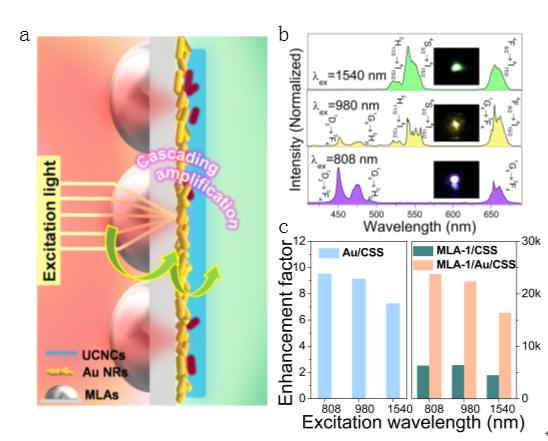
In a new paper published in Light Science & Applications, a team of scientists, led by Professors Hongwei Song and Wen Xu from State Key Laboratory of Integrated Optoelectronics, College of Electronic Science and Engineering, Jilin University, China, Dr. Haichun Liu from Department of Theoretical Chemistry and Biology, KTH Royal Institute of Technology, Stockholm, Sweden, Department of Applied Physics, KTH Royal Institute of Technology, Stockholm, Sweden and co-workers have explored a novel cascade optical field modulation strategy integrating the superlensing effect of polymeric microlens arrays (MLAs) and the plasmonic effect of gold nanorods (Au NRs) to boost UCL. This cascade modulation strategy was found to readily lead to a UCL enhancement by more than four orders of magnitude. They designed and synthesized multi-wavelength responsive core-shell-shell (CSS) structured UCNCs that emit visible light under excitation of 808, 980, or 1540 nm, and constructed NIR PDs on top. Realizing that each UCNC constitutes an information-rich kinetic system, possessing characteristic responses to optical signals in the temporal and frequency domains of different excitation wavelengths, they exploited the possibility of separating the channels of multi-wavelengths photodetection to implement selective detection. They proved that the modulation frequency response can be used to well distinguish the detected wavelengths. In addition, the UCL kinetics of the UCNCs was also optimized by manipulating the concentrations of lanthanide dopants, whereby short response times of 80-120 ms for the final PDs were achieved. These scientists summarize the operational principle of their NIR PDs:
“We have designed and synthesized NaYF4: Yb3+, Er3+@NaYF4@NaYF4: Yb3+, Nd3+, Tm3+ core-shell-shell (CSS) UCNCs, which could be excited by 808, 980 and 1540 nm light and generate visible emissions. By using a novel cascade optical field modulation strategy through integrating the superlensing effect of MLAs and the plasmonic effect of Au NRs, significant UCL enhancements from the UCNCs have been obtained, in concrete terms by factors of 2.4×10⁴, 2.2×10⁴, and 1.6×10⁴ for 808, 980, and 1540 nm excitation, respectively.”
“In comparison, the employment of the LSPR effect can typically enhance UCL by one order of magnitude, while the usage of the superlensing effect can lead to UCL enhancement by two or three orders of magnitude, when using the same routine and easily obtained nano-/micro-structures.”
“The PDs were built based on the synthesized CSS UCNCs adopting the cascade optical field modulation strategy for UCL, which have achieved selective detection to three narrow spectral bands in the NIR region. The PDs possess extremely high responsivity of 30.73, 23.15, and 12.20A/W, and detectivity of 5.36×10¹¹, 3.45×10¹¹, and 1.92×10¹¹ Jones for the 808, 980, and 1540 nm light detection, comparable or well beyond those of other types of NIR PDs such as commercial Ge-based ones, along with short response times in the range of 80-100 ms. ”
“Importantly, the incident light wavelength can be well distinguished by a proposed novel approach, i.e., examining the response to the excitation modulation frequency. Our work highlights new concepts to conquer the relatively high pumping threshold of UCNCs, enabling to build high-photoresponsivity and -detectivity multi-band responsive and distinguishable photodetectors on top of them, and can also stimulate other applications of upconversion nanotechnology.”
###
Media Contact
Hongwei Song
[email protected]
Related Journal Article
http://dx.