• HOME
  • NEWS
  • EXPLORE
    • CAREER
      • Companies
      • Jobs
    • EVENTS
    • iGEM
      • News
      • Team
    • PHOTOS
    • VIDEO
    • WIKI
  • BLOG
  • COMMUNITY
    • FACEBOOK
    • INSTAGRAM
    • TWITTER
Saturday, November 14, 2026
BIOENGINEER.ORG
No Result
View All Result
  • Login
  • HOME
  • NEWS
  • EXPLORE
    • CAREER
      • Companies
      • Jobs
        • Lecturer
        • PhD Studentship
        • Postdoc
        • Research Assistant
    • EVENTS
    • iGEM
      • News
      • Team
    • PHOTOS
    • VIDEO
    • WIKI
  • BLOG
  • COMMUNITY
    • FACEBOOK
    • INSTAGRAM
    • TWITTER
No Result
View All Result
Bioengineer.org
No Result
View All Result
Home NEWS Science News Chemistry

CrystEngComm celebrates the CSD in a special issue

Bioengineer by Bioengineer
November 10, 2020
in Chemistry
Reading Time: 2 mins read
0
IMAGE
Share on FacebookShare on TwitterShare on LinkedinShare on RedditShare on Telegram

The issue contains 33 papers highlighting the breadth of research made possible with this data
IMAGE

Credit: CCDC

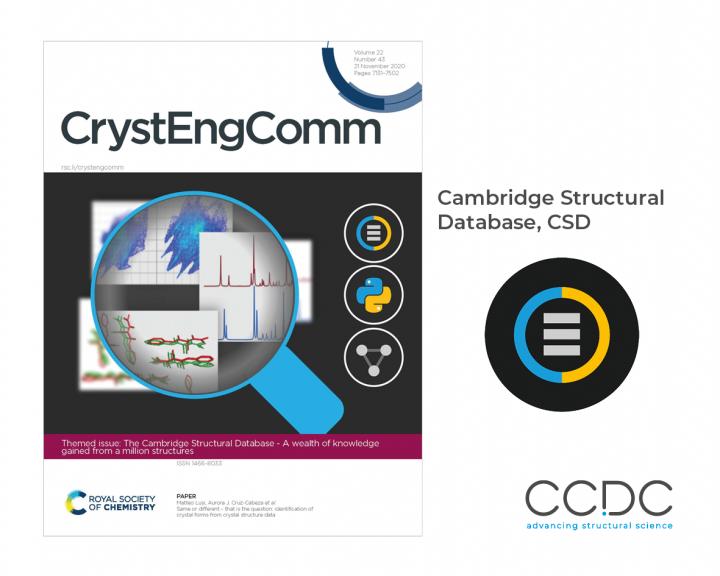
The journal CrystEngComm has published a special issue to mark the Cambridge Structural Database (CSD) reaching 1 million structures, with 33 papers that highlight the breadth of applications made possible with this data.

CrystEngComm has published new research on all aspects in the design and understanding of solid-state and crystalline materials since 1999. They publish work covering a wide range of chemistries, but all involve the use of a design or optimisation strategy to develop a deeper understanding of the structures.

“The breadth of applications of the CSD is incredible, and this special issue of CrystEngComm really celebrates that.” says Suzanna Ward, Head of Database at the CCDC who curate the CSD. “We have groups investigating the nature of bonds, or ways to enhance the discovery of new MOFs, right through to optimizing the selection of co-formers for pharmaceuticals. What these papers have in common is the Cambridge Structural Database and it is wonderful to see how authors have gained new insights from the data we help the community to share.”

Since 1965 the CSD has been the world’s repository for small-molecule organic and metal-organic crystal structures. The data is derived from x-ray and neutron diffraction analyses, with each structure automatically checked and manually curated to enrich the entries with information such as chemical representations, physical properties, or key uses of the molecule. It is used by tens of thousands of scientists around the world to understand, discover, develop, and teach structural science.

To date, the CSD is comprised of 43% organic structures, including drugs, agrochemicals, pigments, explosives and protein ligands, and 57% metal organic structures, including MOFs, catalysts and porous frameworks for gas storage. It is used by top pharma companies, start-ups and academic institutions, and retains links to other key datasets including the PDB, Drugbank, PubChem and more. And the CSD continues to grow and evolve; it is expected to reach 1.1 million structures by the end of the year, and the CCDC are investing heavily in a database evolution project which will ensure the CSD is flexible and extensible to deal with the growing volume, types and uses of structural chemistry data.

“The CSD continues to be a key resource for solid-state scientists everywhere,” says Dr Andrew Shore, Executive Editor of CrystEngComm. “As the database reached 1 million structures we wanted to highlight the amazing variety of research that is possible with this resource. We look forward to seeing what new discoveries are made with the CSD next.”

Read the editorial for this special issue here: https://doi.org/10.1039/D0CE90154G

###

Media Contact
Sophie Bryant
sbryant@ccdc.cam.ac.uk

Original Source

https://www.ccdc.cam.ac.uk/News/List/crystengcomm-special-csd-issue/

Related Journal Article

http://dx.doi.org/10.1039/D0CE90154G

Tags: Chemistry/Physics/Materials SciencesMaterialsMolecular PhysicsPharmaceutical ChemistryPharmaceutical SciencePharmaceutical Sciences
Share12Tweet8Share2ShareShareShare2

Related Posts

Controlled Dehydration-Rehydration Selectively Enriches Ginsenoside F2 in Hydroponic Ginseng Sprouts

Controlled Dehydration-Rehydration Selectively Enriches Ginsenoside F2 in Hydroponic Ginseng Sprouts

November 14, 2026
Ruthenium catalyst matches platinum performance with quarter metal

Ruthenium catalyst matches platinum performance with quarter metal

November 14, 2026

Electrical Conductivity and Altitude Predict Radon Levels in Montenegro Drinking Water

November 14, 2026

Xanthan Gum Hydrogel Removes 99% of Malachite Green Dye

November 14, 2026
Please login to join discussion

POPULAR NEWS

  • SUN Automates Louvain Clustering Resolution Selection for Single-Cell RNA Sequencing Benchmarks

    SUN Automates Louvain Clustering Resolution Selection for Single-Cell RNA Sequencing Benchmarks

    29 shares
    Share 12 Tweet 7
  • Reinjection Maintains Sustainable Geothermal Yield in Dezhou Sandstone With Minimal Cooling

    29 shares
    Share 12 Tweet 7
  • Most Gaza Dermatology Clinic Patients Reported Skin Diseases Began During Conflict

    29 shares
    Share 12 Tweet 7
  • BAF Mutations Drive Cancer by Reshaping DNA Accessibility to CTCF

    29 shares
    Share 12 Tweet 7

About

We bring you the latest biotechnology news from best research centers and universities around the world. Check our website.

Follow us

Recent News

Controlled Dehydration-Rehydration Selectively Enriches Ginsenoside F2 in Hydroponic Ginseng Sprouts

Vancomycin and Piperacillin-Tazobactam Combination Raises Kidney Injury Risk in Cancer Patients

Pde1b Regulates Cyclic Nucleotide Signaling in Dendritic Cells and Macrophages During Infection

Subscribe to Blog via Email

Enter your email address to subscribe to this blog and receive notifications of new posts by email.

Join 87 other subscribers
  • Contact Us

Bioengineer.org © Copyright 2023 All Rights Reserved.

Welcome Back!

Login to your account below

Forgotten Password?

Retrieve your password

Please enter your username or email address to reset your password.

Log In
No Result
View All Result
  • Homepages
    • Home Page 1
    • Home Page 2
  • News
  • National
  • Business
  • Health
  • Lifestyle
  • Science

Bioengineer.org © Copyright 2023 All Rights Reserved.