• HOME
  • NEWS
  • EXPLORE
    • CAREER
      • Companies
      • Jobs
    • EVENTS
    • iGEM
      • News
      • Team
    • PHOTOS
    • VIDEO
    • WIKI
  • BLOG
  • COMMUNITY
    • FACEBOOK
    • INSTAGRAM
    • TWITTER
Tuesday, April 7, 2026
BIOENGINEER.ORG
No Result
View All Result
  • Login
  • HOME
  • NEWS
  • EXPLORE
    • CAREER
      • Companies
      • Jobs
        • Lecturer
        • PhD Studentship
        • Postdoc
        • Research Assistant
    • EVENTS
    • iGEM
      • News
      • Team
    • PHOTOS
    • VIDEO
    • WIKI
  • BLOG
  • COMMUNITY
    • FACEBOOK
    • INSTAGRAM
    • TWITTER
  • HOME
  • NEWS
  • EXPLORE
    • CAREER
      • Companies
      • Jobs
        • Lecturer
        • PhD Studentship
        • Postdoc
        • Research Assistant
    • EVENTS
    • iGEM
      • News
      • Team
    • PHOTOS
    • VIDEO
    • WIKI
  • BLOG
  • COMMUNITY
    • FACEBOOK
    • INSTAGRAM
    • TWITTER
No Result
View All Result
Bioengineer.org
No Result
View All Result
Home NEWS Science News Chemistry

Germanium telluride’s hidden properties at the nanoscale revealed

Bioengineer by Bioengineer
November 6, 2020
in Chemistry
Reading Time: 2 mins read
0
IMAGE
Share on FacebookShare on TwitterShare on LinkedinShare on RedditShare on Telegram

IMAGE

Credit: HZB

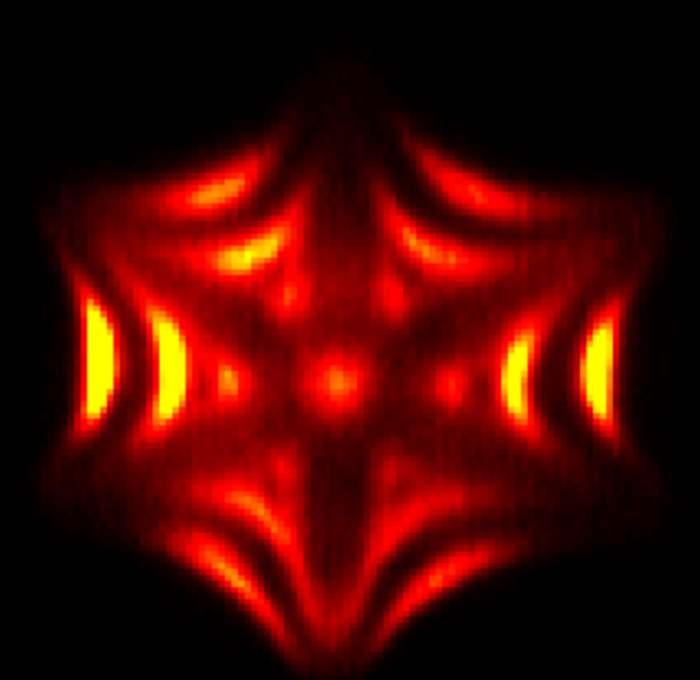
Germanium telluride (GeTe) is known as a ferrolectric Rashba semiconductor with a number of interesting properties. The crystals consist of nanodomains, whose ferrolectric polarization can be switched by external electric fields. Because of the so-called Rashba effect, this ferroelectricity can also be used to switch electron spins within each domain. Germanium telluride is therefore an interesting material for spintronic devices, which allow data processing with significantly less energy input.

Now a team from HZB and the Lomonosov Moscow State University, which has established a Helmholtz-RSF Joint Research Group, has provided comprehensive insights into this material at the nanoscale. The group is headed by physical chemist Dr. Lada Yashina (Lomonosov State University) and HZB physicist Dr. Jaime Sánchez-Barriga. “We have examined the material using a variety of state-of-the-art methods to not only determine its atomic structure, but also the internal correlation between its atomic and electronic structure at the nanoscale,” says Lada Yashina, who produced the high-quality crystalline samples in her laboratory.

Their microscopy investigations showed that the crystals possess two distinct types of boundaries surrounding ferroelectric nanodomains with sizes between 10 to 100 nanometres. At BESSY II, the team was able to observe two surface terminations with opposite ferroelectric polarization, and to analyse how these terminations correspond to nanodomains with either Ge or Te atoms at the topmost surface layer.

“At BESSY II, we were able to precisely analyze the intrincate relationship between the spin polarization in the bulk or at the surface and the opposite configurations of the ferroelectric polarization”, explains Jaime Sánchez-Barriga. The scientists also determined how the spin texture switches by ferroelectric polarization within individual nanodomains. “Our results are important for potential applications of ferroelectric Rashba semiconductors in non-volatile spintronic devices with extended memory and computing capabilities at the nanoscale,” emphasizes Sánchez-Barriga.

###

Media Contact
Antonia Roetger
[email protected]

Original Source

https://www.helmholtz-berlin.de/pubbin/news_seite?nid=22323;sprache=en;seitenid=1

Related Journal Article

http://dx.doi.org/10.1021/acsnano.0c05851

Tags: Chemistry/Physics/Materials Sciences
Share12Tweet8Share2ShareShareShare2

Related Posts

Biochar from Agricultural Waste Significantly Enhances Ozone Treatment for Eliminating Persistent Water Pollutants

Biochar from Agricultural Waste Significantly Enhances Ozone Treatment for Eliminating Persistent Water Pollutants

April 6, 2026
AI Drives Innovation: Designing Advanced Biochar to Eliminate Antibiotics from Water

AI Drives Innovation: Designing Advanced Biochar to Eliminate Antibiotics from Water

April 6, 2026

Breakthrough Microscopy Unveils Concealed Magnetic Chemistry in Living Organisms

April 6, 2026

Advances in Zeolite Morphology Control Using Organic Templates

April 6, 2026
Please login to join discussion

POPULAR NEWS

  • blank

    Revolutionary AI Model Enhances Precision in Detecting Food Contamination

    97 shares
    Share 39 Tweet 24
  • Promising Outcomes from First Clinical Trials of Gene Regulation in Epilepsy

    51 shares
    Share 20 Tweet 13
  • Imagine a Social Media Feed That Challenges Your Views Instead of Reinforcing Them

    1009 shares
    Share 399 Tweet 249
  • Popular Anti-Aging Compound Linked to Damage in Corpus Callosum, Study Finds

    44 shares
    Share 18 Tweet 11

About

We bring you the latest biotechnology news from best research centers and universities around the world. Check our website.

Follow us

Recent News

Tumor Granulocytes and NETs in Colorectal Cancer

Multimorbidity Drives Functional Decline in Retired Seniors

Pythagorean Fuzzy Numbers Resolve Yellow River Conflicts

Subscribe to Blog via Email

Success! An email was just sent to confirm your subscription. Please find the email now and click 'Confirm' to start subscribing.

Join 78 other subscribers
  • Contact Us

Bioengineer.org © Copyright 2023 All Rights Reserved.

Welcome Back!

Login to your account below

Forgotten Password?

Retrieve your password

Please enter your username or email address to reset your password.

Log In
No Result
View All Result
  • Homepages
    • Home Page 1
    • Home Page 2
  • News
  • National
  • Business
  • Health
  • Lifestyle
  • Science

Bioengineer.org © Copyright 2023 All Rights Reserved.