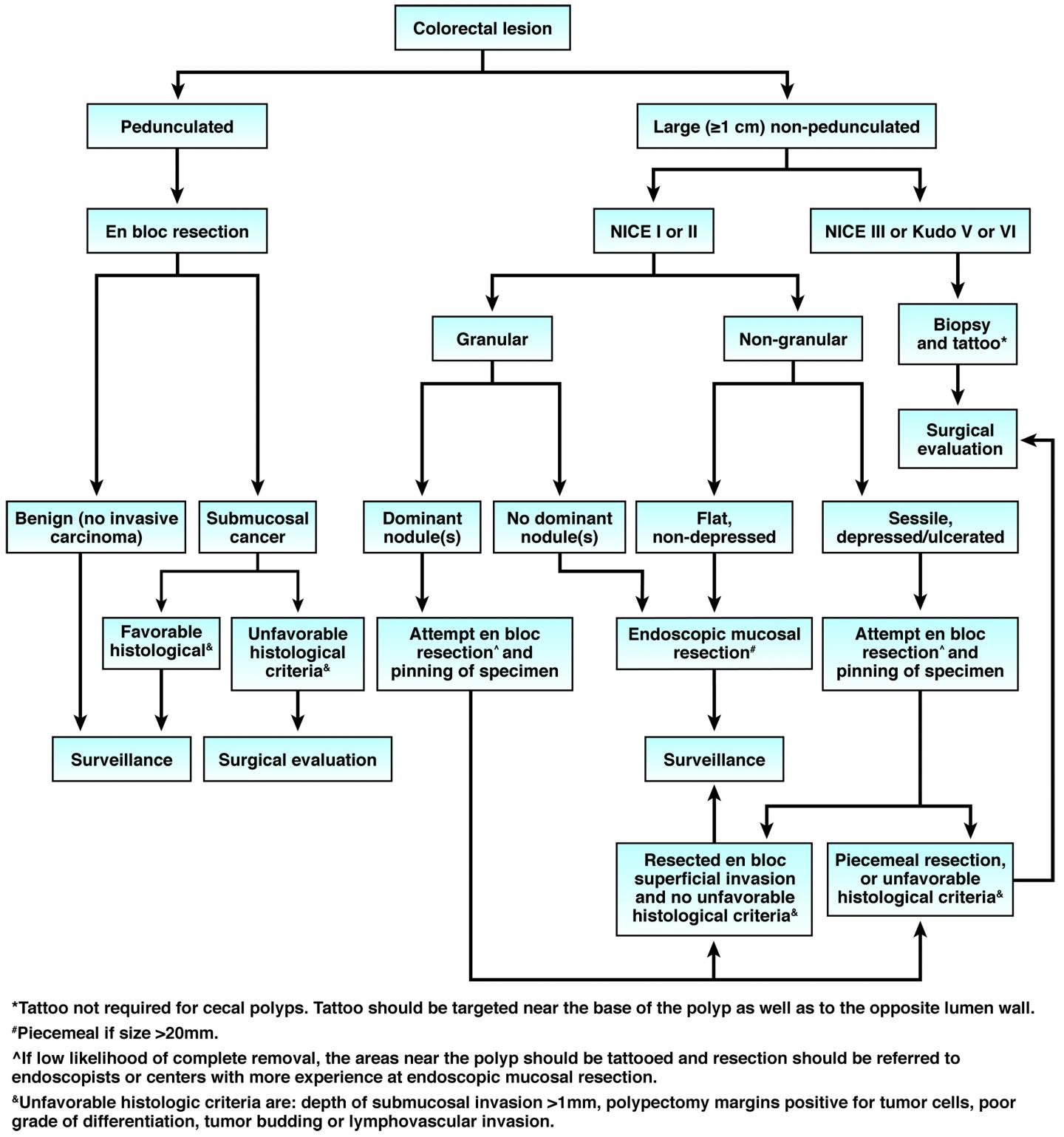
Credit: American Gastroenterological Association
Bethesda, Maryland (Nov. 4, 2020) – Early identification and removal of cancerous colorectal polyps is critical to preventing the progression of colorectal cancer and improving survival rates. The U.S. Multisociety Task Force on Colorectal Cancer has released new guidance for endoscopists on how to assess colorectal lesions for features associated with cancer, discuss how these factors guide management, and outline when to advise surgery after malignant polyp removal.
Key recommendations from the U.S. Multisociety Task Force on Colorectal Cancer, which is comprised of leading experts representing the American College of Gastroenterology (ACG), the American Gastroenterological Association (AGA) and the American Society for Gastrointestinal Endoscopy (ASGE), include:
- Management of malignant polyps must begin with a thorough and knowledgeable endoscopic assessment designed to identify features of deep submucosal invasion.
- In nonpedunculated lesions with features of deep submucosal invasion, endoscopic biopsy and tattooing should be followed by surgical resection.
- Nonpedunculated lesions with high risk of superficial submucosal invasion should be considered for en bloc resection and proper specimen handling.
- When pathology reports cancer in a lesion that was completely resected endoscopically, the decision to recommend surgery is based on polyp shape, whether there was en bloc resection and adequate histologic assessment, the presence or absence of unfavorable histologic features, the patient’s risk for surgical mortality and morbidity, and patient preferences.
###
For more information, review the full publication: Endoscopic Recognition and Management Strategies for Malignant Colorectal Polyps: Recommendations of the US Multi-Society Task Force on Colorectal Cancer.
ABOUT COLORECTAL CANCER
Colorectal cancer, the second leading cause of cancer death in the U.S., is preventable when precancerous polyps are found and removed before they turn into cancer. With routine colorectal cancer screening, more than one-third of colorectal cancer deaths can be avoided. Screening for average-risk patients is recommended to begin at age 50, and earlier for patients with risk factors or family history. To learn more, visit colorectal cancer patient information from ACGhttps:/
TASK FORCE MEMBERS
- Aasma Shaukat, MD, MPH, Minneapolis VA Health Care System, Minnesota
- Tonya R. Kaltenbach, MD, MS, University of California San Francisco
- Jason A. Dominitz, MD, MHS, University of Washington Medicine, Seattle
- Douglas J. Robertson, MD, MPH, Dartmouth Geisel School of Medicine, Hanover, New Hampshire
- Joseph C. Anderson, MD, MHCDS, Dartmouth Geisel School of Medicine, Hanover, New Hampshire
- Michael Cruise, MD Cleveland Clinic, Cleveland Ohio
- Carol A. Burke, MD, Cleveland Clinic, Ohio
- Samir Gupta, MD, MSc, University of California San Diego
- David A. Lieberman, MD, Oregon Health and Science University, Portland
- Sapna Syngal, MD, MPH, Dana-Farber Cancer Institute, Boston, Massachusetts
- Douglas K. Rex, MD, Indiana University School of Medicine, Indianapolis
The U.S. MSTF recommendations are published jointly in Gastroenterology, The American Journal of Gastroenterology, and Gastrointestinal Endoscopy.
About the AGA Institute
The American Gastroenterological Association is the trusted voice of the GI community. Founded in 1897, the AGA has grown to more than 16,000 members from around the globe who are involved in all aspects of the science, practice and advancement of gastroenterology. The AGA Institute administers the practice, research and educational programs of the organization.
http://www.
AGA is now on Instagram.
Like AGA on Facebook.
http://www.
Follow us on Twitter @AmerGastroAssn.
http://www.
Check out our videos on YouTube.
http://www.
Join AGA on LinkedIn.
https:/
About the American College of Gastroenterology
Founded in 1932, the American College of Gastroenterology (ACG) is an organization with an international membership of more than 16,000 individuals from 86 countries. The ACG will be the preeminent champion for prevention, diagnosis and treatment of digestive disorders by facilitating the highest quality, compassionate and evidence-based patient care.
http://www.
Follow ACG on Twitter @AmCollegeGastrohttps:/
About the American Society for Gastrointestinal Endoscopy
Since its founding in 1941, the American Society for Gastrointestinal Endoscopy (ASGE) has been dedicated to advancing patient care and digestive health by promoting excellence and innovation in gastrointestinal endoscopy. ASGE, with more than 14,000 members worldwide, promotes the highest standards for endoscopic training and practice, fosters endoscopic research, recognizes distinguished contributions to endoscopy, and is the foremost resource for endoscopic education. Visit asge.org and screen4coloncancer.org for more information and to find a qualified doctor in your area. Connect with ASGE on Twitter and on LinkedIn and Facebook.
Media Contact
Courtney Reed
[email protected]