• HOME
  • NEWS
  • EXPLORE
    • CAREER
      • Companies
      • Jobs
    • EVENTS
    • iGEM
      • News
      • Team
    • PHOTOS
    • VIDEO
    • WIKI
  • BLOG
  • COMMUNITY
    • FACEBOOK
    • INSTAGRAM
    • TWITTER
Saturday, February 7, 2026
BIOENGINEER.ORG
No Result
View All Result
  • Login
  • HOME
  • NEWS
  • EXPLORE
    • CAREER
      • Companies
      • Jobs
        • Lecturer
        • PhD Studentship
        • Postdoc
        • Research Assistant
    • EVENTS
    • iGEM
      • News
      • Team
    • PHOTOS
    • VIDEO
    • WIKI
  • BLOG
  • COMMUNITY
    • FACEBOOK
    • INSTAGRAM
    • TWITTER
  • HOME
  • NEWS
  • EXPLORE
    • CAREER
      • Companies
      • Jobs
        • Lecturer
        • PhD Studentship
        • Postdoc
        • Research Assistant
    • EVENTS
    • iGEM
      • News
      • Team
    • PHOTOS
    • VIDEO
    • WIKI
  • BLOG
  • COMMUNITY
    • FACEBOOK
    • INSTAGRAM
    • TWITTER
No Result
View All Result
Bioengineer.org
No Result
View All Result
Home NEWS Science News Chemistry

A new method to measure optical absorption in semiconductor crystals

Bioengineer by Bioengineer
October 29, 2020
in Chemistry
Reading Time: 2 mins read
0
IMAGE
Share on FacebookShare on TwitterShare on LinkedinShare on RedditShare on Telegram

IMAGE

Credit: Kazunobu Kojima

Tohoku University researchers have revealed more details about omnidirectional photoluminescence (ODPL) spectroscopy – a method for probing semiconducting crystals with light to detect defects and impurities.

“Our findings confirm the accuracy of ODPL measurements and show the possibility to measure optical absorption of crystals by the ODPL method, making the process much easier,” says Tohoku University materials scientist Kazunobu Kojima.

Huge strides have been made in the development of highly efficient electronic and optical devices, e.g. ultraviolet, blue, and white light-emitting diodes (LEDs) as well as high-frequency transistors, that use nitride semiconductors–specifically aluminum gallium nitride (AlGaN), indium gallium nitride (InGaN), and gallium nitride (GaN).

GaN is a suitable material for power devices on account of its large bandgap energy, high breakdown field and high saturation electron velocity.

There is a strong need for manufacturers to be able to detect crystal defects and test their efficiency. Within such high quality crystals, the concentration of nonradiative recombination centers (NRC) serves as a good predictor of the crystals quality.

Annihilation spectroscopy, deep-level transient spectroscopy and photoluminescence (PL) spectroscopy are among the estimation techniques for detecting point defects which are the source of NRCs. PL spectroscopy is attractive because it requires no electrodes and contacts.

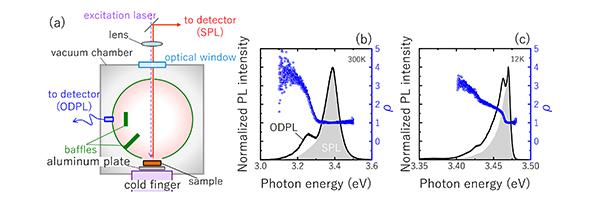
First proposed by Kojima and his research team in 2016, ODPL is a novel form of PL spectroscopy that measures PL intensity by using an integrating sphere to quantify the quantum efficiency of radiation in sample semiconductor crystals. It is non-touching, non-destructive and good for large-sized GaN wafers for room-lighting LEDs and transistors for electric vehicles. Yet, the origin of the two-peak structure formed in ODPL had remained elusive until now.

Kojima and his team combined ODPL and standard PL (SPL) spectroscopy experiments on a GaN crystal at various temperatures (T) between 12 K and 300 K. The intensity ratio (r) of the ODPL spectra to SPL spectra for the NBE emission of GaN showed a linearly decreasing slope for photon energy (E) below a fundamental absorption edge energy (Eabs).The slope obtained in r corresponded to the so-called Urbach-Martienssen (U-M) absorption tail, which is observed in many semiconductor crystals.

Therefore, the origin of the two-peak structure in the ODPL spectra around the NBE emission of the GaN crystal exists because of the U-M tail.

###

Media Contact
Kazunobu Kojima
[email protected]

Original Source

https://www.tohoku.ac.jp/en/press/measure_optical_absorption_in_semiconductor_crystals.html

Related Journal Article

http://dx.doi.org/10.1063/5.0028134

Tags: Chemistry/Physics/Materials Sciences
Share12Tweet8Share2ShareShareShare2

Related Posts

blank

Breakthrough in Environmental Cleanup: Scientists Develop Solar-Activated Biochar for Faster Remediation

February 7, 2026
blank

Cutting Costs: Making Hydrogen Fuel Cells More Affordable

February 6, 2026

Scientists Develop Hand-Held “Levitating” Time Crystals

February 6, 2026

Observing a Key Green-Energy Catalyst Dissolve Atom by Atom

February 6, 2026
Please login to join discussion

POPULAR NEWS

  • Robotic Ureteral Reconstruction: A Novel Approach

    Robotic Ureteral Reconstruction: A Novel Approach

    82 shares
    Share 33 Tweet 21
  • Digital Privacy: Health Data Control in Incarceration

    63 shares
    Share 25 Tweet 16
  • Study Reveals Lipid Accumulation in ME/CFS Cells

    57 shares
    Share 23 Tweet 14
  • Breakthrough in RNA Research Accelerates Medical Innovations Timeline

    53 shares
    Share 21 Tweet 13

About

We bring you the latest biotechnology news from best research centers and universities around the world. Check our website.

Follow us

Recent News

Evaluating Pediatric Emergency Care Quality in Ethiopia

TPMT Expression Predictions Linked to Azathioprine Side Effects

Improving Dementia Care with Enhanced Activity Kits

Subscribe to Blog via Email

Success! An email was just sent to confirm your subscription. Please find the email now and click 'Confirm' to start subscribing.

Join 73 other subscribers
  • Contact Us

Bioengineer.org © Copyright 2023 All Rights Reserved.

Welcome Back!

Login to your account below

Forgotten Password?

Retrieve your password

Please enter your username or email address to reset your password.

Log In
No Result
View All Result
  • Homepages
    • Home Page 1
    • Home Page 2
  • News
  • National
  • Business
  • Health
  • Lifestyle
  • Science

Bioengineer.org © Copyright 2023 All Rights Reserved.