• HOME
  • NEWS
  • EXPLORE
    • CAREER
      • Companies
      • Jobs
    • EVENTS
    • iGEM
      • News
      • Team
    • PHOTOS
    • VIDEO
    • WIKI
  • BLOG
  • COMMUNITY
    • FACEBOOK
    • INSTAGRAM
    • TWITTER
Sunday, October 4, 2026
BIOENGINEER.ORG
No Result
View All Result
  • Login
  • HOME
  • NEWS
  • EXPLORE
    • CAREER
      • Companies
      • Jobs
        • Lecturer
        • PhD Studentship
        • Postdoc
        • Research Assistant
    • EVENTS
    • iGEM
      • News
      • Team
    • PHOTOS
    • VIDEO
    • WIKI
  • BLOG
  • COMMUNITY
    • FACEBOOK
    • INSTAGRAM
    • TWITTER
  • HOME
  • NEWS
  • EXPLORE
    • CAREER
      • Companies
      • Jobs
        • Lecturer
        • PhD Studentship
        • Postdoc
        • Research Assistant
    • EVENTS
    • iGEM
      • News
      • Team
    • PHOTOS
    • VIDEO
    • WIKI
  • BLOG
  • COMMUNITY
    • FACEBOOK
    • INSTAGRAM
    • TWITTER
No Result
View All Result
Bioengineer.org
No Result
View All Result
Home NEWS Science News Chemistry

Ultra-small hollow alloy nanoparticles for synergistic hydrogen evolution catalysis

Bioengineer by Bioengineer
October 28, 2020
in Chemistry
Reading Time: 2 mins read
0
IMAGE
Share on FacebookShare on TwitterShare on LinkedinShare on RedditShare on Telegram

IMAGE

Credit: ©Science China Press

Because hydrogen fuel has high energy density and does not pollute the environment, it has now shown the potential to replace fossil energy. The hydrogen evolution reaction (HER) is one of the most promising hydrogen production methods as a half-reaction of the electrolysis of water. Currently, traditional Pt-based compounds are used as the most active electrocatalysts for hydrogen evolution reactions. However, Pt is relatively scarce and expensive. Therefore, designing and synthesizing highly efficient, stable, and inexpensive catalysts is a frontier topic in the field of water electrolysis.

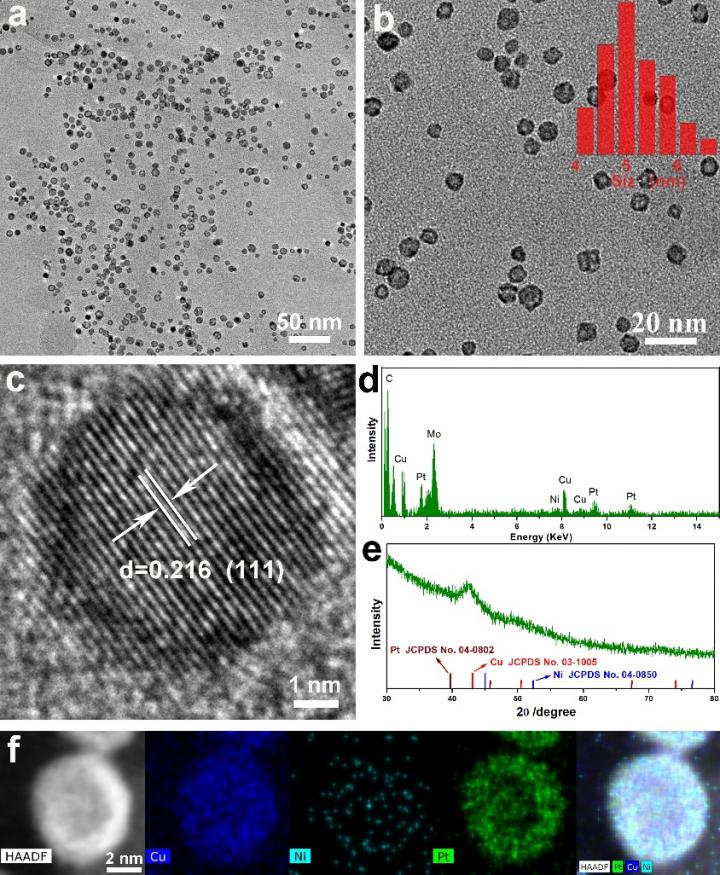
Recently, Zhenxing Li and his team from China University of Petroleum (Beijing) have made exciting progress in the preparation of HER catalysts, using a simple one-pot method to synthesize ultra-small hollow ternary alloy nanoparticles, including PtNiCu nanoparticles, PtCoCu nanoparticles and CuNiCo nanoparticles. During synthesis, the displacement reaction and oxidative etching played important roles in the formation of hollow structures. The average size of PtNiCu nanoparticles is only 5 nm and contains only 10% Pt (Figure 1). The unique hollow structure and large specific surface area increase the degree of surface atom exposure, provide abundant active centers, and make PtNiCu nanoparticles exhibit excellent electrocatalytic activity and stability. In alkaline electrolyte, the overpotential of hollow PtNiCu nanoparticles at 10 mA cm-2 is as low as 28 mV versus RHE with a Tafel slope of 52.1 mV dec-1 (Figure 2), which was lower than those of commercial Pt/C. In addition, its mass activity is 5.62-fold higher than that of commercial Pt/C system. This effectively reduces the cost of platinum-based electrocatalysts and ensures that platinum atoms are used more efficiently.

By analyzing the bonding and antibonding orbital filling, the density functional theory (DFT) calculations show that the ΔGH* of PtNiCu nanoparticles is 0.05 eV, which is close to zero (Figure 3). In the hydrogen evolution reaction (HER) reaction process, the bonding strength of different metals to the hydrogen intermediate (H*) was in the order of Pt > Co > Ni > Cu. Thus, the excellent HER performance of hollow PtNiCu nanoparticles can be attributed to moderately synergistic interactions between the three metals and H*. Combining theoretical calculations with experimental data, this work provides a new strategy for the design and preparation of low-cost and high-performance HER catalysts.

###

This research received funding from the Beijing Natural Science Foundation (Grant No. 2182061) and Science Foundation of China University of Petroleum, Beijing (Grant No. 2462019BJRC001).

See the article:

Zhenxing Li, Chengcheng Yu, Yikun Kang, Xin Zhang, Yangyang Wen, Zhao-Kui Wang, Chang Ma, Cong Wang, Kaiwen Wang, Xianlin Qu, Miao He, Ya-Wen Zhang, and Weiyu Song

Ultra-small hollow ternary alloy nanoparticles for efficient hydrogen evolution reaction

Natl Sci Rev, nwaa204

https://doi.org/10.1093/nsr/nwaa204

Media Contact
Zhenxing Li
[email protected]

Related Journal Article

http://dx.doi.org/10.1093/nsr/nwaa204

Tags: Chemistry/Physics/Materials Sciences
Share12Tweet8Share2ShareShareShare2

Related Posts

Green Solvent and Supercomputer Simulations Unlock a Stubborn Tea Enzyme

Green Solvent and Supercomputer Simulations Unlock a Stubborn Tea Enzyme

October 4, 2026
Artificial Bees Crack the Rubber Blend Puzzle for Cheaper, Tougher Car Parts

Artificial Bees Crack the Rubber Blend Puzzle for Cheaper, Tougher Car Parts

October 4, 2026

Silver Nanowires Wrapped in Zinc and Nickel Oxides Show Boosted Catalytic and Energy-Storage Power

October 4, 2026

Tryptophan Glows Brightest as Electron Beams Reveal Hidden Light in Biomolecules

October 4, 2026
Please login to join discussion

POPULAR NEWS

  • Alloys That Shrink Their Own Grains: New PIX Mechanism Refines Metals With Heat Alone

    Alloys That Shrink Their Own Grains: New PIX Mechanism Refines Metals With Heat Alone

    29 shares
    Share 12 Tweet 7
  • Endurance Exercise Reshapes the Liver in Males and Females Through Distinct Molecular Routes

    29 shares
    Share 12 Tweet 7
  • Single Transcription Factor PU.1 Rapidly Converts Fibroblasts into Macrophage-Lineage Cells

    29 shares
    Share 12 Tweet 7
  • New Scale Measures How Ready Nurse Educators Really Are for the AI Era

    29 shares
    Share 12 Tweet 7

About

We bring you the latest biotechnology news from best research centers and universities around the world. Check our website.

Follow us

Recent News

Alloys That Shrink Their Own Grains: New PIX Mechanism Refines Metals With Heat Alone

Endurance Exercise Reshapes the Liver in Males and Females Through Distinct Molecular Routes

Single Transcription Factor PU.1 Rapidly Converts Fibroblasts into Macrophage-Lineage Cells

Subscribe to Blog via Email

Enter your email address to subscribe to this blog and receive notifications of new posts by email.

Join 85 other subscribers
  • Contact Us

Bioengineer.org © Copyright 2023 All Rights Reserved.

Welcome Back!

Login to your account below

Forgotten Password?

Retrieve your password

Please enter your username or email address to reset your password.

Log In
No Result
View All Result
  • Homepages
    • Home Page 1
    • Home Page 2
  • News
  • National
  • Business
  • Health
  • Lifestyle
  • Science

Bioengineer.org © Copyright 2023 All Rights Reserved.