• HOME
  • NEWS
  • EXPLORE
    • CAREER
      • Companies
      • Jobs
    • EVENTS
    • iGEM
      • News
      • Team
    • PHOTOS
    • VIDEO
    • WIKI
  • BLOG
  • COMMUNITY
    • FACEBOOK
    • INSTAGRAM
    • TWITTER
Saturday, February 7, 2026
BIOENGINEER.ORG
No Result
View All Result
  • Login
  • HOME
  • NEWS
  • EXPLORE
    • CAREER
      • Companies
      • Jobs
        • Lecturer
        • PhD Studentship
        • Postdoc
        • Research Assistant
    • EVENTS
    • iGEM
      • News
      • Team
    • PHOTOS
    • VIDEO
    • WIKI
  • BLOG
  • COMMUNITY
    • FACEBOOK
    • INSTAGRAM
    • TWITTER
  • HOME
  • NEWS
  • EXPLORE
    • CAREER
      • Companies
      • Jobs
        • Lecturer
        • PhD Studentship
        • Postdoc
        • Research Assistant
    • EVENTS
    • iGEM
      • News
      • Team
    • PHOTOS
    • VIDEO
    • WIKI
  • BLOG
  • COMMUNITY
    • FACEBOOK
    • INSTAGRAM
    • TWITTER
No Result
View All Result
Bioengineer.org
No Result
View All Result
Home NEWS Science News Chemistry

Magnetic nature of complex vortex-like structures in a Kagome crystal Fe3Sn2

Bioengineer by Bioengineer
October 28, 2020
in Chemistry
Reading Time: 2 mins read
0
IMAGE
Share on FacebookShare on TwitterShare on LinkedinShare on RedditShare on Telegram

IMAGE

Credit: ©Science China Press

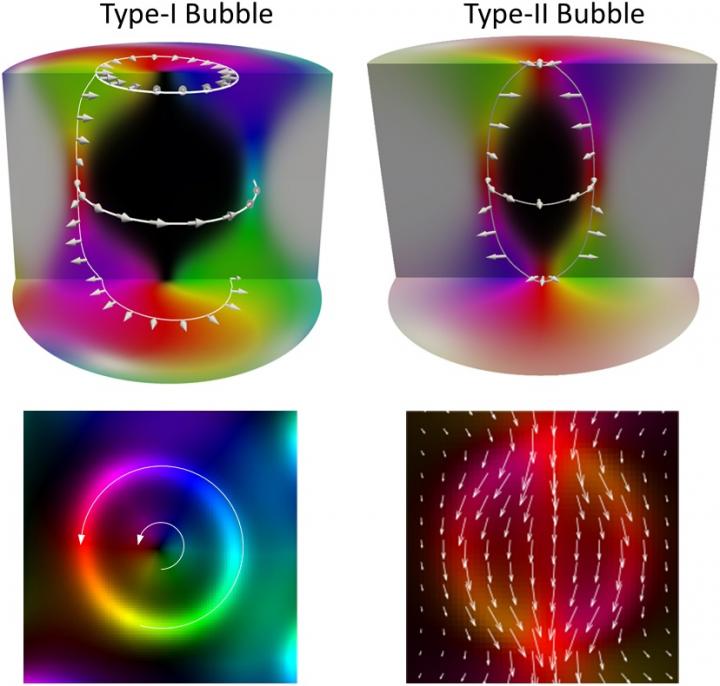
Recently, observation of new topological magnetic structures represented by skyrmions is expected to provide new paths in constructing spintronic devices. In magnetic bubbles, although these are “ancient” cylinder domains, the type-I bubbles (renamed as skyrmion bubbles with the same topology as skyrmions) have remotivated general scientific interests. On using Lorentz transmission electron microscopy (Lorentz-TEM) to recognize magnetic bubbles in magnetic nanostructures, scientists observed some complex vortex-like magnetic structures beyond the traditional magnetic bubbles (Figure 1a), which could be used as information carriers in emerging spintronic devices. Physical understanding of them, however, remains unclear. Recently, Tang et al. from High Magnetic Field Laboratory of Chinese Academy of Sciences clarified these complex vortex-like structures as depth-modulated three-dimensional (3D) magnetic bubbles in a Kagome crystal Fe3Sn2.

As retrieved from the traditional TIE analysis technique, the magnetic configurations may deviate significantly from real magnetic structures. Because of the direct detection of the local magnetic field of the differential phase contrast (DPC) technique, DPC makes it a more advanced technique in determining real magnetic configurations accurately. Using the DPC technique, first, authors obtained the real features of these complex magnetic configurations (Figure 1b). Then, by combining with 3D numerical simulated types-I and II magnetic bubbles, authors further demonstrated that the integral in-plane magnetization mappings of two types of magnetic bubbles are in high consistency with the experiments (Figure 2) and are responsible for the complex vortex-like magnetic structures.

As obtained from the TEM technique, the magnetic configurations are more readily considered as two-dimensional magnetic domains. This study suggests that 3D magnetic structures play an important role in understanding complex magnetic configurations. Recently, 3D magnetic structures have attracted much attention; however, direct observation of 3D magnetic structures remains a challenging task. This study provides an important experimental proof of the existence of 3D magnetic structures.

###

See the article:

Jin Tang, Yaodong Wu, Lingyao Kong, Weiwei Wang, Yutao Chen, Yihao Wang, Y Soh, Yimin Xiong, Mingliang Tian, and Haifeng Du

Two-dimensional characterization of three-dimensional nanostructures of magnetic bubbles in Fe3Sn2

Natl Sci Rev, 2020, doi: 10.1093/nsr/nwaa200

https://doi.org/10.1093/nsr/nwaa200

Media Contact
Haifeng Du
[email protected]

Related Journal Article

http://dx.doi.org/10.1093/nsr/nwaa200

Tags: Chemistry/Physics/Materials Sciences
Share12Tweet8Share2ShareShareShare2

Related Posts

blank

Breakthrough in Environmental Cleanup: Scientists Develop Solar-Activated Biochar for Faster Remediation

February 7, 2026
blank

Cutting Costs: Making Hydrogen Fuel Cells More Affordable

February 6, 2026

Scientists Develop Hand-Held “Levitating” Time Crystals

February 6, 2026

Observing a Key Green-Energy Catalyst Dissolve Atom by Atom

February 6, 2026
Please login to join discussion

POPULAR NEWS

  • Robotic Ureteral Reconstruction: A Novel Approach

    Robotic Ureteral Reconstruction: A Novel Approach

    82 shares
    Share 33 Tweet 21
  • Digital Privacy: Health Data Control in Incarceration

    63 shares
    Share 25 Tweet 16
  • Study Reveals Lipid Accumulation in ME/CFS Cells

    57 shares
    Share 23 Tweet 14
  • Breakthrough in RNA Research Accelerates Medical Innovations Timeline

    53 shares
    Share 21 Tweet 13

About

We bring you the latest biotechnology news from best research centers and universities around the world. Check our website.

Follow us

Recent News

TPMT Expression Predictions Linked to Azathioprine Side Effects

Improving Dementia Care with Enhanced Activity Kits

Decoding Prostate Cancer Origins via snFLARE-seq, mxFRIZNGRND

Subscribe to Blog via Email

Enter your email address to subscribe to this blog and receive notifications of new posts by email.

Join 73 other subscribers
  • Contact Us

Bioengineer.org © Copyright 2023 All Rights Reserved.

Welcome Back!

Login to your account below

Forgotten Password?

Retrieve your password

Please enter your username or email address to reset your password.

Log In
No Result
View All Result
  • Homepages
    • Home Page 1
    • Home Page 2
  • News
  • National
  • Business
  • Health
  • Lifestyle
  • Science

Bioengineer.org © Copyright 2023 All Rights Reserved.